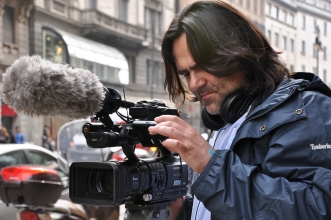
CNN is beginning its final push to go completely tapeless, with the purchase of 177 JVC GY-HM100U ProHD camcorders, as it begins to replace hundreds of ageing, tape-based standard definition DV camcorders now in use across CNN’s global operations. It is expected to become tape free in 2011.
The HM100 is a compact, handheld 3-CCD camcorder recording HD video at 35 Mbps in the XDCAM EX MPEG-2 format, which is already used by CNN. The camcorder can record 1920x1080 50/60i or 24/25/30p files in either the .mov or MP4 formats directly onto SDHC memory cards. Recording .mov means that Final Cut Pro users can simply drag the files onto the timeline with no transcoding. It costs about £2,000 ($3,000).
“The GY-HM100 ProHD camcorder is well suited for a fast-paced newsgathering organisation,” claimed Larry Librach, JVC VP, Broadcast & Public Sector. “Its lightweight form factor, sturdy solid-state recording, and high-quality imaging make it an ideal complement to CNN's traditional shoulder-type ENG equipment.”
November 25, 2010
NEX-VG10E adds AF support
Sony’s large-sensor Handycam NEX-VG10E has gained the ability to autofocus with A-mount lenses from Sony and Carl Zeiss, via a free firmware upgrade.
It will allow autofocus with 14 A-mount SAM and SSM lenses, provided you fit the optional LA-EA1 Mount Adaptor, and do a separate firmware upgrade for the LA-EA1. With an A-mount lens attached to NEX-VG10E, autofocus takes approximately 2 to 7 seconds.
The SAM lenses covered:
· DT 18-55mm F3.5-5.6
· 28-75mm F2.8
· DT 55-200mm F4-5.6
· DT 30mm F2.8 Macro
· DT 35mm F1.8
· DT 50mm F1.8
· 85mm F2.8
The SSM lenses covered:
· Vario-Sonnar T* 16-35mm F2.8 ZA
· Vario-Sonnar T* 24-70mm F2.8 ZA
· Distagon T* 24mm F2 ZA
· 70-200mm F2.8 G
· 70-300mm F4.5-5.6 G
· 70-400mm F4-5.6 G
· 300mm F2.8 G
It will allow autofocus with 14 A-mount SAM and SSM lenses, provided you fit the optional LA-EA1 Mount Adaptor, and do a separate firmware upgrade for the LA-EA1. With an A-mount lens attached to NEX-VG10E, autofocus takes approximately 2 to 7 seconds.
The SAM lenses covered:
· DT 18-55mm F3.5-5.6
· 28-75mm F2.8
· DT 55-200mm F4-5.6
· DT 30mm F2.8 Macro
· DT 35mm F1.8
· DT 50mm F1.8
· 85mm F2.8
The SSM lenses covered:
· Vario-Sonnar T* 16-35mm F2.8 ZA
· Vario-Sonnar T* 24-70mm F2.8 ZA
· Distagon T* 24mm F2 ZA
· 70-200mm F2.8 G
· 70-300mm F4.5-5.6 G
· 70-400mm F4-5.6 G
· 300mm F2.8 G
November 23, 2010
Bag design throws light on interiors
Petrol Bags has added three new bags to its range – a doctor's bag with interior lighting, a case for lights, and backpack for DSLRs.
The new Black Deca Dr. Bags have a lighting system for the bag’s interior, making contents easier to see during nighttime shoots without resorting to a torch in your mouth or trying to identify a cable using the light from an iPhone.... The battery-powered LED lights are replaceable and easily installed or removed via an internal zipper.
Inspired by a traditional doctor’s bag, the semi-rigid equipment bag is designed to hold a camera and accessories comfortably and securely and offer fast and easy access to its contents. It is made from black 900D and ballistic nylon fabrics, with a floor made from Petrol’s new shock-resistant, moulded AbsorbaPad. Attached by Velcro, it provides extra protection against accidental damage from jolts. A pattern of ridges and raised dots on the Pad's surface provide extra grip to keep the camera steady. Twin connecting brackets on the bottom of the bag allow for the quick and easy connection of Petrol’s new Snaplock wheel and trolley system (purchased separately).
The design includes: hinged, extra wide opening for fast and easy access to the camera with a mattebox and microphone attached; detachable padded internal dividers for custom configuration; bottom panels of shockproof, cold-moulded laminate for extra equipment protection; exterior side pockets for additional storage; U-Grip interlock carrying handle; adjustable, ergonomic padded shoulder strap; and dual directional easy-glide zippers. The Deca Dr. Bag is available in six models, to fit compact camcorders or full-size broadcast cameras.
Light Case
The new Deca Light Case is a lightweight, semi-hard carrier that holds up to four light heads and four stands (up to 88cm). Five internal cushioned dividers separate the main chamber into sections for storing heads, cables and gels. The dividers can be removed to create a single large compartment.
Features include: rugged twin side handles; an ergonomic interlock carrying handle; and dual-directional, easy glide zippers. The exterior is constructed of heavy-duty water-resistant 900D and ballistic nylon fabrics. On the bottom, twin connecting brackets allow for the quick and easy connection of Deca’s new Snaplock wheel and trolley system.
There is also a smaller model for three light heads and stands up to 73cm long.
Digiback Backpack
The top lid of the new Digiback DSLR Backpack unzips to reveal an upper compartment contoured to fit a DSLR camera with the lens attached. When outfitted with a telephoto or other extra long lens, the camera can be inserted with the lens in a vertical position. The spacious lower chamber has ample room for accessories.
Removable internal dividers help secure contents and create pockets for holding a mattebox, camera plate, follow focus, extra lenses, camera light, spare batteries, viewfinder, and more. There’s also space for holding a laptop. The contents are cushioned by layers of padded brushed polyester, and double-sided exterior monopockets offer additional storage.
The integral backpack system uses breathable 3D mesh, with padded shoulder straps and adjustable sternum and waist straps, and cushioned back support. Contents are accessible from either side, and a rear zipper completely exposes the pack’s interior.
By David Fox
The new Black Deca Dr. Bags have a lighting system for the bag’s interior, making contents easier to see during nighttime shoots without resorting to a torch in your mouth or trying to identify a cable using the light from an iPhone.... The battery-powered LED lights are replaceable and easily installed or removed via an internal zipper.
Inspired by a traditional doctor’s bag, the semi-rigid equipment bag is designed to hold a camera and accessories comfortably and securely and offer fast and easy access to its contents. It is made from black 900D and ballistic nylon fabrics, with a floor made from Petrol’s new shock-resistant, moulded AbsorbaPad. Attached by Velcro, it provides extra protection against accidental damage from jolts. A pattern of ridges and raised dots on the Pad's surface provide extra grip to keep the camera steady. Twin connecting brackets on the bottom of the bag allow for the quick and easy connection of Petrol’s new Snaplock wheel and trolley system (purchased separately).
The design includes: hinged, extra wide opening for fast and easy access to the camera with a mattebox and microphone attached; detachable padded internal dividers for custom configuration; bottom panels of shockproof, cold-moulded laminate for extra equipment protection; exterior side pockets for additional storage; U-Grip interlock carrying handle; adjustable, ergonomic padded shoulder strap; and dual directional easy-glide zippers. The Deca Dr. Bag is available in six models, to fit compact camcorders or full-size broadcast cameras.
Light Case
The new Deca Light Case is a lightweight, semi-hard carrier that holds up to four light heads and four stands (up to 88cm). Five internal cushioned dividers separate the main chamber into sections for storing heads, cables and gels. The dividers can be removed to create a single large compartment.
Features include: rugged twin side handles; an ergonomic interlock carrying handle; and dual-directional, easy glide zippers. The exterior is constructed of heavy-duty water-resistant 900D and ballistic nylon fabrics. On the bottom, twin connecting brackets allow for the quick and easy connection of Deca’s new Snaplock wheel and trolley system.
There is also a smaller model for three light heads and stands up to 73cm long.
Digiback Backpack
The top lid of the new Digiback DSLR Backpack unzips to reveal an upper compartment contoured to fit a DSLR camera with the lens attached. When outfitted with a telephoto or other extra long lens, the camera can be inserted with the lens in a vertical position. The spacious lower chamber has ample room for accessories.
Removable internal dividers help secure contents and create pockets for holding a mattebox, camera plate, follow focus, extra lenses, camera light, spare batteries, viewfinder, and more. There’s also space for holding a laptop. The contents are cushioned by layers of padded brushed polyester, and double-sided exterior monopockets offer additional storage.
The integral backpack system uses breathable 3D mesh, with padded shoulder straps and adjustable sternum and waist straps, and cushioned back support. Contents are accessible from either side, and a rear zipper completely exposes the pack’s interior.
By David Fox
CamCage seeks Kickstart support
An animator has created an interesting new low-cost camera cage that will be produced if prospective purchasers pledge the $20,000 he needs.
The CamCage Mini is a softly rounded aluminium camera bracket that securely surrounds your camera on three sides with handles and is joined by two brackets that can carry the camera and accessories.
The initial $20,000 needed for the first production run of 125 units is being gathered through the new US-based Kickstarter project, which requires prospective users to pledge money – they will then be the first to get their hands on the units (although nothing is paid over until the full amount is reached, which has to be before the cut-off deadline in this instance of December 14).
The $160 CamCage Mini can fit any camera that is 12.5cm high (plus the quick release plate), which includes many compact camcorders and almost all DSLRs, such as the Canon 5D Mark II. It weighs 660g.
Its maker, Bryan Evans, who works in the animation business in Los Angeles, believes that it will be ideal for extreme sports, such as skating, diving, surfing or any action filming with camera movement, which it helps stabilize. "The curved handles have incredible strength and great grip feel to inspire confidence in the field or studio," he claimed.
"When I shoot video I like to move the camera and get a variety of angles, and this lead me to look at camera holders of all kinds. I did quite a bit of research and was struck by two things: first, almost all of them are really expensive; and, second, they weren't really designed for the human hand. So I decided to build my own," he explained. "It gives your camera more handle area than any other camera rig in existence at a lower cost."
Evans built prototypes out of inexpensive PVC pipe and has put a DIY CamCage video on his site if anyone wants to build their own – for about $30 in materials (http://camcagesystems.com/diy). "In the end, I wanted something stronger, with larger diameter tubes for better handgrip," so he turned to metal, which lead to "an entirely new bracket design, which is an open accessory platform. You can put microphones, lights, monitors, audio recorders (I've used the Zoom H4 and H1 both); anything that attaches to a quarter-inch thread or a one-inch tube works great on this." He envisages versions for larger cameras if this one is a success.
[UPDATE: Funding was unsuccessful on the Kickstarter project, however, CamCage is going ahead with limited production runs - and the standard unit is available for pre-order at $159 flat pack or $199 fully assembled]
By David Fox
The CamCage Mini is a softly rounded aluminium camera bracket that securely surrounds your camera on three sides with handles and is joined by two brackets that can carry the camera and accessories.
The initial $20,000 needed for the first production run of 125 units is being gathered through the new US-based Kickstarter project, which requires prospective users to pledge money – they will then be the first to get their hands on the units (although nothing is paid over until the full amount is reached, which has to be before the cut-off deadline in this instance of December 14).
The $160 CamCage Mini can fit any camera that is 12.5cm high (plus the quick release plate), which includes many compact camcorders and almost all DSLRs, such as the Canon 5D Mark II. It weighs 660g.
Its maker, Bryan Evans, who works in the animation business in Los Angeles, believes that it will be ideal for extreme sports, such as skating, diving, surfing or any action filming with camera movement, which it helps stabilize. "The curved handles have incredible strength and great grip feel to inspire confidence in the field or studio," he claimed.
"When I shoot video I like to move the camera and get a variety of angles, and this lead me to look at camera holders of all kinds. I did quite a bit of research and was struck by two things: first, almost all of them are really expensive; and, second, they weren't really designed for the human hand. So I decided to build my own," he explained. "It gives your camera more handle area than any other camera rig in existence at a lower cost."
Evans built prototypes out of inexpensive PVC pipe and has put a DIY CamCage video on his site if anyone wants to build their own – for about $30 in materials (http://camcagesystems.com/diy). "In the end, I wanted something stronger, with larger diameter tubes for better handgrip," so he turned to metal, which lead to "an entirely new bracket design, which is an open accessory platform. You can put microphones, lights, monitors, audio recorders (I've used the Zoom H4 and H1 both); anything that attaches to a quarter-inch thread or a one-inch tube works great on this." He envisages versions for larger cameras if this one is a success.
[UPDATE: Funding was unsuccessful on the Kickstarter project, however, CamCage is going ahead with limited production runs - and the standard unit is available for pre-order at $159 flat pack or $199 fully assembled]
By David Fox
LDK8300, Phantom, Alexa awarded
Both Grass Valley and Vision Research have won Technical Emmys for slow-motion cameras, while Arri has won an HPA award for its Alexa.
It is Grass Valley's 17th Technical Emmy Award, this time for the design and implementation of its LDK 8300 HD Live Super SloMo camera system.
Since its was introduced in 2008, the LDK 8300 has been used extensively at major sporting events, such as the 2008 Summer Olympics, 2010 Winter Olympics, and 2010 World Cup, and is widely used throughout Europe for live slow motion.
“The Grass Valley LDK 8300 is unique in its ability to deliver extremely high-quality images at multiple frame rates, allowing it to be used as a standard HD camera and for captivating slow motion effects at 2x or 3x speed,” said Jeff Rosica, Senior Vice President of Grass Valley. “This latest recognition by NATAS is a testament to our engineering team in Breda, The Netherlands and countless others who have made the LDK 8300 such a resounding success within the global production community. We set the standard in 3x Super Slow-Motion in SD with our LDK 23 camera system and now we’ve set a new standard in HD with the LDK 8300.”
Probably the most interesting technology it uses it is AnyLight flicker reduction, which compensates for the flicker caused by artificial lighting and enables it to cope with the uncertainties of stadium lighting (which can often have different types of lights flickering at different rates).
Ultra Slow
The high-speed Vision Research HD Phantom camera won its Emmy from NATAS in the same category as the LDK 8300. “We are truly honored to receive this distinguished award,” said Andy Jantzen, Chief Technology Officer and Co-Founder of Vision Research. “The ultra-slow-motion technology we created has been widely adopted in sporting and other live events around the world, including the Super Bowl, World Series, Olympics, World Cup and the Commonwealth Games. Our technology also is used in television commercials and motion pictures and is a key component of the 3D imaging that can now be seen in many Hollywood films.
The technology being recognised can be found in the Phantom v640 digital high-speed camera when used for broadcast applications (as well as in the v12.1 and v710). The v640 (pictured left) can record at speeds of up to 2,700 frames per second at 1920x1080, allowing ultra-slow-motion replay.
The National Academy of Television Arts & Sciences' 2010 Technical and Engineering Emmys will be given to both Grass Valley and Vision Research at the 2011 CES Show in Las Vegas in January, in the category of HD Super Slow Motion System for Acquisition, Recording and Playback for Broadcast Entertainment and Sports Production.
Alexa Excellence
Arri has won the Hollywood Post Alliance first Engineering Excellence Award given for an acquisition system, for its Alexa camera.
The Arri Alexa (right) is the first camera to support the recording of Apple ProRes 4444, 422 (HQ), LT or PROXY encoded images onto on-board SxS memory cards for Direct To Edit delivery. This means that no transcoding or re-wrapping is required for editing in Final Cut Pro. Avid Media Access also supports ProRes for Media Composer 5, allowing time and cost savings. Productions can also record in uncompressed HD or ArriRAW with QuickTime/ProRes off-line editing proxies created directly in the camera.
“We are honoured that the Alexa camera has been recognized by the HPA for Engineering Excellence. Arri has always focused on providing the highest quality cameras with convenience, reliability and ruggedness to meet the demanding needs of production. In the digital world, this commitment extends to providing convenient and compatible workflows to support post production," said Glenn Kennel, President of Arri.
By David Fox
It is Grass Valley's 17th Technical Emmy Award, this time for the design and implementation of its LDK 8300 HD Live Super SloMo camera system.
Since its was introduced in 2008, the LDK 8300 has been used extensively at major sporting events, such as the 2008 Summer Olympics, 2010 Winter Olympics, and 2010 World Cup, and is widely used throughout Europe for live slow motion.
“The Grass Valley LDK 8300 is unique in its ability to deliver extremely high-quality images at multiple frame rates, allowing it to be used as a standard HD camera and for captivating slow motion effects at 2x or 3x speed,” said Jeff Rosica, Senior Vice President of Grass Valley. “This latest recognition by NATAS is a testament to our engineering team in Breda, The Netherlands and countless others who have made the LDK 8300 such a resounding success within the global production community. We set the standard in 3x Super Slow-Motion in SD with our LDK 23 camera system and now we’ve set a new standard in HD with the LDK 8300.”
Probably the most interesting technology it uses it is AnyLight flicker reduction, which compensates for the flicker caused by artificial lighting and enables it to cope with the uncertainties of stadium lighting (which can often have different types of lights flickering at different rates).
Ultra Slow
The high-speed Vision Research HD Phantom camera won its Emmy from NATAS in the same category as the LDK 8300. “We are truly honored to receive this distinguished award,” said Andy Jantzen, Chief Technology Officer and Co-Founder of Vision Research. “The ultra-slow-motion technology we created has been widely adopted in sporting and other live events around the world, including the Super Bowl, World Series, Olympics, World Cup and the Commonwealth Games. Our technology also is used in television commercials and motion pictures and is a key component of the 3D imaging that can now be seen in many Hollywood films.
The technology being recognised can be found in the Phantom v640 digital high-speed camera when used for broadcast applications (as well as in the v12.1 and v710). The v640 (pictured left) can record at speeds of up to 2,700 frames per second at 1920x1080, allowing ultra-slow-motion replay.The National Academy of Television Arts & Sciences' 2010 Technical and Engineering Emmys will be given to both Grass Valley and Vision Research at the 2011 CES Show in Las Vegas in January, in the category of HD Super Slow Motion System for Acquisition, Recording and Playback for Broadcast Entertainment and Sports Production.
Alexa Excellence
Arri has won the Hollywood Post Alliance first Engineering Excellence Award given for an acquisition system, for its Alexa camera.
The Arri Alexa (right) is the first camera to support the recording of Apple ProRes 4444, 422 (HQ), LT or PROXY encoded images onto on-board SxS memory cards for Direct To Edit delivery. This means that no transcoding or re-wrapping is required for editing in Final Cut Pro. Avid Media Access also supports ProRes for Media Composer 5, allowing time and cost savings. Productions can also record in uncompressed HD or ArriRAW with QuickTime/ProRes off-line editing proxies created directly in the camera.
“We are honoured that the Alexa camera has been recognized by the HPA for Engineering Excellence. Arri has always focused on providing the highest quality cameras with convenience, reliability and ruggedness to meet the demanding needs of production. In the digital world, this commitment extends to providing convenient and compatible workflows to support post production," said Glenn Kennel, President of Arri.
By David Fox
November 22, 2010
BBC buys 50 Canon XF305 cameras
The BBC's DV Solutions department has ordered 50 units of Canon's XF305 compact HD camcorder from CVP, the largest supplier of Canon HD equipment in the UK.
The XF300 and XF305 are already selling well to independent production companies, as the cameras are the most affordable models approved for HD use by the BBC. The new order positions the XF305 as the successor to Sony's HVR-Z1 tape-based HDV camcorder, which became the most popular compact camcorder for SD production after DV Solutions had bought large numbers.
The XF300 and XF305 are the first compact camcorders to record internally at a 50Mbps data rate, one of the requirements the BBC has for HD broadcast applications. It records onto solid-state Compact Flash cards.
"We are delighted that the BBC has placed this order with us as it clearly demonstrates that not only is the Canon XF305 the BBC's preferred handheld HD camcorder but that CVP is the BBC's preferred supplier," said Phil Baxter, CVP's CEO.
The BBC has also chosen Sony XDCAM EX PMW-350 and Sony PMW-500 models as its new shoulder-mounted 2/3-inch ENG cameras for news and current affairs (see the full story at TVB Europe). The PMW-500 is the first XDCAM EX solid-state camcorder to record at 50Mbps and has the same form factor as the PMW-350 (which records at up to 35Mbps).
By David Fox
The XF300 and XF305 are already selling well to independent production companies, as the cameras are the most affordable models approved for HD use by the BBC. The new order positions the XF305 as the successor to Sony's HVR-Z1 tape-based HDV camcorder, which became the most popular compact camcorder for SD production after DV Solutions had bought large numbers.
The XF300 and XF305 are the first compact camcorders to record internally at a 50Mbps data rate, one of the requirements the BBC has for HD broadcast applications. It records onto solid-state Compact Flash cards.
"We are delighted that the BBC has placed this order with us as it clearly demonstrates that not only is the Canon XF305 the BBC's preferred handheld HD camcorder but that CVP is the BBC's preferred supplier," said Phil Baxter, CVP's CEO.
The BBC has also chosen Sony XDCAM EX PMW-350 and Sony PMW-500 models as its new shoulder-mounted 2/3-inch ENG cameras for news and current affairs (see the full story at TVB Europe). The PMW-500 is the first XDCAM EX solid-state camcorder to record at 50Mbps and has the same form factor as the PMW-350 (which records at up to 35Mbps).
By David Fox
Sony shows Super 35mm NXCAM
Sony has shown a potential spoiler for Panasonic's AG-AF100/AF101 that boasts a larger Super 35mm sensor for desirable shallow depth of field shots and 50p recording.
This will be an entry-level digital cinema camera, recording AVCHD at 24Mbps – however, full details are still sketchy and where Panasonic offers 50p/60p recording (on its high-end consumer SD700 and TM700 camcorders) it uses 28Mbps MPEG4-AVC/H.264 recording, which is not part of the AVCHD standard. The S35 NXCAM will also have uncompressed 10-bit 4:2:2 output through HD-SDI and/or HDMI.
The camera will use an E-mount interchangeable lens system identical to the Alpha series lens system used on the NEX-5 and NEX-3 stills/video cameras and Handycam NEX-VG10. It will also be possible to fit A-mount lenses via a lens adaptor, and PL-mount lenses with another adaptor (which may be part of the package). There are also other third-party lens adaptors to allow the camera to be used with lenses from the likes of Canon, Nikon, Pentax and Leica.
Besdes 50p (and presumably 60p), it will also record 25p (and 30/24p), although Sony currently seems to be planning separate European (25/50p) and US (24/30/60p) versions rather than a single worldwide model.
It will use a Super 35mm-sized CMOS sensor, apparently the same sensor as on the PMW-F3, and record to SDHC or Memory Stick media. It will have two-channel uncompressed audio and its design is based on a lot of feedback it got at IBC when it showed the VG10, so it will have XLR audio connections, improved ergonomics, and a wider range of recording formats. List price should be about €6,000 and it is expected to ship sometime after NAB, which is in April.
Related posts: Sony PMW-F3: Budget filmmaking?, Panasonic AF100 / AF101 - the movie, Sony's HD DSLR in a Handycam, Sony embarks on 35mm camera development + Sony NEX-FS100 takes on DSLRs
By David Fox
This will be an entry-level digital cinema camera, recording AVCHD at 24Mbps – however, full details are still sketchy and where Panasonic offers 50p/60p recording (on its high-end consumer SD700 and TM700 camcorders) it uses 28Mbps MPEG4-AVC/H.264 recording, which is not part of the AVCHD standard. The S35 NXCAM will also have uncompressed 10-bit 4:2:2 output through HD-SDI and/or HDMI.
The camera will use an E-mount interchangeable lens system identical to the Alpha series lens system used on the NEX-5 and NEX-3 stills/video cameras and Handycam NEX-VG10. It will also be possible to fit A-mount lenses via a lens adaptor, and PL-mount lenses with another adaptor (which may be part of the package). There are also other third-party lens adaptors to allow the camera to be used with lenses from the likes of Canon, Nikon, Pentax and Leica.
Besdes 50p (and presumably 60p), it will also record 25p (and 30/24p), although Sony currently seems to be planning separate European (25/50p) and US (24/30/60p) versions rather than a single worldwide model.
It will use a Super 35mm-sized CMOS sensor, apparently the same sensor as on the PMW-F3, and record to SDHC or Memory Stick media. It will have two-channel uncompressed audio and its design is based on a lot of feedback it got at IBC when it showed the VG10, so it will have XLR audio connections, improved ergonomics, and a wider range of recording formats. List price should be about €6,000 and it is expected to ship sometime after NAB, which is in April.
Related posts: Sony PMW-F3: Budget filmmaking?, Panasonic AF100 / AF101 - the movie, Sony's HD DSLR in a Handycam, Sony embarks on 35mm camera development + Sony NEX-FS100 takes on DSLRs
By David Fox
November 12, 2010
Chrosziel adapts to 3D and DSLRs
German accessory specialist, Chrosziel, has announced support for the new Panasonic AG-3DA1 3D camcorder, as well as new DSLR and related products.
The AG-3DA1 fits on the same Chrosziel Light Weight Support (LWS 401-415) as used with the Panasonic HVX-200 / 200A. The MatteBox MB 450R2 Super Wide and the MB 456 Academy (Chrosziel’s recommended combination) can be used, as can any other Chrosziel MatteBox with at least 5-inch filter holders. Using 5-inch filters means that the angle of rotation is fully unrestricted, causing no vignetting. It has developed Light Prevention Rings with masks that follow the outer shape of the dual lenses for 130mm (Super Wide and Academy) and 142.5mm connections.
Its new €69 Adaptor Plate Sachtler 401-400-CDS allows the use of all of Chrosziel's LightWeight Supports on the tripod plate of the recently introduced Sachtler Cine DSLR head. The long wedge plate with twist stop directly takes cameras or lenses with tripod thread. The new adaptor plate means that Follow Focus and MatteBox can be used. The plate uses the fixed rear twist stop of the Sachtler wedge plate and is fixed with the existing 1/4-inch screw. On the Chrosziel Support, the adapter is fixed twist-safe with two provided 1/4-inch screws.
The slideable slot-nut in the Chrosziel LWS bottom also allows the use of the Handgrip DSLR, the Chrosziel shoulder brace Balancer and Shoulder Pad proVideo (with the adapter in the foremost position) without the need to take off the Sachtler wedge plate, so that users can change from tripod to shoulder in a second. With this Adapter Plate, both HD DSLR and video cameras can use this Sachtler head.
Its new €19 accessory clamp, the DSLR 3310, has been developed for its DSLR handle. There are rarely enough 1/4-inch and 3/8-inch connections to fix accessories when you shoot with HD DSLR cameras, so the new clamp slides onto the handgrip rod and is fixed with a screw in the desired position. It provides two 3/8-inch threads, one of them with a 1/4-inch insert. The clamp also fits on all LightWeight Supports with standard diameter 15mm and can thus e.g. take an articulating arm to carry the receiver of a remote control.
By David Fox
The AG-3DA1 fits on the same Chrosziel Light Weight Support (LWS 401-415) as used with the Panasonic HVX-200 / 200A. The MatteBox MB 450R2 Super Wide and the MB 456 Academy (Chrosziel’s recommended combination) can be used, as can any other Chrosziel MatteBox with at least 5-inch filter holders. Using 5-inch filters means that the angle of rotation is fully unrestricted, causing no vignetting. It has developed Light Prevention Rings with masks that follow the outer shape of the dual lenses for 130mm (Super Wide and Academy) and 142.5mm connections.
![]() |
| Chrosziel LWS with hand grip on Sachtler Cine DSLR plate |
Its new €69 Adaptor Plate Sachtler 401-400-CDS allows the use of all of Chrosziel's LightWeight Supports on the tripod plate of the recently introduced Sachtler Cine DSLR head. The long wedge plate with twist stop directly takes cameras or lenses with tripod thread. The new adaptor plate means that Follow Focus and MatteBox can be used. The plate uses the fixed rear twist stop of the Sachtler wedge plate and is fixed with the existing 1/4-inch screw. On the Chrosziel Support, the adapter is fixed twist-safe with two provided 1/4-inch screws.
The slideable slot-nut in the Chrosziel LWS bottom also allows the use of the Handgrip DSLR, the Chrosziel shoulder brace Balancer and Shoulder Pad proVideo (with the adapter in the foremost position) without the need to take off the Sachtler wedge plate, so that users can change from tripod to shoulder in a second. With this Adapter Plate, both HD DSLR and video cameras can use this Sachtler head.
Its new €19 accessory clamp, the DSLR 3310, has been developed for its DSLR handle. There are rarely enough 1/4-inch and 3/8-inch connections to fix accessories when you shoot with HD DSLR cameras, so the new clamp slides onto the handgrip rod and is fixed with a screw in the desired position. It provides two 3/8-inch threads, one of them with a 1/4-inch insert. The clamp also fits on all LightWeight Supports with standard diameter 15mm and can thus e.g. take an articulating arm to carry the receiver of a remote control.
By David Fox
Indie shows 3D in the RAW
Vienna-based IndieCam has a new, modular 3D system ideal for Indie filmmakers, with small cameras and the ability to record RAW video.
The tiny 1080p 50/60 cameras output a 10-bit RAW file, using Adobe's Cinema DNG format. The prototype system uses single 2/3-inch CCD sensors that produce a 12-bit signal, going through an in-camera look-up table, which means it is not just a linear translation, so it can retain more of the 12-bit goodness. It can also output YUV 4:2:2.
The small cameras mean the rig could have an interaxial distance of just 40mm (although that depends on the size of the C-mount lenses used).
It is also developing its own Shuttle recorder that can record the RAW files and acta as a camera controller. The Shuttle has two HD-SDI inputs, and multiple power outputs, for monitors, etc., but IndieCam is also designing a remote control system for it, which would give users the option of recording on another HD-SDI recorder, such Convergent Design's nanoFlash or the AJA Ki Pro Mini. "It is not necessary to use the camera heads with our Indie Shuttle system," said Peter Niklas, software and hardware development (pictured).
Camera aids include histograms or zebra stripes, and it can create anaglyph previews on its 7-inch monitor. The LCD is sunlight readable and will come in DVI or SDI versions.
The full system is expected to cost less than €40,000. Although the camera heads are available now, in limited quantities, the recorder and controller will probably not be ready until NAB. The remote control should be available this month.
The system has been used on a few projects so far, including one multicam shoot with 12 3D rigs.
Related post: IndieGS2K global shutter camera
By David Fox
The tiny 1080p 50/60 cameras output a 10-bit RAW file, using Adobe's Cinema DNG format. The prototype system uses single 2/3-inch CCD sensors that produce a 12-bit signal, going through an in-camera look-up table, which means it is not just a linear translation, so it can retain more of the 12-bit goodness. It can also output YUV 4:2:2.
The small cameras mean the rig could have an interaxial distance of just 40mm (although that depends on the size of the C-mount lenses used).
It is also developing its own Shuttle recorder that can record the RAW files and acta as a camera controller. The Shuttle has two HD-SDI inputs, and multiple power outputs, for monitors, etc., but IndieCam is also designing a remote control system for it, which would give users the option of recording on another HD-SDI recorder, such Convergent Design's nanoFlash or the AJA Ki Pro Mini. "It is not necessary to use the camera heads with our Indie Shuttle system," said Peter Niklas, software and hardware development (pictured).
Camera aids include histograms or zebra stripes, and it can create anaglyph previews on its 7-inch monitor. The LCD is sunlight readable and will come in DVI or SDI versions.
The full system is expected to cost less than €40,000. Although the camera heads are available now, in limited quantities, the recorder and controller will probably not be ready until NAB. The remote control should be available this month.
The system has been used on a few projects so far, including one multicam shoot with 12 3D rigs.
Related post: IndieGS2K global shutter camera
By David Fox
November 11, 2010
Financial markets rise on HD news
Business TV specialist, Globelynx has upgraded fixed camera sites in London's financial centre to meet demand for HD coverage from Sky News.
It has delivered its first HD TV broadcast in collaboration with Colt, providing a live HD feed from the trading floor at spread betting and CFD (Contracts for difference) provider, CMC Markets’ offices in the City of London, allowing its presenter to deliver hourly live reports throughout the market day for a special feature on the City.
A permanent Colt link connects CMC Markets to Globelynx Network’s master control switch using uncompressed 1.5GB broadcast circuits over its London metro network, which has been designed specifically for HD, requiring a five-fold increase in bandwidth compared to standard definition, as well as offering low latency and jitter.
The Globelynx fixed camera network is used for live TV interviews from the business and financial sectors without requiring satellite truck deployment or travel by interviewees to studios. To meet the new demand for news in HD, Globelynx is now upgrading some of its camera sites and plug in facilities, which are located at the offices of leading banks and other businesses across London, apparently accounting for 80% of all in-office broadcasting systems in London. During 2010, Globelynx has also expanded into Holland and will soon be setting up in France, using connectivity from Colt.
”Our close working relationship with Colt has allowed us to respond promptly to the demand from our camera-using customers and from Sky News for full broadcast quality HD feeds of live business news and analysis. We are delighted with the on air results," said David FitzGerald, Globelynx CEO.
Terry Quigley, head of Industry Practices at Colt added: “HD TV demands a real step-change in bandwidth from standard definition and we are delighted to be supporting Globelynx on its first live HD deployment. We are seeing increasing demand for HD information delivery from across the broadcast sector.”
By David Fox
It has delivered its first HD TV broadcast in collaboration with Colt, providing a live HD feed from the trading floor at spread betting and CFD (Contracts for difference) provider, CMC Markets’ offices in the City of London, allowing its presenter to deliver hourly live reports throughout the market day for a special feature on the City.
A permanent Colt link connects CMC Markets to Globelynx Network’s master control switch using uncompressed 1.5GB broadcast circuits over its London metro network, which has been designed specifically for HD, requiring a five-fold increase in bandwidth compared to standard definition, as well as offering low latency and jitter.
The Globelynx fixed camera network is used for live TV interviews from the business and financial sectors without requiring satellite truck deployment or travel by interviewees to studios. To meet the new demand for news in HD, Globelynx is now upgrading some of its camera sites and plug in facilities, which are located at the offices of leading banks and other businesses across London, apparently accounting for 80% of all in-office broadcasting systems in London. During 2010, Globelynx has also expanded into Holland and will soon be setting up in France, using connectivity from Colt.
”Our close working relationship with Colt has allowed us to respond promptly to the demand from our camera-using customers and from Sky News for full broadcast quality HD feeds of live business news and analysis. We are delighted with the on air results," said David FitzGerald, Globelynx CEO.
Terry Quigley, head of Industry Practices at Colt added: “HD TV demands a real step-change in bandwidth from standard definition and we are delighted to be supporting Globelynx on its first live HD deployment. We are seeing increasing demand for HD information delivery from across the broadcast sector.”
By David Fox
November 10, 2010
Shoulder stabiliser with Endura-nce
IDX Technology's new Shoulder Stabilisation System for hand-held cameras offers users the extra power of IDX’s high-capacity Endura batteries.
It is designed for use with camcorders and HD DSLRs and is based around an A-CA74E shoulder adaptor base, on which the camera position can be adjusted for balance. It has a cushioned shoulder pad and an adjustable, rear battery plate for attaching an optional P-V series plate, which allows the connection of a V-Mount battery.
The A-HG74 handgrip support option has three cushioned, adjustable handles, two at the front and a third at the rear to add support to the chest area. The A-HG74 has an integrated tripod adaptor for attaching the system to a standard tripod.
There are three optional V-Mount plates that take the battery’s 14.4v output and convert it to: 5v or 7.3v for a range of Panasonic, JVC and Canon models; 12v for the Sony EX series; or 8.4v for other Sony camera models (it is pictured fitted to a JVC GY-HM100). There are seven optional DC cables that connect from the regulated D-Tap of the P-V plate and plug into the camera battery channel or power input terminal. Each P-V plate has a second D-Tap output for lights or audio accessories.
By David Fox
It is designed for use with camcorders and HD DSLRs and is based around an A-CA74E shoulder adaptor base, on which the camera position can be adjusted for balance. It has a cushioned shoulder pad and an adjustable, rear battery plate for attaching an optional P-V series plate, which allows the connection of a V-Mount battery.
The A-HG74 handgrip support option has three cushioned, adjustable handles, two at the front and a third at the rear to add support to the chest area. The A-HG74 has an integrated tripod adaptor for attaching the system to a standard tripod.
There are three optional V-Mount plates that take the battery’s 14.4v output and convert it to: 5v or 7.3v for a range of Panasonic, JVC and Canon models; 12v for the Sony EX series; or 8.4v for other Sony camera models (it is pictured fitted to a JVC GY-HM100). There are seven optional DC cables that connect from the regulated D-Tap of the P-V plate and plug into the camera battery channel or power input terminal. Each P-V plate has a second D-Tap output for lights or audio accessories.
By David Fox
Correct 3D errors + convert 2D-3D
The new Teranex VC1 production toolkit corrects errors inherent in beam-splitter rigs and does real-time 2D to 3D video conversion.
The newly introduced package comprises of two main software applications that build on the dual-channel architecture of the Teranex VC100 hardware platform. They are: The VC1-3DTK 3D toolkit, which enables broadcasters to correct any errors arising from using a dual-camera beam-splitter or mirror rigs; and the VC1-2D-3D Advanced Stereoscopic Processor, which takes care of the 2D to 3D conversion.
The VC1-3DTK 3D can correct and resolve many 3D production issues. It provides 3D synchronisation to ensure right and left eye streams are perfectly time-locked even when sourced from non-genlocked cameras. It does horizontal and vertical flipping, pixel-accurate horizontal and vertical positioning, axial rotation, colour-correction and adjustment of video signal parameters to match right and left eye streams. It will also do 3D logo insertion with X, Y and Z positioning.
The VC1-2D-3D stereoscopic image generator gives the ability to repurpose 2D content for 3D distribution or mix 2D archives with 3D content It can also insert 3D logos with adjustable horizontal, vertical and depth position.
Two encoding/decoding processors are also available. The VC1-3D-ENC encoder converts 3D image content into the main stereoscopic formats, such as side-by-side, top/bottom and checkerboard streams. The VC1-3D-DEC decodes from these formats back into separate right and left image channels.
Existing VC100 users will be able to upgrade their systems with the new software. The VC100 platform is an HD/SD universal frame synchroniser supporting 107 format conversion configurations (expandable to 257). It is available in single or dual-channel versions, with composite and component video in/out, analogue and AES-digital audio in/out plus expanded format and frame-rate conversion support including linear HD standards conversion. Additional features include aspect ratio conversion with active fill information, video indexing with active format description, full SD 608 and HD 708 closed-caption conversion support, colour correction, logo insertion, integral video and audio test signal and timecode generation, all under local or IP-based remote control.
The VC1 production toolkit and real-time 2D to 3D video converter is available in the UK through Teranex distributor, Preco Broadcast Systems.
For a comprehensive report on the powerful 2D to 3D conversion this can do, have a look at Adrian Pennington's article for TVB Europe.
By David Fox
The newly introduced package comprises of two main software applications that build on the dual-channel architecture of the Teranex VC100 hardware platform. They are: The VC1-3DTK 3D toolkit, which enables broadcasters to correct any errors arising from using a dual-camera beam-splitter or mirror rigs; and the VC1-2D-3D Advanced Stereoscopic Processor, which takes care of the 2D to 3D conversion.
The VC1-3DTK 3D can correct and resolve many 3D production issues. It provides 3D synchronisation to ensure right and left eye streams are perfectly time-locked even when sourced from non-genlocked cameras. It does horizontal and vertical flipping, pixel-accurate horizontal and vertical positioning, axial rotation, colour-correction and adjustment of video signal parameters to match right and left eye streams. It will also do 3D logo insertion with X, Y and Z positioning.
The VC1-2D-3D stereoscopic image generator gives the ability to repurpose 2D content for 3D distribution or mix 2D archives with 3D content It can also insert 3D logos with adjustable horizontal, vertical and depth position.
Two encoding/decoding processors are also available. The VC1-3D-ENC encoder converts 3D image content into the main stereoscopic formats, such as side-by-side, top/bottom and checkerboard streams. The VC1-3D-DEC decodes from these formats back into separate right and left image channels.
Existing VC100 users will be able to upgrade their systems with the new software. The VC100 platform is an HD/SD universal frame synchroniser supporting 107 format conversion configurations (expandable to 257). It is available in single or dual-channel versions, with composite and component video in/out, analogue and AES-digital audio in/out plus expanded format and frame-rate conversion support including linear HD standards conversion. Additional features include aspect ratio conversion with active fill information, video indexing with active format description, full SD 608 and HD 708 closed-caption conversion support, colour correction, logo insertion, integral video and audio test signal and timecode generation, all under local or IP-based remote control.
The VC1 production toolkit and real-time 2D to 3D video converter is available in the UK through Teranex distributor, Preco Broadcast Systems.
For a comprehensive report on the powerful 2D to 3D conversion this can do, have a look at Adrian Pennington's article for TVB Europe.
By David Fox
Rory Peck Awards 2010
[Updated with winners] Broadcasters increasingly rely on freelancers to go to places that they are reluctant to send their own staff, to bring back stories that would otherwise not be told, something demonstrated by the finalists at this month's Rory Peck Awards.
The Awards, which recognise the skill and achievement of freelance cameramen and camerawomen in international news and current affairs, take place on November 17 at London’s BFI Southbank.
The finalists also show how freelancers have raised the bar technically, demonstrating what small cameras can do in difficult situations.
The face of conflict - up close, personal and intimate – dominates the films short-listed for the two awards for News and for Features, with stories from Bangkok, Kyrgyzstan, Zimbabwe and both sides of the conflict in Afghanistan.
The struggle of everyday life away from conflict characterises the shortlist for the Sony Professional Impact Award, with stories showing the human face of illegal immigration in the US and Guatemala, the plight of Roma gypsy children forced to steal and beg, and the harsh reality of life for children in the slums of Mumbai.
“The standard and range of entries to this year’s awards show that the freelance community is vibrant and thriving,” said Tina Carr, Director of the Rory Peck Trust. “Every year we are impressed by the level of commitment, drive and courage. Many of this year’s finalists worked under extremely difficult circumstances to produce extraordinary stories."
“We have three extremely moving films on this year’s Sony Professional Impact shortlist,” added Olivier Bovis, Sony Professional’s AV Media Business Head, and one of the judges for the Sony Professional Award. “I was particularly impressed with the way the finalists translated the emotion of what they saw through the camera lens. Each of them managed to articulate the human dimension of their stories in a way that had real impact - and that’s not easy to achieve."
Finalists – The Rory Peck Award For Features 2010
Hopewell Rugoho Chin'ono for A Violent Response - Shot in Zimbabwe and part self funded with Television International for K24. Some footage has been broadcast by ITN.
Najibullah Quraishi (pictured above), won the award for Behind Enemy Lines - Shot in Afghanistan; Clover Films for Channel 4 - Dispatches
Paul Refsdal, for Taliban: Behind The Masks - Shot in Afghanistan; Novemberfilm and Norwegian Film Institute for NRK
Finalists - The Rory Peck Award For News 2010
Roger Arnold, won the award for Bangkok Street Protests, Thailand, for Wall Street Journal.com
Robin Forestier-Walker, for Kyrgyzstan, for Aljazeera English
Greg Brosnan / Jen Szymaszek, for In the Shadow of the Raid - Shot in Guatemala and the US, and part self-funded with support from the Institute for Justice and Journalism Fund. Broadcast by PBS
Finalists - Sony Professional Impact Award 2010
Sebastian Rich, for Afghanistan, for NBC News
Nick Read (pictured top), won the award for The Slumdog Children of Mumbai, India - True Vision Productions for Channel 4 - Dispatches
Liviu Tipurita (pictured above), for Gypsy Child Thieves - Shot in Spain, Italy and Romania, for BBC Two - This World
The Awards, which recognise the skill and achievement of freelance cameramen and camerawomen in international news and current affairs, take place on November 17 at London’s BFI Southbank.
The finalists also show how freelancers have raised the bar technically, demonstrating what small cameras can do in difficult situations.
The face of conflict - up close, personal and intimate – dominates the films short-listed for the two awards for News and for Features, with stories from Bangkok, Kyrgyzstan, Zimbabwe and both sides of the conflict in Afghanistan.
The struggle of everyday life away from conflict characterises the shortlist for the Sony Professional Impact Award, with stories showing the human face of illegal immigration in the US and Guatemala, the plight of Roma gypsy children forced to steal and beg, and the harsh reality of life for children in the slums of Mumbai.
“The standard and range of entries to this year’s awards show that the freelance community is vibrant and thriving,” said Tina Carr, Director of the Rory Peck Trust. “Every year we are impressed by the level of commitment, drive and courage. Many of this year’s finalists worked under extremely difficult circumstances to produce extraordinary stories."
“We have three extremely moving films on this year’s Sony Professional Impact shortlist,” added Olivier Bovis, Sony Professional’s AV Media Business Head, and one of the judges for the Sony Professional Award. “I was particularly impressed with the way the finalists translated the emotion of what they saw through the camera lens. Each of them managed to articulate the human dimension of their stories in a way that had real impact - and that’s not easy to achieve."
Finalists – The Rory Peck Award For Features 2010
Hopewell Rugoho Chin'ono for A Violent Response - Shot in Zimbabwe and part self funded with Television International for K24. Some footage has been broadcast by ITN.
Najibullah Quraishi (pictured above), won the award for Behind Enemy Lines - Shot in Afghanistan; Clover Films for Channel 4 - Dispatches
Paul Refsdal, for Taliban: Behind The Masks - Shot in Afghanistan; Novemberfilm and Norwegian Film Institute for NRK
Finalists - The Rory Peck Award For News 2010
Roger Arnold, won the award for Bangkok Street Protests, Thailand, for Wall Street Journal.com
Robin Forestier-Walker, for Kyrgyzstan, for Aljazeera English
Greg Brosnan / Jen Szymaszek, for In the Shadow of the Raid - Shot in Guatemala and the US, and part self-funded with support from the Institute for Justice and Journalism Fund. Broadcast by PBS
Finalists - Sony Professional Impact Award 2010
Sebastian Rich, for Afghanistan, for NBC News
Nick Read (pictured top), won the award for The Slumdog Children of Mumbai, India - True Vision Productions for Channel 4 - Dispatches
Liviu Tipurita (pictured above), for Gypsy Child Thieves - Shot in Spain, Italy and Romania, for BBC Two - This World
Flying cameras Via Rail
Mo-Sys Via Rail II is a customised, horizontal camera rail system that can also, now offer vertical movement too, with a new scissor lift. "That gives us a new dimension, while keeping the floor clear," said its CEO, Michael Geissler.
"More and more newsrooms are wanting to have that dramatic opening shot flying over all the desks," and the Via Rail II system is fully computerised, allowing cameras to travel at up to 1.5m per second – faster on request. It has completed a vertical system, in Lebanon, that rises through four studios (above each other) at up to 4m per second.
Most of its clients order it in lengths of 20-50m, which can be almost any shape they like, and it has recently won five orders in Europe and the Near East.
By David Fox
"More and more newsrooms are wanting to have that dramatic opening shot flying over all the desks," and the Via Rail II system is fully computerised, allowing cameras to travel at up to 1.5m per second – faster on request. It has completed a vertical system, in Lebanon, that rises through four studios (above each other) at up to 4m per second.
Most of its clients order it in lengths of 20-50m, which can be almost any shape they like, and it has recently won five orders in Europe and the Near East.
By David Fox
Zeiss extends Compact Prime range
Zeiss CP.2 100mm/2.1 CF CloseUp from Stefan Czech on Vimeo.
Carl Zeiss has expanded its Compact Prime CP.2 lens series with two new focal lengths: 50mm with macro; and 100mm with close focus function. These lenses have been developed for filming with HD DSLR cameras and extend the range to nine lenses of 18-100mm.
The 1.49kg CP.2 100 mm/T2.1 CF can focus as close as 70cm. The 1.35kg CP.2 50mm/T2.1 Makro allows close-up shots to be taken at a distance of just 24cm. All the Compact Prime CP.2 lenses come with interchangeable PL-, EF- and F-mounts. They will cost from €3,700.
Zeiss also plans to offer the Compact Prime range with Micro 4/3 and A-mounts. “The possibility of using our CP.2 lenses flexibly for three different camera systems is not only interesting for new customers. Stores that rent cameras and camera equipment also benefit from the lenses’ enhanced flexibility," said Michael Schiehlen, Head of Sales of Carl Zeiss AG Camera Lens Division.
In its collaboration with Arri, there is now a new Arri/Zeiss 12mm/T1.3 Master Prime – the range now goes from 12-150mm over 16 models.
By David Fox
Subscribe to:
Posts (Atom)