Showing posts with label GoPro. Show all posts

April 09, 2014

Panasonic HX-A500 4K action cam


The world’s first 4K 25p/30p wearable camcorder has been launched by Panasonic, as part of a growing Ultra HD ecosystem that encompasses home cinema, professional monitors, a new prosumer 4K DSLR (the GH4), and its 4K VariCam 35broadcast camera launched at NAB.

The new, lightweight HX-A500 UHD action cam can also record HD at 50p, and is waterproof (to 3m for 30 minutes) and dustproof.

May 10, 2011

Sphinx-cam takes JVC to new heights

WWProd, an Alpe d'Huez-based production company specialising in extreme sports, particularly skiing, has bought JVC GY-HM100 ProHD camcorders for use in its Sphinx-cam miniature helicopter systems.

To capture aerial shots, Lionel Géhin, WWProd's founder, designed a remote controlled multi-rotor machine for filming in-flight. The compact Sphinx-cam Pro XL6 and XL8 machines can carry 2.5kg and 4.5 kg of equipment respectively.

After the Sphinx-cam passed vigorous tests, the company had to find a camera suitable for aerial use, and eventually decided that the lightweight form factor and CCD sensors of the HM100 met its requirements and worked well on the Sphinx-cam.

"We encountered the phenomenon of image distortion during fast movements related to rolling shutter CMOS sensors in camcorders. The GY-HM100 cameras, which use CCDs, remained free of these defects,” explained Géhin.

“As the GY-HM100 has detachable handles, we can reduce the camera’s weight which enables us to reduce the burden of the Sphinx to carry two cameras at the same time. This provides us with the option to shoot the front and the rear and also in 3D.”

The Sphinx-cam Pro XL6 and XL8 have also received interest from other filmmakers, production companies and architects, as it can provide very smooth, controllable movement from a small platform at low-cost.

On WWProd's Vimeo page (http://vimeo.com/user1224737) there are demonstrations of the Sphinx-cam systems with a Canon DSLR, a GoPro 3D rig (anaglyph glasses required) and the JVC (late in the video below). The DSLR sequences show the problems Géhin described with the rolling shutter effects from its CMOS sensor - even in normal flight there is a lot of unsettling skew and ripple.


SphynX-Cam XL6 from SphinX-Cam on Vimeo.

By David Fox

April 06, 2011

GoPro acquires CineForm - Goes 3D

GoPro, makers of the best-selling PoV action camera, has bought CineForm, creator of compression technologies (such as NeoHD, Neo4K and Neo3D) used with mainstream editing systems.

“CineForm is an industry leader in video codec technology and is famous in professional circles for their HD and 3D content creation tools. As GoPro is focused on making it easy for consumers to capture professional quality content, we’re eager to incorporate CineForm’s technology and passion into future GoPro products," explained Nicholas Woodman, GoPro’s founder and CEO.

The cross-platform 12-bit CineForm 444 Codec makes HD and 3D editing faster and more convenient while retaining image quality. CineForm has produced several award-winning editing applications that exploit the functionality of its codec, all of which are compatible with the likes of Adobe Premiere Pro, Apple Final Cut Pro, Avid Media Composer, and Sony Vegas, as well as Apple iMovie and Windows Movie Maker. Following the acquisition, the codec has been renamed GoPro CineForm "to emphasize GoPro's commitment to developing professional content capture and editing solutions."

“Numerous Hollywood feature films, including the runaway Oscar winner, Slumdog Millionaire, were captured with CineForm’s codec and edited with their software tools,” added Woodman. “GoPro is in constant pursuit of image quality and CineForm represents a terrific step for us.”

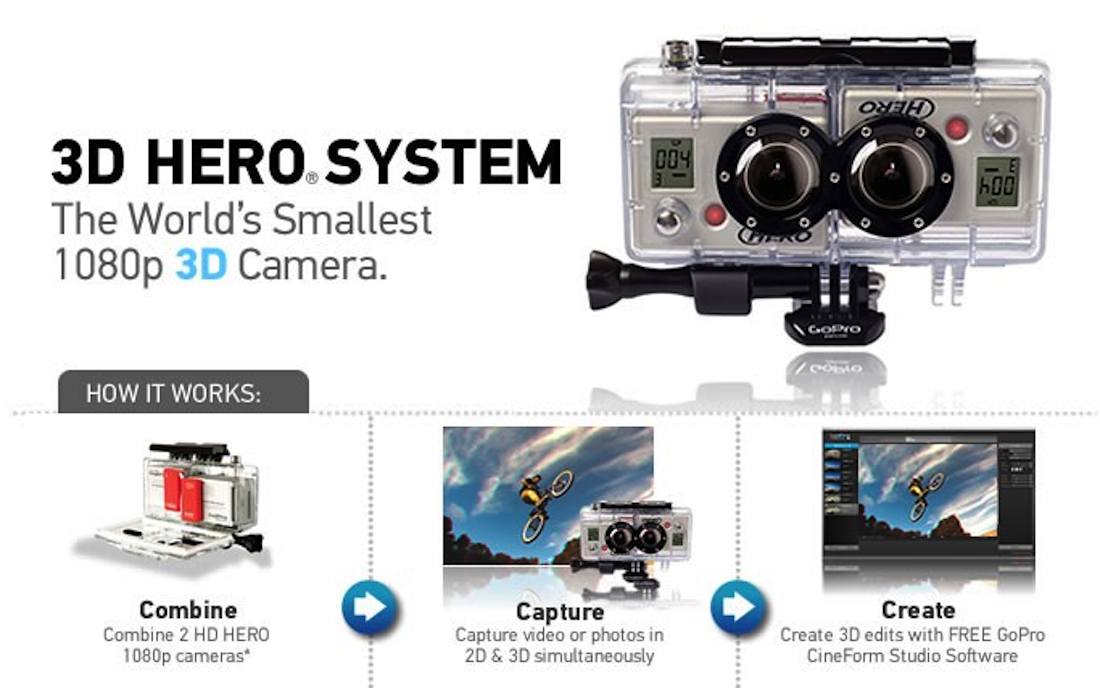
The first new GoPro product to incorporate CineForm’s technology is the new 3D Hero (pictured), a $100 expansion accessory for GoPro’s 1080p HD Hero line of cameras (cameras not included, but only $260 each), which started shipping this week.

The 3D Hero allows users to combine two of the cameras in a single housing to capture synchronized 3D photos and video. A synchronization cable joins the cameras via an expansion port on the back of each, and the package comes with the CineForm Studio 3D editing software, which converts the 3D Hero files into 3D H.264 files or 10-bit CineForm 422 Codec files.

“GoPro has come out of nowhere to become a leading HD capture solution for professionals wanting to capture new, never before seen perspectives,” said David Newman, CineForm’s co-founder and CTO. “We were very impressed with the 3D Hero System’s ability to rival cameras costing ten times as much. We’re looking forward to putting CineForm’s content creation tools into more hands than ever before thanks to GoPro’s global brand and distribution.”

David Taylor, co-founder and CEO of CineForm added: “It’s exciting to look out and see how many people, consumers and professionals alike, are using GoPro cameras to create compelling content. As we worked with GoPro over the last year, the more we learned about GoPro’s vision, the more we realized how complementary GoPro and CineForm are to each other. We’re thrilled to join GoPro and to help usher in a new era of accessible professional content capture and creation.”

CineForm will move to GoPro's San Diego offices, and will continue to develop its own software as well as working on new GoPro products.

The HD Hero camera is claimed to be used by more professional production crews in the broadcast and film industry than any other camera in its class. GoPro recently released a new $80 LCD BacPac attachment for the cameras and apparently shipped 75,000 in the first month. They are widely used by the BBC, on such programmes as Top Gear and Countryfile, the Discovery Channel, and almost any show dealing with skydiving, winter or water sports (the housings are waterproof). Fans include Lucasfilm producer Rick McCallum, who said: "When I saw the footage from the GoPro on our big screens at Skywalker Ranch, I was amazed..."

By David Fox

January 25, 2011

Live view for GoPro + Contour

Both GoPro and Contour are upgrading their go-anywhere helmet cameras so that users can finally see what they are filming as they shoot.

The GoPro is probably the most widely-used miniature, waterproof, point-of-view action camera for broadcast work, despite the fact that you have to just point it in the general direction of what you are shooting and hope it gets it – as it is normally fixed to a helmet, or bike handlebars, or some other form of transport, there isn't usually much you could do to frame it anyway.

However, next month GoPro is introducing a removable LCD BacPac (costing less than $70) for live viewing and camera control to its 1080p HD Hero camera. This takes advantage of the bus connection that is being used for its new 3D Hero rig. It includes a built-in speaker and will allow users to see what shots they are framing and to playback their videos without transferring them to a computer - best photos I've seen of the LCD BacPac so far are on Engadget.

There will also be a Battery BacPac (costing under $40) that doubles the battery life and can also be used as a standalone battery charger. Both BacPacs require the fitting of a new back to the HD Hero's waterproof housing. GoPro is also likely to release other BacPac units in future – probably ones that duplicate the functions of Contour's latest development….

For aiming a camera that is fixed to somewhere that isn't easily viewable, the LCD BacPac might not make framing a shot any easier - although it will be useful for handheld use. However, it's rival, Contour, is adding remote live viewing to its range via a Bluetooth connection that will send the video to an iPhone/iPad or Android mobile – the apps to view it aren't available yet, but should be soon, with the iOS version appearing first. The Bluetooth connection can also be used for remote control.

It comes as part of the new $350 ContourGPS, which, as the name suggests, also includes a GPS chip. It can capture 1920x080 video at 25p or 30p and 1280x720 50p or 60p, using the H.264 .mov format.

"We're excited about turning a phone into a live screen for the ContourGPS and delivering the single feature nearly all of our customers have been asking for," said Marc Barros, Contour's CEO. "ContourGPS was already the first hands-free camera to introduce real-time GPS, bringing a whole new level of video storytelling to our customers around the world. But with the enabling of Bluetooth, ContourGPS becomes the only hands-free video camera with a wireless viewfinder."

Related post: GoPro acquires CineForm - Goes 3D

By David Fox

January 11, 2011

GoPro sports 3D Hero HD

GoPro has developed a small, waterproof 3D rig for shooting full 1080p 3D video with its tiny Hero HD cameras. These are already widely used for TV production to get shots in wet, dusty or difficult conditions (such as fixed to a ski helmet).

The upcoming 3D Hero Expansion Kit will allow users to fit two of the 1080p cameras in the one housing, with a synchronization cable that connects the camera's bus outputs (it says that this synchronises "video capture and settings", hopefully including the auto exposure). The kit should cost less than $100, and each HD Hero costs $260 (although many production companies and cameramen will already have one or two of them).

The interaxial distance between the lenses can be adjusted, by simply turning one of the cameras upside down (going from about 60mm apart to about 25-30mm - my estimate) – although rolling shutter effects with verticals skewing in opposite directions may make this unusable for some shots. The normal GoPro housing is waterproof to 60m, so presumably the 3D rig will be too. The whole rig should weigh less than 400g, including cameras. The kit should be available soon, and will probably lead to lots of 3D base-jumping, skydiving, snowboarding and climbing videos on YouTube.

GoPro also supplies 3D conversion software to import video from one camera and have the other camera's video automatically imported and aligned to create a 3D file.

Related post: GoPro acquires CineForm - Goes 3D

By David Fox