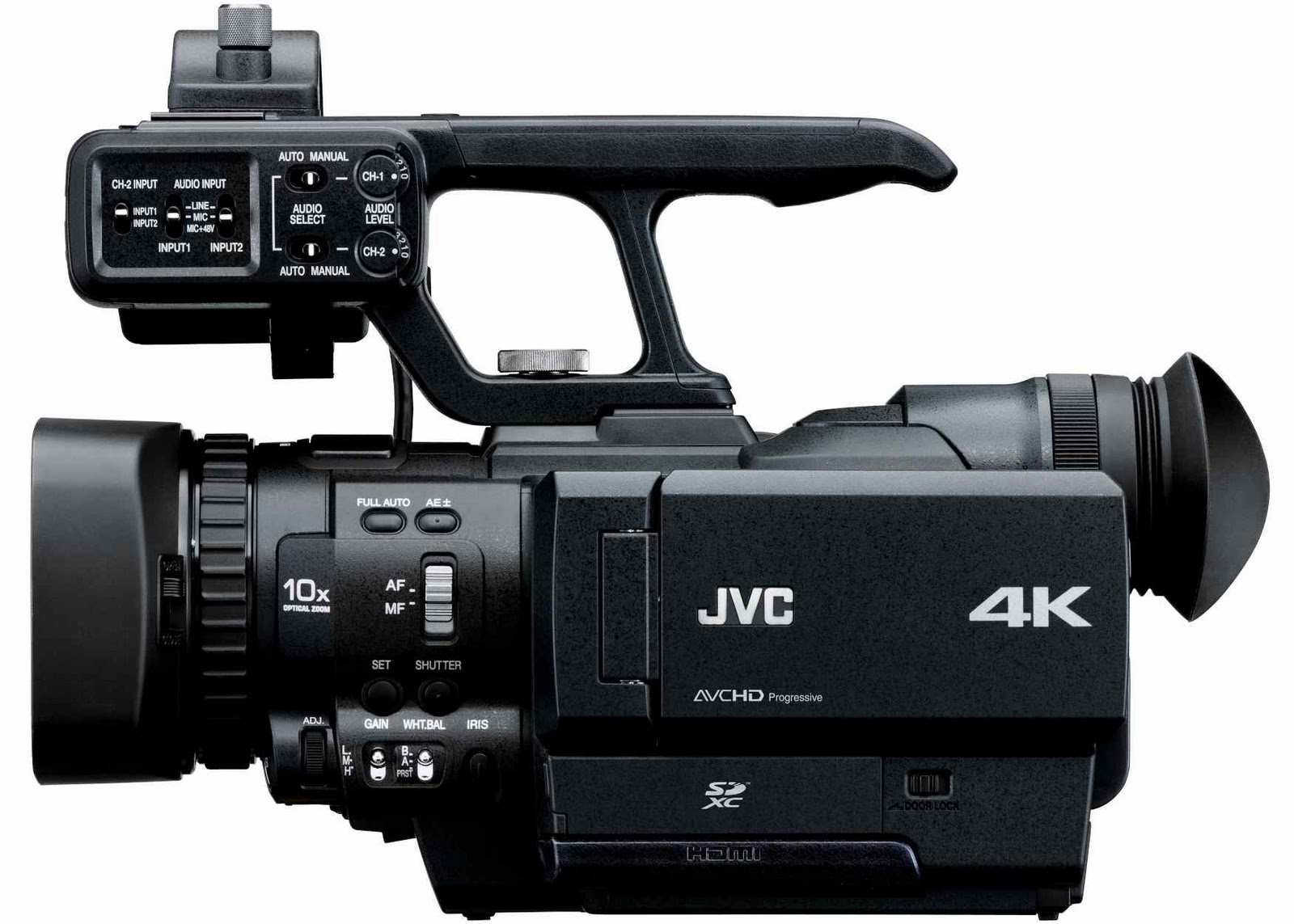
JVC has launched two new large sensor (Super 35mm) Ultra HD
cameras with interchangeable Micro Four Thirds lens mounts. The GY-LS300
camcorder (pictured below), and the GW-SP100 miniature camera (above) and separate recording system, are
part of its new range of 4Kcam camcorders. The other two (the live streaming GY-HM200 and compact GY-HM170) use smaller 1/2.3-inch sensors.
Showing posts with label JVC. Show all posts
November 12, 2014
JVC's GY-HM200 + GY-HM170 4Kcam compact UHD camcorders
JVC Professional has launched its new 4Kcam (Ultra HD)
product line, including two new large sensor cameras (the GY-LS300 and GW-SP100 - dealt with elsewhere), and two smaller models: the GY-HM200, which includes HD
streaming and an SDI output; and the compact GY-HM170. All four should arrive
early in 2015.
The GY-HM200 (pictured above) and GY-HM170 are essentially the same, but the
HM200 will be the one to choose if you need to deliver breaking stories for
broadcast or the web via WiFi, internet or mobile (3G or 4G) connections, or if
you are working with other (SDI-based) broadcast equipment.
March 13, 2013
JVC GY-HM70 shoulder camera
The new JVC GY-HM70 AVCHD camera should be of interest to
many of our readers, as our now-ancient (October 2010) post on AVCHD shoulder mounted camcorders is our most popular ever…
The GY-HM70 will ship in May, and has a list price of $1,995 (apparently the UK street price is likely to be under £1,200),
and some nice features, even if it doesn’t have XLR audio input.
It is designed principally for event production, and to make
it useful for covering long-form events, such as weddings or conferences, it
has hot-swappable batteries (pictured below - a first in this price bracket), so you can keep
shooting continuously, without interruption.
Being shoulder-mounted, it should
also be a lot more comfortable for long-term use than more compact cameras
(although it isn’t particularly big), and is reasonably light, weighing about 3kg
(6.7lb) with one battery attached.
It can record 1920x1080 HD at up to 50p or 60p in AVCHD
Progressive, to dual SDHC/SDXC memory cards (Class 4/6/10) at up to 28Mbps. It
will also shoot at 250 frames per second at 720x576 (for 50Hz/Pal production)
or 300fps at 720x480 (for 60Hz/NTSC countries), and offers 50/60i shooting or
SD at lower bit rates.
Interval recording in steps from one second up to 80
seconds is also an option, as are still images at up to 4000x3000-pixel
resolution. Stills in 12Megapixel can be shot at the same time as video or
stills can be shot at 2Megapixel resolution.
The camera should also be pretty useful in low light. It
uses JVC's Super LoLux technology to enhance image quality and offer more
accurate colour capture indoors or in dark situations (there is a minimum
illumination of 1lux, which is certainly good, but hardly exceptional).
The F1.2-F5.6 GT Lens has a 10x optical zoom, plus a 16x
“dynamic zoom” that only works with the optical image stabilisation turned off
and makes use of the overabundance of pixels on the sensor by reducing from
5.4Mpixels to 2.07Mpixels (there is also a 200x digital zoom).
The lens delivers
a not-particularly wide wide-angle of 29.5mm – to 476mm if dynamic zoom used (35mm-equivalent),
and was developed specifically for the 1/2.3-inch 12Megapixel back-illuminated
CMOS sensor (apparently the same sensor used in JVC’s GY-HMQ10 small 4K
handheld camcorder), which is claimed to deliver “high resolution, high
sensitivity, and excellent colour reproduction.”
The camera features manual or auto focus (with focus assist),
manual iris and shutter, manual or automatic white balance, and optical image
stabilization.
There is a 3-inch 16:9 230K-pixel Touch Screen LCD display
plus a 0.24-inch LCOS 16:9 260K-pixel colour viewfinder; an internal stereo
microphone (plus a mini-jack microphone input); remote-control input; while
outputs include an HDMI Mini connector and RCA video and audio ports. It comes
with an AC adapter (AP-V20); battery pack (BN-VF823); composite/audio cable
(RCA x 3) and USB cable.
By David Fox
BBC buys 500+ GY-HM650 cameras
JVC has recently made a big breakthrough in broadcast news
use with the order of more than 500 units of its GY-HM650 ProHD network-enabled
camcorder by BBC News for use in newsgathering throughout the UK and globally.
The lightweight cameras record HD or SD in multiple file
formats, including native XDCAM EX (.MP4), Final Cut Pro (.MOV), and AVCHD, to
SD cards. The 650 also supports MXF files for metadata.
One of its advantages for news is that it has dual codecs,
so that it can record full HD files on one memory card, while simultaneously
creating smaller, web-friendly files (1/4 HD or SD) on a second card. It also
has built-in FTP client and network connectivity, so that it can deliver the
footage back to a station without a microwave or satellite connection (all it
requires is a WiFi connection or mobile broadband).
It has a secure web server built-in, to allow you to take
full control of the camera – including zoom, Rec start/stop and metadata
editing – via any browser-enabled device such as an iPad or smart phone.
Other features include: three, 1/3-inch 12-bit CMOS sensors,
each with 1920x1080 pixels; a 29mm-667mm (35mm equivalent) Fujinon 23x
autofocus zoom lens with optical image stabilizer; manual focus, zoom and iris
rings, plus three ND filters; auto-focus with face detection; good low-light
performance (F12 at 2000 lux in extended mode); a 1.22MP colour viewfinder and
3.5-inch LCD; a second trigger and servo zoom control on the built-in handle to
make it easy to record while holding the cameras at low or high angles; Pre Rec
to continuously record and store up to 15 seconds of footage in cache memory to
help prevent missed shots of breaking events; built-in stereo microphone plus
two XLR inputs with phantom power; separate input for a wireless mic receiver;
LANC remote connector; time-code synchronization input; plus HD-SDI and HDMI
outputs. It also has Flash Band Correction, to avoid rolling shutter problems
if you shoot an event there are flash guns going off.
The camera has been tested by Alan Roberts (whose reports are always worth reading) and met the EBU’s criteria under EBU Tech 3335 for
journalism use (Tier 2J), and will also meet the requirements for general long
form HD programming (Tier 2L), when used with a suitable external recording
device supporting 50Mbps or greater recording (it records up to 35Mbps
internally).
By David Fox
April 17, 2012
JVC GY-HM600 + GY-HM650
NAB 2012: JVC has launched two new handheld ProHD ENG camcorders, including one with built-in WiFi/FTP for shooting and relaying news back to the studio as quickly as possible.
The GY-HM600 is claimed to be “light, versatile and extremely easy to use” and “designed for fast paced ENG delivering exceptional imagery and features for news, sports, and independent production.” It promises good low light performance (F11 at 2000 lux), and has a 23x autofocus zoom lens.
It records HD or SD in multiple file formats, including native XDCAM EX (.MP4), Final Cut Pro (.MOV), and AVCHD, to SDHC or SDXC media cards. Users can choose relay mode for uninterrupted recording, or simultaneous recording to both memory cards for instant backup or a client copy.
“It sets a new standard of performance for handheld cameras with incredible optics, intuitive operation and the industry’s fastest shoot-to-edit workflow,” claimed Gustav Emrich, European Product Manager.
The GY-HM600 offers a 1.22-megapixel colour viewfinder and 3.5-inch LCD; a second trigger and servo zoom control on the built-in handle make it easy to record while holding the camera at low or high angles; while the Pre Rec (cache memory) feature continuously records and stores up to five seconds of footage to help prevent missed shots of breaking events.
It has: three 1/3-inch 12-bit 1920x1080 CMOS sensors; a built-in Fujinon HD lens with a focal range of 29mm-667mm (35mm equivalent), with manual focus, zoom, and iris rings; three ND filters; auto-focus with face detection; an optical image stabilizer; LANC remote connector; timecode input; plus HD-SDI and HDMI outputs.
There is a built-in stereo microphone plus two XLR inputs with phantom power and a shotgun microphone holder, as well as a headphone jack and separate input for a wireless microphone receiver. It is expected to ship in the Autumn.
GY-HM650
The GY-HM650 is based on the HM600 and will be available late this year. It can record full HD files on one memory card while simultaneously creating smaller, web-friendly files (1/4 HD – 960x540) on a second card. It has built-in FTP and WiFi connectivity to deliver the footage back to a station without a microwave or satellite connection. It also records .MXF files with metadata, optimized for asset management.
“With built-in web connectivity, simultaneous recording of a web-friendly video file, and .MXF files with rich descriptive metadata, the GY-HM650 is ideal for today's file-based workflows,” said Emrich.
[UPDATE: More than 500 of the HM650 camcorders have been bought by BBC News]
By David Fox
The GY-HM600 is claimed to be “light, versatile and extremely easy to use” and “designed for fast paced ENG delivering exceptional imagery and features for news, sports, and independent production.” It promises good low light performance (F11 at 2000 lux), and has a 23x autofocus zoom lens.
It records HD or SD in multiple file formats, including native XDCAM EX (.MP4), Final Cut Pro (.MOV), and AVCHD, to SDHC or SDXC media cards. Users can choose relay mode for uninterrupted recording, or simultaneous recording to both memory cards for instant backup or a client copy.
“It sets a new standard of performance for handheld cameras with incredible optics, intuitive operation and the industry’s fastest shoot-to-edit workflow,” claimed Gustav Emrich, European Product Manager.
The GY-HM600 offers a 1.22-megapixel colour viewfinder and 3.5-inch LCD; a second trigger and servo zoom control on the built-in handle make it easy to record while holding the camera at low or high angles; while the Pre Rec (cache memory) feature continuously records and stores up to five seconds of footage to help prevent missed shots of breaking events.
It has: three 1/3-inch 12-bit 1920x1080 CMOS sensors; a built-in Fujinon HD lens with a focal range of 29mm-667mm (35mm equivalent), with manual focus, zoom, and iris rings; three ND filters; auto-focus with face detection; an optical image stabilizer; LANC remote connector; timecode input; plus HD-SDI and HDMI outputs.
There is a built-in stereo microphone plus two XLR inputs with phantom power and a shotgun microphone holder, as well as a headphone jack and separate input for a wireless microphone receiver. It is expected to ship in the Autumn.
GY-HM650
The GY-HM650 is based on the HM600 and will be available late this year. It can record full HD files on one memory card while simultaneously creating smaller, web-friendly files (1/4 HD – 960x540) on a second card. It has built-in FTP and WiFi connectivity to deliver the footage back to a station without a microwave or satellite connection. It also records .MXF files with metadata, optimized for asset management.
“With built-in web connectivity, simultaneous recording of a web-friendly video file, and .MXF files with rich descriptive metadata, the GY-HM650 is ideal for today's file-based workflows,” said Emrich.
[UPDATE: More than 500 of the HM650 camcorders have been bought by BBC News]
By David Fox
January 10, 2012
JVC HMQ10 handheld 4K camera
JVC has launched the world’s first handheld 4K camcorder, this week, at CES in Las Vegas. The GY-HMQ10, which captures, records and plays back video at four times the resolution of HD, will have a list price [Updated] of £5,090/€5,850 and is expected to ship in March [the price had originally been given as $/€4,995, but prices have since been revised (I've only been sent UK and EU prices so far), although the street price is likely to be under $5,000].
Its small size, about the same as JVC’s GY-HM150 ProHD camcorder, and relatively low price means it will not only appeal as a B camera for users of larger 4K cameras, but also as set and forget camera for HD use, where the ability to crop and pan full HD images from the 4K image could be very useful.
The camera is powered by JVC’s Falconbrid large-scale integration chip for high-speed signal processing and has a 1/2-inch CMOS sensor with 8.3 million active pixels, which delivers realtime 3840x2160 footage at 24p and 50p or 60p.
“We’re witnessing the birth of what is destined to become a broad market for full 4K end-to-end production,” said JVC Professional Europe product manager, Gustav Emrich. “The GY-HMQ10 is a breakthrough product that opens up 4K imaging to users who previously wouldn't have considered it.”
Falconbrid processing takes the raw image data from the sensor and deBayers it in real time. Unlike many high-end 4K cameras, the GY-HMQ10 can output 4K images to a monitor or projector in real time with virtually no latency.
It records using MPEG-4/H.264 compression, with a variable bit rate of up to 144Mbps, and can record up to two hours of 4K video to low-cost SDHC or SDXC memory cards (it uses four cards at a time to capture the four HD images that combine to create the 4K version). It can deliver live 4K output via four HDMI terminals.
It also records 1080i or 1080/50p HD, on a single card in a format compatible with most editing systems. Cropping an HD image from a 4K frame can be done in post, or in real time during camera playback, using a trimming feature on the camera's 3.5-inch touch screen LCD.
The GY-HMQ10 has an F2.8 10x zoom lens with optical image stabiliser, plus a colour viewfinder, manual level controls for audio, with audio metering in the LCD and viewfinder displays. A microphone holder and two balanced XLR connectors with phantom power are located on the handle. The camera also has a built-in stereo mic for ambient sound.
Other features include JVC’s patented Focus Assist, as well as manual and auto control of focus, iris, gain, shutter, gamma, colour matrix and white balance.
“It's part of a larger move at JVC to bring 4K technology to a wide range of customers," explained Emrich. JVC already has an affordable line of 4K projectors for the home theatre market, while its high-end 4K projectors are widely used in commercial flight simulators and planetariums. “4K is the logical step beyond HD,” he added, “and JVC is uniquely positioned to lead the industry in this new direction.”
See related posts: JVC HMZ1 ProHD 3D camcorder + JVC HD LSI offers cost + speed gains
Its small size, about the same as JVC’s GY-HM150 ProHD camcorder, and relatively low price means it will not only appeal as a B camera for users of larger 4K cameras, but also as set and forget camera for HD use, where the ability to crop and pan full HD images from the 4K image could be very useful.
The camera is powered by JVC’s Falconbrid large-scale integration chip for high-speed signal processing and has a 1/2-inch CMOS sensor with 8.3 million active pixels, which delivers realtime 3840x2160 footage at 24p and 50p or 60p.
“We’re witnessing the birth of what is destined to become a broad market for full 4K end-to-end production,” said JVC Professional Europe product manager, Gustav Emrich. “The GY-HMQ10 is a breakthrough product that opens up 4K imaging to users who previously wouldn't have considered it.”
Falconbrid processing takes the raw image data from the sensor and deBayers it in real time. Unlike many high-end 4K cameras, the GY-HMQ10 can output 4K images to a monitor or projector in real time with virtually no latency.
It records using MPEG-4/H.264 compression, with a variable bit rate of up to 144Mbps, and can record up to two hours of 4K video to low-cost SDHC or SDXC memory cards (it uses four cards at a time to capture the four HD images that combine to create the 4K version). It can deliver live 4K output via four HDMI terminals.
It also records 1080i or 1080/50p HD, on a single card in a format compatible with most editing systems. Cropping an HD image from a 4K frame can be done in post, or in real time during camera playback, using a trimming feature on the camera's 3.5-inch touch screen LCD.
The GY-HMQ10 has an F2.8 10x zoom lens with optical image stabiliser, plus a colour viewfinder, manual level controls for audio, with audio metering in the LCD and viewfinder displays. A microphone holder and two balanced XLR connectors with phantom power are located on the handle. The camera also has a built-in stereo mic for ambient sound.
Other features include JVC’s patented Focus Assist, as well as manual and auto control of focus, iris, gain, shutter, gamma, colour matrix and white balance.
“It's part of a larger move at JVC to bring 4K technology to a wide range of customers," explained Emrich. JVC already has an affordable line of 4K projectors for the home theatre market, while its high-end 4K projectors are widely used in commercial flight simulators and planetariums. “4K is the logical step beyond HD,” he added, “and JVC is uniquely positioned to lead the industry in this new direction.”
See related posts: JVC HMZ1 ProHD 3D camcorder + JVC HD LSI offers cost + speed gains
By David Fox
May 10, 2011
Sphinx-cam takes JVC to new heights
WWProd, an Alpe d'Huez-based production company specialising in extreme sports, particularly skiing, has bought JVC GY-HM100 ProHD camcorders for use in its Sphinx-cam miniature helicopter systems.
To capture aerial shots, Lionel Géhin, WWProd's founder, designed a remote controlled multi-rotor machine for filming in-flight. The compact Sphinx-cam Pro XL6 and XL8 machines can carry 2.5kg and 4.5 kg of equipment respectively.
After the Sphinx-cam passed vigorous tests, the company had to find a camera suitable for aerial use, and eventually decided that the lightweight form factor and CCD sensors of the HM100 met its requirements and worked well on the Sphinx-cam.
"We encountered the phenomenon of image distortion during fast movements related to rolling shutter CMOS sensors in camcorders. The GY-HM100 cameras, which use CCDs, remained free of these defects,” explained Géhin.
“As the GY-HM100 has detachable handles, we can reduce the camera’s weight which enables us to reduce the burden of the Sphinx to carry two cameras at the same time. This provides us with the option to shoot the front and the rear and also in 3D.”
The Sphinx-cam Pro XL6 and XL8 have also received interest from other filmmakers, production companies and architects, as it can provide very smooth, controllable movement from a small platform at low-cost.
On WWProd's Vimeo page (http://vimeo.com/user1224737) there are demonstrations of the Sphinx-cam systems with a Canon DSLR, a GoPro 3D rig (anaglyph glasses required) and the JVC (late in the video below). The DSLR sequences show the problems Géhin described with the rolling shutter effects from its CMOS sensor - even in normal flight there is a lot of unsettling skew and ripple.
SphynX-Cam XL6 from SphinX-Cam on Vimeo.
By David Fox
To capture aerial shots, Lionel Géhin, WWProd's founder, designed a remote controlled multi-rotor machine for filming in-flight. The compact Sphinx-cam Pro XL6 and XL8 machines can carry 2.5kg and 4.5 kg of equipment respectively.
After the Sphinx-cam passed vigorous tests, the company had to find a camera suitable for aerial use, and eventually decided that the lightweight form factor and CCD sensors of the HM100 met its requirements and worked well on the Sphinx-cam.
"We encountered the phenomenon of image distortion during fast movements related to rolling shutter CMOS sensors in camcorders. The GY-HM100 cameras, which use CCDs, remained free of these defects,” explained Géhin.
“As the GY-HM100 has detachable handles, we can reduce the camera’s weight which enables us to reduce the burden of the Sphinx to carry two cameras at the same time. This provides us with the option to shoot the front and the rear and also in 3D.”
The Sphinx-cam Pro XL6 and XL8 have also received interest from other filmmakers, production companies and architects, as it can provide very smooth, controllable movement from a small platform at low-cost.
On WWProd's Vimeo page (http://vimeo.com/user1224737) there are demonstrations of the Sphinx-cam systems with a Canon DSLR, a GoPro 3D rig (anaglyph glasses required) and the JVC (late in the video below). The DSLR sequences show the problems Géhin described with the rolling shutter effects from its CMOS sensor - even in normal flight there is a lot of unsettling skew and ripple.
SphynX-Cam XL6 from SphinX-Cam on Vimeo.
By David Fox
April 12, 2011
JVC HMZ1 ProHD 3D camcorder
JVC unveiled its new GY-HMZ1 ProHD 3D camcorder at NAB, and demonstrated its 4K technology in the smallest ever 4K camcorder.
The HMZ1 is an integrated 3D twin lens design powered by JVC’s new Falconbrid large-scale integration (LSI) chip for high-speed processing of HD video. It can simultaneously record each left and right image in full 1920x1080 resolution.
The handheld camcorder features dual 3.32-megapixel CMOS sensors – one for each lens – and delivers 34 Mbps AVCHD recording in 3D (17Mbps AVCHD for each lens) or 24 Mbps in 2D. Video can be recorded with timecode at 60i or 50i to provide smooth motion (for sports and other fast action) or 24p (probably 25p for European market) for a film-like effect. The GY-HMZ1U can also capture 3D time lapse and 3D digital stills.
“With the new GY-HMZ1U, video production professionals get true 3D with full HD resolution,” said Craig Yanagi, JVC's national marketing and brand manager. “3D production can be extremely complex, but JVC’s new ProHD camcorder makes 3D more accessible to independent filmmakers, commercial and corporate production houses, and even educational markets.”
Equipped with an advanced image stabilizer, the twin F1.2 HD lenses offer a 5x optical zoom in 3D or 10x in 2D. Video is recorded to SDHC or SDXC media cards or to the camera’s built-in 80GB internal memory. The 3.5-inch colour LCD touch panel offers glasses-free 3D viewing and built-in tools like zebra pattern (for checking exposure). Other professional features include a handle with dual XLR microphone inputs and a shotgun microphone mount (mic optional).
4K roadmap
The Falconbrid chip is not only useful for 3D, but also for higher resolution 2D work, and JVC was showing two prototype 4K cameras.
The new LSI enables processing, encoding, and recording of 4K2K images, which have four times the resolution of full HD. However, the cameras are not necessarily planned to become products, but are seen by JVC as a way to find out exactly what users want.
“JVC continues to be at the forefront of technological innovation in our industry. Our new LSI technology can handle data-intensive acquisition, which opens the door to exciting possibilities for the production community,” said Bob Mueller, executive vice president and COO. “Over the next few months, JVC is going to invite innovative cinematographers and other production professionals to help us develop 4K cameras, 3D cameras, and other products that deliver outstanding images and improved workflows at an affordable price point.”
With advanced image codecs and other technologies assembled in a single chip, the new LSI’s camera signal processing enables real-time RGB debayering of 8.3 megapixel video at 60 fps. Plus, the LSI requires 40 percent less power and, compared to previous LSIs, cuts systems costs in half. The result is a high-level processor suited to a wide range of professional products – and with all hardware and software integrated into a single platform, products using the LSI platform can be commercialized quickly.
By David Fox
The HMZ1 is an integrated 3D twin lens design powered by JVC’s new Falconbrid large-scale integration (LSI) chip for high-speed processing of HD video. It can simultaneously record each left and right image in full 1920x1080 resolution.
The handheld camcorder features dual 3.32-megapixel CMOS sensors – one for each lens – and delivers 34 Mbps AVCHD recording in 3D (17Mbps AVCHD for each lens) or 24 Mbps in 2D. Video can be recorded with timecode at 60i or 50i to provide smooth motion (for sports and other fast action) or 24p (probably 25p for European market) for a film-like effect. The GY-HMZ1U can also capture 3D time lapse and 3D digital stills.
“With the new GY-HMZ1U, video production professionals get true 3D with full HD resolution,” said Craig Yanagi, JVC's national marketing and brand manager. “3D production can be extremely complex, but JVC’s new ProHD camcorder makes 3D more accessible to independent filmmakers, commercial and corporate production houses, and even educational markets.”
Equipped with an advanced image stabilizer, the twin F1.2 HD lenses offer a 5x optical zoom in 3D or 10x in 2D. Video is recorded to SDHC or SDXC media cards or to the camera’s built-in 80GB internal memory. The 3.5-inch colour LCD touch panel offers glasses-free 3D viewing and built-in tools like zebra pattern (for checking exposure). Other professional features include a handle with dual XLR microphone inputs and a shotgun microphone mount (mic optional).
The GY-HMZ1 will be available in the Autumn, priced under $2,500. In the meantime, JVC's GS-TD1 full HD 3D consumer camcorder is already available.
4K roadmap
The Falconbrid chip is not only useful for 3D, but also for higher resolution 2D work, and JVC was showing two prototype 4K cameras.
The new LSI enables processing, encoding, and recording of 4K2K images, which have four times the resolution of full HD. However, the cameras are not necessarily planned to become products, but are seen by JVC as a way to find out exactly what users want.
“JVC continues to be at the forefront of technological innovation in our industry. Our new LSI technology can handle data-intensive acquisition, which opens the door to exciting possibilities for the production community,” said Bob Mueller, executive vice president and COO. “Over the next few months, JVC is going to invite innovative cinematographers and other production professionals to help us develop 4K cameras, 3D cameras, and other products that deliver outstanding images and improved workflows at an affordable price point.”
With advanced image codecs and other technologies assembled in a single chip, the new LSI’s camera signal processing enables real-time RGB debayering of 8.3 megapixel video at 60 fps. Plus, the LSI requires 40 percent less power and, compared to previous LSIs, cuts systems costs in half. The result is a high-level processor suited to a wide range of professional products – and with all hardware and software integrated into a single platform, products using the LSI platform can be commercialized quickly.
By David Fox
March 28, 2011
Format choice: Going tapeless
Virtually every camera now available uses some form of tapeless recording. The few tape-based camcorders still being produced can record to some form of add-on memory or external recorder. However, with choice comes indecision... Moving to a new format or recording media means additional costs and trying to find a new workflow that's efficient and works for you and your clients.
To help put all of this in context, we've talked to camera users and owners about what tapeless systems they use, to find out the benefits and the disadvantages, and have put up a comprehensive (and rather lengthy) page on going tapeless.
February 11, 2011
JVC's new GY-HM750 ProHD
JVC Professional will be showing its latest GY-HM750E ProHD compact shoulder-mount camcorder at BVE 2011. It is claimed to offer "the industry’s fastest shoot-to-edit workflow by recording native HD or SD footage in ready-to-edit file formats on low-cost SDHC memory cards."
It uses the same 3-CCD imaging system as the GY-HM790E, JVC’s ProHD flagship camcorder, and records HD in 720p, 1080p, and 1080i, as well as SD (576i) at selectable data rates up to 35 Mbps.
It has a dual card slot design that records to SDHC cards and/or an optional SxS recorder. This had been requested by customers and allows simultaneous recording to both SDHC cards, for instant backup or client copy.
Users can record in ready-to-edit file formats for Apple Final Cut Pro or Adobe Premiere (.mov), or as Sony XDCAM EX files (.MP4). For standard definition work, it can also record DV files (.avi or .mov).
Building on the modular approach of the GY-HM790E, the GY-HM750E includes a 68-pin chassis connector for a clean, direct interface to various modules. The new KA-AS790 ASI output module, for example, provides a direct feed from the camera to a satellite uplink or microwave transmitter via BNC, ideal for broadcasting live HD from the field. The GY-HM750E automatically switches to low-latency mode (less than 300ms delay) when the module is in use.
JVC has also improved its Pre Rec (cache) feature, which continuously records and stores footage in cache memory and helps prevent missed shots of breaking events, which now stores 20 seconds. Other features include variable frame rate recording, extensive image customisation, a high-resolution (1.22 million pixel) LCOS viewfinder and 4.3-inch flip-out LCD monitor, and JVC’s Focus Assist. It also has two XLR audio inputs with phantom power, plus manual audio level controls with an audio meter.
The GY-HM750E includes a Canon 14:1 zoom lens, but accommodates any lens with a 1/3-inch bayonet lens mount.
Because it uses CCDs instead of CMOS sensors, it doesn't suffer from any rolling shutter effects (such as skew or flashes from photographers covering only part of the frame). Combine this with its 20-second cache, quick workflow, and reasonable price (about £6,000) and it seems to be one of the best choices for news or event coverage - CNN bought 177 of its little brother, the HM100 for news use.
By David Fox
It uses the same 3-CCD imaging system as the GY-HM790E, JVC’s ProHD flagship camcorder, and records HD in 720p, 1080p, and 1080i, as well as SD (576i) at selectable data rates up to 35 Mbps.
It has a dual card slot design that records to SDHC cards and/or an optional SxS recorder. This had been requested by customers and allows simultaneous recording to both SDHC cards, for instant backup or client copy.
Users can record in ready-to-edit file formats for Apple Final Cut Pro or Adobe Premiere (.mov), or as Sony XDCAM EX files (.MP4). For standard definition work, it can also record DV files (.avi or .mov).
Building on the modular approach of the GY-HM790E, the GY-HM750E includes a 68-pin chassis connector for a clean, direct interface to various modules. The new KA-AS790 ASI output module, for example, provides a direct feed from the camera to a satellite uplink or microwave transmitter via BNC, ideal for broadcasting live HD from the field. The GY-HM750E automatically switches to low-latency mode (less than 300ms delay) when the module is in use.
JVC has also improved its Pre Rec (cache) feature, which continuously records and stores footage in cache memory and helps prevent missed shots of breaking events, which now stores 20 seconds. Other features include variable frame rate recording, extensive image customisation, a high-resolution (1.22 million pixel) LCOS viewfinder and 4.3-inch flip-out LCD monitor, and JVC’s Focus Assist. It also has two XLR audio inputs with phantom power, plus manual audio level controls with an audio meter.
The GY-HM750E includes a Canon 14:1 zoom lens, but accommodates any lens with a 1/3-inch bayonet lens mount.
Because it uses CCDs instead of CMOS sensors, it doesn't suffer from any rolling shutter effects (such as skew or flashes from photographers covering only part of the frame). Combine this with its 20-second cache, quick workflow, and reasonable price (about £6,000) and it seems to be one of the best choices for news or event coverage - CNN bought 177 of its little brother, the HM100 for news use.
By David Fox
January 10, 2011
Sony + JVC low-cost 3D camcorders
3D was probably the key theme at the Consumer Electronics Show in Las Vegas last week (even more so than would be iPad rivals), with 3D displays, 3D games consoles, 3D-equipped laptops, and cheap and simple consumer cameras on many stands – some of which could find themselves used for professional applications.
By David Fox
Sony's first foray into the world of consumer 3D camcorders includes one that should be of interest to professional users.
The Sony HDR-TD10E was claimed to be "the world’s first Double Full HD 3D consumer camcorder" – JVC made similar claims (see below). It uses an integrated dual lens system with two Sony G Lenses, two Exmor R CMOS sensors, and two BIONZ image processors, recording 1920x1080 on both channels. It can also output full HD 2D video, and recordings can be played back in 3D without glasses on the camcorder’s 3.5-inch autostereoscopic LCD touch screen.
Other features include: 10x optical zoom with Optical SteadyShot (Active Mode) and iAUTO in 3D mode; 64GB of built-in flash memory.
The HDR-TD10E will be available in April for about $1,499.
Sony also has one of the simplest, cheapest and smallest 3D camcorders on offer in its new Bloggie HD range.
The Sony MHS-FS3 Bloggie 3D records 1920x1080 MP4 video and 5-megapixel still photos. It has two lenses (very close together), two image sensors, stereo microphone and built-in LED light. Recordings can be viewed in 3D without glasses on the camera’s 2.4-inch LCD or via a 3D screen using HDMI. It has 8GB of internal memory and will be available in April for less than $250.
JVC goes full on
JVC's GS-TD1 full HD 3D consumer camcorder (pictured top) can also record 1920x1080 (50i or 60i) on both left and right channels simultaneously (as well as supporting side-by-side format AVCHD 3D plus AVCHD 2D).
It features two 3D HD GT 5x lenses (10x in 2D mode), two 3.32 megapixel CMOS sensors, 64GB of built-in flash memory plus an SD card slot, the new Falconbrid LSI chip, and a 3.5-inch glasses-free 3D touch panel LCD. It should cost less than $1,700 and ship in March, a month before the HDR-TD10 – which might indeed mean it lives up to JVC's claim that "the newly developed LR Independent Format makes the GS-TD1 the world's first consumer-oriented camcorder capable of 3D shooting in Full HD."
It has an Optical Axis Automatic Stabilization System for disparity control to give depth to 3D images, Biphonic technology for dynamic 3D sound, and Automatic Parallax Adjustment to optimize the 3D-video comfort zone. The f1.2 lenses have round iris diaphragms to give a pleasing bokeh effect (background blurring) for both video and stills alike – although the small, back-illuminated CMOS sensors may not always give the shallow depth of field needed to make that useful - although shallow depth of field isn't really applicable to 3D as it makes the 3D effect look less natural.
The GS-TD1 will be able to do 3D time-lapse recording, which could make it very useful as a set and forget camcorder for long-term projects. It also records 3D still images. [UPDATE: The first reviews are coming in - see GS-TD1 review at Digital Trends].
JVC also showed a new compact HD Everio camcorder with 3D capabilities. The $950 GZ-HM960 has 2D-to-3D conversion built in, to turn any 2D footage into 3D. Output can be viewed without glasses on the camera's 3.5-inch 3D LCD monitor, or by connecting the camcorder to a 3D TV. It will be available in February.
By David Fox
JVC HD LSI offers cost + speed gains
[UPDATED] JVC has developed "the world’s first LSI for high-speed processing of Full High-Definition video and stills on one chip for HD camcorders" and shown the first models using the chip at CES2011 in Las Vegas.
The large scale integrated chip will enable shooting and recording Full HD, including 3D images, and also higher resolution 4Kx2K images. High-speed photography with high-speed processing will also be possible. The LSI boasts low power consumption and should enable lower system costs by incorporating all image-processing technologies for HD shooting, including camera-signal processing and video/still image codecs.
JVC showed a concept "high speed multi-purpose camera" that uses this LSI at CES: the GC-PX1. Looking very like Sony's F707 stills camera, it offered 1920x1080 HD video at 60p (at 36Mbps), amongst other video and stills settings.
The Falconbrid LSI is also being used in JVC's new 3D camcorder, the GS-TD1. The LSI should be 2.7 times faster than JVC's previous CPU. It also: improves signal processing speeds by 70% (enabling 8.3-megapixel video at 60fps); doubles the speed of processing H.264 video (enabling compression of 2.07MP images at 60fps); speeds JPEG still-image processing by 5.5 times compared to its previous technology (enabling compression of images as large as 8.3MP in JPEG at 60fps).
It supports higher resolution video images, which it calls 4K2K (3840x2160 – that 8.3MP – at 60p) which is four times the data of HD.
Falconbrid should also deliver a 40% reduction in power consumption and 50% reduction of system costs compared to previous LSIs, making it suitable for use in a wide range of both consumer and professional products.
As all hardware and software is integrated into one platform, products that use it can be developed much more rapidly.
It will be particularly suitable for 3D, as it can do real-time 3D compression of separate Full HD images (1920 x 1080/60p) from right and left cameras using MPEG-4 MVC. The amount of data is double the conventional side-by-side 3D recording format, enabling high-resolution Full HD 3D images with one chip.
It could even do high-speed video capture in 3D, recording at 300fps (but at VGA resolution).
By David Fox
The large scale integrated chip will enable shooting and recording Full HD, including 3D images, and also higher resolution 4Kx2K images. High-speed photography with high-speed processing will also be possible. The LSI boasts low power consumption and should enable lower system costs by incorporating all image-processing technologies for HD shooting, including camera-signal processing and video/still image codecs.
JVC showed a concept "high speed multi-purpose camera" that uses this LSI at CES: the GC-PX1. Looking very like Sony's F707 stills camera, it offered 1920x1080 HD video at 60p (at 36Mbps), amongst other video and stills settings.
The Falconbrid LSI is also being used in JVC's new 3D camcorder, the GS-TD1. The LSI should be 2.7 times faster than JVC's previous CPU. It also: improves signal processing speeds by 70% (enabling 8.3-megapixel video at 60fps); doubles the speed of processing H.264 video (enabling compression of 2.07MP images at 60fps); speeds JPEG still-image processing by 5.5 times compared to its previous technology (enabling compression of images as large as 8.3MP in JPEG at 60fps).
It supports higher resolution video images, which it calls 4K2K (3840x2160 – that 8.3MP – at 60p) which is four times the data of HD.
Falconbrid should also deliver a 40% reduction in power consumption and 50% reduction of system costs compared to previous LSIs, making it suitable for use in a wide range of both consumer and professional products.
As all hardware and software is integrated into one platform, products that use it can be developed much more rapidly.
It will be particularly suitable for 3D, as it can do real-time 3D compression of separate Full HD images (1920 x 1080/60p) from right and left cameras using MPEG-4 MVC. The amount of data is double the conventional side-by-side 3D recording format, enabling high-resolution Full HD 3D images with one chip.
It could even do high-speed video capture in 3D, recording at 300fps (but at VGA resolution).
By David Fox
January 05, 2011
DSLR v Video: Why not both?
A matter of choice: Gollner and Davis (and Canon 550D DSLR)
HD DSLRs are now widely used for video production, even for prominent TV series and movie making. Users love the shallow depth of field and low cost of entry. But just how useful are they for professional production, how do they compare to low-end video cameras, and can they withstand the introduction of large sensor video cameras that give the same look but without the operational problems?
"The tones of the images, the look, the range of lenses, the animation capability – they make these cameras a dream for independent filmmakers, but they're not good for everything. For the videographer who gets paid to shoot, run around, be quick, gather audio, videos, interviews. Quick turnaround. Guaranteed results, meaning its not going to screw up; the DSLRs have proved far from ideal," said Rick Young, editor/director/cameraman, MacVideo.TV.
For him it's not a matter of choosing one over the other, "they're both fantastic," but of choosing the right one for a particular shoot.
Producer/director, Matt Davis, MDMA, has a Sony EX1, and wanted to do wider shots. So, he bought expensive wide-angle adapters, but then worked out that a Canon 550D costs less than the adapter, even including the wide angle lens (he bought a Tokina 11-17mm zoom, which he praises for its sharpness). "The wide angle experience has been absolutely monumental. It does everything that an EX1 can't. There is no droop at the sides. It's got this wonderful panoramic feel. It is a smaller camera that can get into smaller places." He is only now investing in longer lenses.
"It had to work with an EX1. It couldn't just stand on its own looking beautiful and arty. It had to play fair with the rest of the video family." He makes sure that both the DSLR and the EX1 are shooting within similar contrast ranges "It's close, but it's not exact. It still needs a little bit of finishing off in Final Cut," to match the two pictures, but that is now quick and straightforward.
When he cuts the two together, it is difficult to spot the difference. The blacks can give the DSLR footage away. The EX1 can use Cine Gamma to give soft ramping in the blacks, and the DSLRs don't necessarily have that exposure range. "They're pretty and they're good, but they have limits, and you really can't push beyond those limits like you can with a decent broadcast camera," said Davis.
"If you look at DSLRs in isolation they look fantastic," said Young. "But when you put it together [with video], that's when you can really see the difference."
Young has augmented his two Sony EX1Rs and two JVC HM100s with two Canon 5D Mark IIs with Canon 16-35mm and Sigma 12-24mm lenses, "and it's staggering what you can get out of it. And even if I only use the DSLR for nothing but those wide shots, it would suit a fantastic purpose. The cost of buying a serious wide-angle lens for conventional video technology would be more than probably buying the whole DSLR package," he told the recent MacVideo Expo in London.
"We need this technology. It doesn't mean that it is everything; it complements what we've got, but it doesn't necessarily take over," although it has become "an integral part" of the kit he needs.
Overcoming limitations
"It's just another tool, and it's a very exciting tool," said Den Lennie, founder, F.Stop Academy, who shoots with a wide range of cameras from Digital Betacam to XDCAM EX and DSLRs. He has produced four training DVDs dealing with HD DSLRs, but they have not all been shot using DSLRs. The 5D Mark II training videos were shot on a Sony XDCAM 350, while the Canon 7D DVD was shot on an EX1 and 5D Mark II.
"The limitations of DSLRs particularly lie in the audio," and when he was shooting in Malaysia with Dan Chung it was essentially a two hour documentary, which would have been much more difficult to do if he had to use a separate audio recorder (see some clips from it at www.dslrvideoonassignment.com). However, the training video uses both EX1 and DSLR footage cut together, which works very well. "You really don't have to do a lot of work [in post] if you match your cameras up beforehand," he added.
He tends to roll the sharpness, contrast and saturation down on the 5D Mark II, and bring a little back in post if necessary, and also roll down the detail settings on the EX1. The fundamentals of the craft of filmmaking remain the same whichever you use.
Alex Gollner, producer/director/editor, Alex4D.com (who has created a wide range of free Final Cut plug ins), now uses a Canon EOS 7D and 5D Mark II as his primary cameras, only occasionally using video cameras.
He likes to use a DSLR because he so often has to interview people in small rooms where the background would be distracting if he didn't have shallow depth of field. It also allows him use a very small lighting kit, enabling him to set up more quickly. He doesn't do news style material with it, where he would choose his HDV camcorders.
DSLRs give "blurred backgrounds behind my interviewee" and a "touch of class" to the result, he feels.
He uses a Zoom H4n recorder for audio and gets his subject to clap. "Synching only takes a few moments, as long as I don't stop and start the camera too often, and make sure they answer in less than 12 minutes," due to the file length restrictions.
He generally uses the camera locked off and just zooms in in post for close ups, as 720p is what most clients want the video delivered in.
When shooting on the EX1, Lennie uses a Tiffen low contrast filter to help smooth out some of the contrast so it matches better with the DSLR. "It is much easier to shoot on video where it's necessary to shoot in difficult conditions or where you are working as a one man band rather than using the Zoom recorder." If he has to synch DSLR audio in post, he uses PluralEyes (www.singularsoftware.com).
He filmed a concert recently for The Skids on five 7Ds, where the 12 minute recording limit was an issue (similar to shooting on film), so they staggered the recording on each camera by about 30 seconds and stopped/started recording one by one at the end of each track, for a two hour shoot. "You make a decision on what's right for the project," he said.
Davis feels that there is space for both proper video cameras and DSLRs at the moment, until the large sensor video cameras establish themselves. "I definitely do need both because there is no such thing as a single perfect camera." He finds that people react differently to stills and video cameras. Sometimes, if they see a DSLR, they may pose as if for stills, so you can get less posed reaction shots with a video camera.
Lennie doesn't worry about rolling shutter effects, as it's not an issue for most of what he shoots, while problems with moiré can be countered by using filters or defocusing. "It's just a limitation of the technology." He feels that DSLRs are particularly good for shooting in the back of a cab or other confined space.
Even with the Panasonic AF101 and Sony F3 coming along, Young feels that DSLRs still have some advantages, such as their compact size. He finds all of his cameras equally useful and they are used for different things.
Reflecting on glass
One problem, said Davis, is that a 50mm lens is not really a 50mm lens on cameras that use APS-C (which has a 1.5x or 1.6x crop factor) or Micro Four Thirds (2x) sensors. "The standard lens on a full frame camera is quite a long telephoto on a Four Thirds camera."
However, he feels that investing in glass will hold its value. "Glass can be a long term investment. The back end doesn't matter. Think about the front end."
"My clients are not going to see too much of a distinction in between video quality" on these cameras, said Gollner. It's more his own pride that makes the difference.
"If the client's images look better and they are paying less or the same for a higher quality product, that makes you look good," added Lennie.
Gollner believes that he could possibly achieve the same with DV or HDV, but it would take some extra work. "I'm just getting better quality pictures for a little less work than I used to a few years ago."
"It's all about the pictures […] who cares about what the camera is," added Lennie, "It doesn't really matter what you shoot on if you know how to shoot well."
"For extreme wides and extreme beauty shots," DSLRs "can't be beat," concluded Young, but for most other things, especially long record times and having all the right controls in the right place, he turns to his video cameras.
This article first appeared in the December issue of TVB Europe magazine - the full issue is available to view online and download any pages as pdf files.
By David Fox
November 25, 2010
CNN makes leap from DV to HD
CNN is beginning its final push to go completely tapeless, with the purchase of 177 JVC GY-HM100U ProHD camcorders, as it begins to replace hundreds of ageing, tape-based standard definition DV camcorders now in use across CNN’s global operations. It is expected to become tape free in 2011.
The HM100 is a compact, handheld 3-CCD camcorder recording HD video at 35 Mbps in the XDCAM EX MPEG-2 format, which is already used by CNN. The camcorder can record 1920x1080 50/60i or 24/25/30p files in either the .mov or MP4 formats directly onto SDHC memory cards. Recording .mov means that Final Cut Pro users can simply drag the files onto the timeline with no transcoding. It costs about £2,000 ($3,000).
“The GY-HM100 ProHD camcorder is well suited for a fast-paced newsgathering organisation,” claimed Larry Librach, JVC VP, Broadcast & Public Sector. “Its lightweight form factor, sturdy solid-state recording, and high-quality imaging make it an ideal complement to CNN's traditional shoulder-type ENG equipment.”
The HM100 is a compact, handheld 3-CCD camcorder recording HD video at 35 Mbps in the XDCAM EX MPEG-2 format, which is already used by CNN. The camcorder can record 1920x1080 50/60i or 24/25/30p files in either the .mov or MP4 formats directly onto SDHC memory cards. Recording .mov means that Final Cut Pro users can simply drag the files onto the timeline with no transcoding. It costs about £2,000 ($3,000).
“The GY-HM100 ProHD camcorder is well suited for a fast-paced newsgathering organisation,” claimed Larry Librach, JVC VP, Broadcast & Public Sector. “Its lightweight form factor, sturdy solid-state recording, and high-quality imaging make it an ideal complement to CNN's traditional shoulder-type ENG equipment.”
October 14, 2010
Shoulder-mounted AVCHD cameras
The upcoming Sony HXR-MC2000 is claimed to be "the first affordable, shoulder-mounted full HD camcorder". It is aimed at entry-level professional use and will cost less than £1,500.
A lot of users prefer shoulder-mounted camcorders, because they are easier to use if you are doing a lot of hand-held work, where actually hand holding the camera makes it harder to keep stable and tires you out pretty quickly.
The MC2000 will record AVCHD 24Mbps to 64GB of internal memory as well as memory stick Pro Duo or SD/SDHC cards.
Features include: a 12x (29.8mm-357.6mm) G-Lens; single 1/4-inch Exmor CMOS sensor with reasonable low light performance (3lux); Optical SteadyShot; a 2.7-inch 230k touch panel; an external microphone (stereo mini jack); and weighs 2.9kg including battery.
“The release of the HXR-MC2000E is further evidence of Sony’s desire to provide professional equipment suitable for every level of the market. This new camcorder comes complete with a great feature set and as well as being lightweight, is also highly affordable. Ideal for a range of customers from event videography though to corporate communications and educational training use, the MC2000E is bound to offer existing tape-based customers a clear migration path to solid-state acquisition,” said Bill Drummond, European Product Manager, Sony Professional.
Its main competitor will probably be Panasonic's new AG-HMC80/AG-HMC81. It lists at €2,550 excluding VAT (so should cost about £2,000), and records both HD at 24Mbps and SD (in the 25Mbps DV format) to SD cards.
It uses three 3-megapixel MOS sensors, and can also take 10.6-megapixel still images - storing them as standard JPEGs on the SDHC card.
The shoulder-mounted camera includes: user-assignable manual focus ring functions (Focus/Iris/Zoom); time code/UB recording; time/date stamp; and two wired remote control terminals (for zoom, focus, iris, REC start/stop controls). It has a 12x zoom lens with a 40.8mm (35mm lens equivalent) wide-angle setting. It has an Optical Image Stabilizer, Dynamic Range Stretch and a Cine-Like Gamma mode to give recordings a more film-like look – it can record 1080/24p (as well as 25/30p, 50/60i and 720 24p, 25/30p. 50/60p).
Outputs include: HDMI (AVCHD only), USB 2.0, composite (BNC), analogue component (BNC x 3) and FireWire (DV). For audio it has a built-in stereo microphone, a 3.5mm mini jack, and two XLR inputs (something the MC2000 doesn't have).
[UPDATE: There are very few low-cost shoulder-mounted camcorders about, but Sony has introduced the NEX-EA50 NXCAM camcorder, which is designed to sit well on the shoulder without any accessories.]
[March 2013 UPDATE: JVC has now introduced a new shoulder-mounted AVCHD Progressive (28Mbps 50p or 60p) camera, the GY-HM70 (pictured), with dual hot-swappable batteries for longer shooting times and dual SD memory cards, for under $2,000.]
By David Fox
A lot of users prefer shoulder-mounted camcorders, because they are easier to use if you are doing a lot of hand-held work, where actually hand holding the camera makes it harder to keep stable and tires you out pretty quickly.
The MC2000 will record AVCHD 24Mbps to 64GB of internal memory as well as memory stick Pro Duo or SD/SDHC cards.
Features include: a 12x (29.8mm-357.6mm) G-Lens; single 1/4-inch Exmor CMOS sensor with reasonable low light performance (3lux); Optical SteadyShot; a 2.7-inch 230k touch panel; an external microphone (stereo mini jack); and weighs 2.9kg including battery.
“The release of the HXR-MC2000E is further evidence of Sony’s desire to provide professional equipment suitable for every level of the market. This new camcorder comes complete with a great feature set and as well as being lightweight, is also highly affordable. Ideal for a range of customers from event videography though to corporate communications and educational training use, the MC2000E is bound to offer existing tape-based customers a clear migration path to solid-state acquisition,” said Bill Drummond, European Product Manager, Sony Professional.
Its main competitor will probably be Panasonic's new AG-HMC80/AG-HMC81. It lists at €2,550 excluding VAT (so should cost about £2,000), and records both HD at 24Mbps and SD (in the 25Mbps DV format) to SD cards.
It uses three 3-megapixel MOS sensors, and can also take 10.6-megapixel still images - storing them as standard JPEGs on the SDHC card.
The shoulder-mounted camera includes: user-assignable manual focus ring functions (Focus/Iris/Zoom); time code/UB recording; time/date stamp; and two wired remote control terminals (for zoom, focus, iris, REC start/stop controls). It has a 12x zoom lens with a 40.8mm (35mm lens equivalent) wide-angle setting. It has an Optical Image Stabilizer, Dynamic Range Stretch and a Cine-Like Gamma mode to give recordings a more film-like look – it can record 1080/24p (as well as 25/30p, 50/60i and 720 24p, 25/30p. 50/60p).
Outputs include: HDMI (AVCHD only), USB 2.0, composite (BNC), analogue component (BNC x 3) and FireWire (DV). For audio it has a built-in stereo microphone, a 3.5mm mini jack, and two XLR inputs (something the MC2000 doesn't have).
[UPDATE: There are very few low-cost shoulder-mounted camcorders about, but Sony has introduced the NEX-EA50 NXCAM camcorder, which is designed to sit well on the shoulder without any accessories.]
[March 2013 UPDATE: JVC has now introduced a new shoulder-mounted AVCHD Progressive (28Mbps 50p or 60p) camera, the GY-HM70 (pictured), with dual hot-swappable batteries for longer shooting times and dual SD memory cards, for under $2,000.]
By David Fox
April 13, 2010
ENG and studio connected by ProHD
JVC has introduced a new range topper for its ProHD camcorder line at NAB. The GY-HM790 effectively takes the successful GY-HM700 and makes it more flexible and studio friendly. The HM790 can be fitted with multicore or fibre outputs for studio or OB use.
It has three 1/3-inch CCDs (so no rolling shutter effects), recording 1920x1080 at 50/60i, or 720p, or standard definition, recording using Sony's 35Mbps XDCAM codec or Final Cut-compatible .mov files to SDHC cards. An optional SxS recorder module allows simultaneous recording to SDHC and SxS cards.
An optional ASI output module provides a direct feed from the camera to a satellite uplink or microwave transmitter via BNC for live HD video. For ENG use, there is also an analogue SD pool feed input. It has a 4.3-inch LCD screen and a 1.2megapixel LCOS viewfinder, plus two XLR audio inputs, HD-SDI and FireWire ports
For studio or multi-camera use the HM790 has time code in/out and genlock. The studio modules connect directly to the camera without external cabling, so they can be used either with the studio sled or handheld JVC may bring out further modules. A remote camera control unit, remote shader panel, 8.4-inch studio viewfinder, and multi-input special effects generators, are also available. It should be available in the Summer, priced at under $12,000 including a Canon 14x zoom lens (it will also be available without the lens).
However, there will be a further version in the Autumn that might be very interesting. The GY-HM790LL is a low light version that will use JVC’s patented LoLux function to capture video in "extremely low light" – on some of its other cameras this is as low as 0.05 lux, which is hardly any light (1 lux performance is usually about the best you can get).
By David Fox
It has three 1/3-inch CCDs (so no rolling shutter effects), recording 1920x1080 at 50/60i, or 720p, or standard definition, recording using Sony's 35Mbps XDCAM codec or Final Cut-compatible .mov files to SDHC cards. An optional SxS recorder module allows simultaneous recording to SDHC and SxS cards.
An optional ASI output module provides a direct feed from the camera to a satellite uplink or microwave transmitter via BNC for live HD video. For ENG use, there is also an analogue SD pool feed input. It has a 4.3-inch LCD screen and a 1.2megapixel LCOS viewfinder, plus two XLR audio inputs, HD-SDI and FireWire ports
For studio or multi-camera use the HM790 has time code in/out and genlock. The studio modules connect directly to the camera without external cabling, so they can be used either with the studio sled or handheld JVC may bring out further modules. A remote camera control unit, remote shader panel, 8.4-inch studio viewfinder, and multi-input special effects generators, are also available. It should be available in the Summer, priced at under $12,000 including a Canon 14x zoom lens (it will also be available without the lens).
However, there will be a further version in the Autumn that might be very interesting. The GY-HM790LL is a low light version that will use JVC’s patented LoLux function to capture video in "extremely low light" – on some of its other cameras this is as low as 0.05 lux, which is hardly any light (1 lux performance is usually about the best you can get).
By David Fox
August 11, 2009
Checking Your Exposure Settings
I get asked this question (and variations on it) a lot….
I purchased a Sony ZIU and have one question: When shooting, either in Auto or Manual iris mode, with daylight or well lit indoor environments, the image brightness 'oscillates' up and down. I have tried to lock the iris, but with very little success. The iris fluctuating up and down rapidly is getting frustrating, and I can't seem to pinpoint what the cause is. Any help would be extremely appreciated…..
What you have to remember is that there are four things that affect exposure. To remember them all think SING:
Shutter
Iris
ND Filter
Gain
Now all of these guys work together when you go totally automatic. In the video below, I shot the flowers then tilted to the bright sky. If you watch the data code at the bottom of the screen you’ll see the iris, gain and shutter all changing.
Checking Your Exposure Settings from UrbanFox.TV on Vimeo.
The problem comes when you start to go manual. Because you can’t just go manual on one of these functions, you have to go manual on all of them – if you want full control over exposure.
So, the answer to the original problem is … You may have switched the Iris into manual mode – but what about gain and shutter?
If gain and shutter are still in auto they will try to “help” with exposure.
So, if you go manual Iris, then make sure Gain is set to manual (usually 0dB) – then set the shutter to 50 for PAL or 60 for NTSC.
Now you will be truly in manual exposure mode and in total control.....and the exposure should stop changing of it’s own accord.
That said we can make use of this help with exposure. Stills cameras have had this function for some time – it is called aperture priority and shutter priority. If you own one of the Canon cameras it is the AV and TV modes on the control dial.
In aperture priority you have control over the iris. You set the iris – not for exposure but to get the depth of field you want and the camera sets the exposure using shutter and gain with a hint if you need ND.
In Shutter priority you have control over the shutter. You set the shutter – perhaps to get clear high speed rotating helicopter blades or for that Top Gear alloy wheel effect and once again the camera sets the exposure but this time using iris and gain (or ND).
Christina Fox
July 23, 2009
Cheap 35mm video
There is a lot of interest in Canon's 5D Mark II digital SLR for video production, as it is probably the cheapest way to shoot full-frame 35mm, and make the most of the shallow depth of filed you get with the bigger sensors. But "it has made me swear more than any other camera on a shoot, although the new firmware has made a huge difference," according to DoP, director and editor, Philip Bloom (pictured). The recent changes at least mean "you can now get the same exposure shot after shot," he told the recent Final Cut Pro User Group SuperMeet in London.A huge bonus is that "the camera is incredible in low light," but there are problems. Even so, "I do think the camera is a game changer. Even with all the flaws it's got. If those are dealt with it will be brilliant."
He advised not to try to edit the native H.264 files, because they stutter in the editor, but to transcode it. The files can be converted in Final Cut Studio using Compressor, to ProRes, or in the free MPEG Streamclip from Squared 5, which is twice as fast. Unfortunately, the Canon shoots at 30fps, although users hope that Canon will issue a further firmware update for native 24 and 25fps. Meanwhile, there is no perfect way of converting 30p to 24p or 25p. The best way that Bloom has found is to change the time base in Cinema Tools (part of FCS). Although that will give an overcranked look (slow motion replay), it is simple to do. Otherwise, he advises using JES Deinterlacer, which is free, fast and retains the sound sync. It is also better to edit 30p native, then convert rather than converting the rushes.
Bloom also demonstrated JVC's small HM-100 camcorder, which records to cheap SDHC cards and can be set to capture in 35Mbps QuickTime, so that files can be instantly accessible to Final Cut Pro. "This is the quickest transfer you're going to have if you're a Final Cut user. There is no rewrapping, no capturing, and no transcoding. You just copy across the files."
SDHC can also solve one of the biggest problems with tapeless: "How do you archive? But these cards are so cheap you could store them." A 16GB card can store 50 minutes and costs about £25. The camera can also record MP4 files, for compatibility with other NLEs.
David Fox
Subscribe to:
Posts (Atom)