Showing posts with label tripod. Show all posts

February 22, 2013

Vinten Vision blue3 tripod head


Vinten will show the third pan and tilt head in its Vision blue range at BVE in London next week. The Vision blue3 sits between the original Vision blue (payload range 2.1-5kg/4.6-11lb) and the recently launched Vision blue5 (5.5-12kg/12.1-26.5lb), balancing intermediate payloads of between 3.0-6.6kg (6.6-14.6lb), making it ideal for 1/3-inch chip camcorders and DSLRs.

The Vision blue range has all of the key features associated with Vinten’s heads, such as infinitely adjustable Perfect Balance and LF drag technology to provide smooth control and consistent movement quality.

“The Vision blue range has been designed to make the filming process effortless, enabling the camera operator to release his or her creativity. The new Vision blue3 completes the range and brings uncompromised professional performance to the broadest range of users, regardless of the payload of the camcorder and its accessories,” said Andrew Butler, Vinten’s strategic planning and project manager.

The Vision blue3 will be shown publically for the first time on Vinten’s stand #F022 at BVE 2013, which takes place at Excel London on 26-28 February, where, as usual, we'll be taking part in some of the free seminars.

March 21, 2012

Manfrotto MVH502 fluid head

Manfrotto’s new MVH502 fluid head replaces its popular 501 head, but has been completely redesigned to use Manfrotto’s bridging technology.

It will carry up to 4kg, be available either with a flat base or an integral 75mm ball, and should ship by April. Features include: a larger camera base; larger sliding plate; fixed counterbalance; and two 3/8-inch threads for fixing accessories. A complete kit, with tripod legs, should cost about £450.

It is based on the same design as the recently introduced 509HD, which carries up to 13kg and has three stages of counterbalance, plus “a levelling/balancing memory to make it easier to rebalance the tripod if going between handheld and tripod,” explained Peter Novell, Manfrotto’s video channel sales manager (pictured). The 509HD costs about £660, or £1,160 with legs.

By David Fox

September 26, 2011

Sachtler Ace tripod and head

Sachtler has developed a completely new fluid head for its new Ace tripod system, which is designed for use with compact camcorders and DSLRs weighing up to 4kg.

For Ace, the compact, durable and lightweight head has a completely new, patented, drag: Synchronised Actuated Drag, which is claimed to guarantee the accuracy and repeatability of its larger systems "at an astonishing price/performance ratio" offering "a genuine broadcast feel for every videographer."

As it seems it will sell for about £450 ($550/€500), it's hardly cheap, but it is about 20-40% less than a Vinten Vision Blue or other main rivals (although specifications are not exactly comparable), and the head action feels good.

The SA-drag offers three vertical and three horizontal grades of drag (+ 0), to enable fine adjustment for precise panning and tilting. It also has a five-step counterbalance that makes fast counterbalancing of the camera set-up very simple, from 0 to 4 kg, and has a tilt range of +90° to -75°. With the mid-level spreader its height range is 78-169cm, with floor-level spreader it is 57-173cm, and it collapses to 85cm for storage.

It uses a glass fibre-reinforced composite material, which makes the new 75mm fluid head lighter (1.7kg - with legs and mid- or floor-level spreader the total package weighs 4.4 or 4.6kg), with a comfortable and non-slip surface. Sachtler says it paid special attention to ergonomics, so that users can work intuitively (which you can). It also has regular Sachtler features such as a practical parking position for spare camera screws and the long 104mm sliding range of the camera plate. 

By David Fox

July 21, 2011

Miller's Compass on new heading

Miller Camera Support’s Compass range of fluid heads has been extended with the release of the new Compass 12 system packages.

This is claimed to bring "premium camera support with optimal professional performance in cost effective systems package pricing". The Compass 12's easy to use design offers a wide payload range, selectable pan and tilt drag settings, and illuminated bubble level in a compact, lightweight 75mm ball levelling fluid head.

The Miller range now includes the Compass 12, Compass 15, Compass 20 and the 100mm ball-based Compass 25 fluid heads.

The Compass models use the same fluid drag system components as its Arrow range. This results in soft take offs, stable pan/tilt moves and smooth stops in addition to several settings of distinct levels of drag resistance.

The 75mm fluid heads can take payloads of between 2-10kg for the Compass 12 and Compass 15 models and 2-12kg for Compass 20, while the 100mm Compass 25 has a selectable 4-14kg payload range.

A variety of system packages are available, from the 2-stage 75mm or 100mm alloy tripod to versatile 2-stage or 3-stage Solo DV/Solo ENG tripods to the quick deployment Sprinter 2-stage carbon fibre tripod.

To meet the setup demands of today’s highly accessorised DSLR, ENG and lightweight EFP and studio cameras, Miller has added an accessory mounting bracket to allow users to side mount camera accessories (monitors, lights, etc.) up to 3kg to all Compass and Arrow models.

One tripod we've had for several years is a Miller Solo, with an older head, which has been durable, easy to set up and comfortable to carry.

By David Fox

May 09, 2011

Vinten unveils 3D Wedge adapter

Vinten has devised a new 3D wedge adapter for its OB and studio heads, which balances rigs that cannot be mounted to a conventional head in a balanced position.

It is designed to facilitate the proper balancing of under/through beamsplitter 3D rigs and allows more clearance for the under-slung camera, which increases the amount of downward tilt available.

The adapter offsets the head’s level position by a few degrees so the balance mechanism produces a back-torque when the camera is level. This enables the centre of gravity of the payload to be forward of the tilt axis.

It is flexible and cost effective, as it integrates seamlessly with Vinten’s full range of heads. For outside broadcast customers that need to have dual-purpose equipment, the adapters allow the option of shooting in 2D and 3D without compromise, removing the need to replace any existing heads.

At NAB it was shown with a Vector 950 system set up with a Stereotec mid-size beam splitter rig. The 950 is Vinten's highest capacity fluid head and can handle the many possible camera system configurations for shooting in S3D. It balances heavy payloads and high centres of gravity with ease, and allows the user to maintain fingertip control over the entire tilt range.

“All of our adapters are designed to help improve the versatility and usability of Vinten’s products and this set up demonstrates how the new wedge adapter can help users to deliver 3D performance without compromising creativity. The wedge adapter is a significant addition to our extensive range of accessories, it is able to perfectly balance the often heavy payloads used in 3D broadcast and proves that Vinten is 3D ready," said Peter Harman, Vinten’s product manager.

New Vector 75 head

The cost effective Vector 75 is suitable for both studio and OB use, can carry a payload of up to 75kg, and should start to ship in June.

Its design is based on the widely used Vector 70, but with greater carrying capacity (5kg more), and stronger, more durable components. It has the same LF drag control that helped make its predecessor an industry standard - an infinitely adjustable lubricated friction system, allowing for fine adjustment of drag levels as well as whip pan at any level of drag.

The Vector 75 also includes Vinten’s infinitely adjustable Perfect Balance, which is easily adjustable, with no time-consuming cam changes, and provides up to ±60° perfectly balanced tilt range. Other features include: illuminated levelling bubble; and a T bar slide plate positioner for controlled fore and aft camera adjustment.

Related post: Heads up on new Vinten Vector 75

By David Fox

December 21, 2010

Autocue moves into acquisition

The prompter and newsroom automation maker, Autocue, has expanded into the acquisition market, with lighting and camera support.

The new products are designed to go with its popular Starter Series prompters, "as customers [and dealers] want an all-in-one system," said Autocue CEO, Frank Hyman. "Our Starter Series has really taken off, and we’ve gone from zero to more than 50 units per month in six months."

Its lights are "really, really entry level," he said. The range includes LED and softbox lighting kits, with dimmable 1000 and 500 LED lights (£499 and £279 respectively) and stands (£49), plus a three-head softbox lighting kit including case and 12 fluorescent bulbs for £249. There is also an on-camera, 120 LED light for just £109.

Its first two entry-level aluminium tripods are the Heavyweight (£349) with floor spreader and 18kg payload capacity, and Medium-weight (£229) with mid-level spreader and a 6kg payload capacity.

Hyman is particularly pleased with The Glide, a professional, handheld camera stabiliser, manufactured and designed by Autocue (the other items are OEM). It is aimed at cameras weighing from 450g to 2.7kg, and is competitively priced at £549.

The handle has a high quality foam grip and can be docked on a tripod plate. To aid portability, the whole unit folds up flat for storage in its small carry case. "We believe the Glide is the highest quality product on the market," he added.

It has also introduced four modular video servers, "aimed at the affordable end of the market," with prices ranging from £3,000 to £20,000 (depending on I/O ports and storage – up to four channels and 12TB). It can also do RAID systems that are "ideally suited to VTR replacement and secondary applications, such as back up," said Hyman. They currently work with Autocue's own automation system, but will add others later.

"We were originally asked to provide a video server as part of a complete workflow solution for a university. We saw a great opportunity to offer more ports, more storage and more flexibility at a lower cost than existing devices, and have now developed a uniquely different server solution," added CTO, Neil Hutchins.

It is also now offering Grade 2 production monitors, including 17- and 24-inch versions.

By David Fox

December 14, 2010

OConnor supports Modern Family

Cinematographer James Bagdonas ASC has chosen OConnor fluid heads to support the new season of the US mockumentary, Modern Family. "I’ve been using OConnor fluid heads my entire career,” said Bagdonas (pictured). “I’ve had them on Lois and Clarke, The Guardian, Chicago Hope and Boston Legal. With my last two shows they have become the only head we use. For the style of this show, we decided to shoot with Panavised [Sony] F35 cameras and either Primo or Optimo [Angenieux] zooms.

“With having to whip pan constantly, our operators need to keep one hand on the zoom lens at all times for constant changes. The fluid head is the only answer. With OConnor’s superior balance at any angle, these moves are possible. With many of the new camera systems, the lenses usually outweight the camera. Only the OConnor will handle this with no problem.

“Many of the shots are not rehearsed and, at times, the operators even have to grab the focus knob,” added Bagdonas. “A good example would be the Dumphy kitchen scenes. We usually have four to six people all moving about the business of the day, going into the refrigerator, getting something from the cabinets. In this fray, we sometimes try to go for their hands or pan with a look to a POV and other opportunities that just ‘happen.’ That’s where the 2575 is essential. No other fluid head has such great balance through a wide range of motion.

“At times, I change to the new OConnor 120 EX head, especially on the heavier zoom lenses. For a head that was designed to carry more weight, this 120 EX still gives you a lightweight feel.”

Modern Family, a 20th Century Fox produced comedy series, has garnered over 20 award nominations and four wins, and airs on ABC in the US and Sky One in the UK.

By David Fox

November 12, 2010

Chrosziel adapts to 3D and DSLRs

German accessory specialist, Chrosziel, has announced support for the new Panasonic AG-3DA1 3D camcorder, as well as new DSLR and related products.

The AG-3DA1 fits on the same Chrosziel Light Weight Support (LWS 401-415) as used with the Panasonic HVX-200 / 200A. The MatteBox MB 450R2 Super Wide and the MB 456 Academy (Chrosziel’s recommended combination) can be used, as can any other Chrosziel MatteBox with at least 5-inch filter holders. Using 5-inch filters means that the angle of rotation is fully unrestricted, causing no vignetting. It has developed Light Prevention Rings with masks that follow the outer shape of the dual lenses for 130mm (Super Wide and Academy) and 142.5mm connections.

Chrosziel LWS with hand grip on Sachtler Cine DSLR plate

Its new €69 Adaptor Plate Sachtler 401-400-CDS allows the use of all of Chrosziel's LightWeight Supports on the tripod plate of the recently introduced Sachtler Cine DSLR head. The long wedge plate with twist stop directly takes cameras or lenses with tripod thread. The new adaptor plate means that Follow Focus and MatteBox can be used. The plate uses the fixed rear twist stop of the Sachtler wedge plate and is fixed with the existing 1/4-inch screw. On the Chrosziel Support, the adapter is fixed twist-safe with two provided 1/4-inch screws.

The slideable slot-nut in the Chrosziel LWS bottom also allows the use of the Handgrip DSLR, the Chrosziel shoulder brace Balancer and Shoulder Pad proVideo (with the adapter in the foremost position) without the need to take off the Sachtler wedge plate, so that users can change from tripod to shoulder in a second. With this Adapter Plate, both HD DSLR and video cameras can use this Sachtler head.

Its new €19 accessory clamp, the DSLR 3310, has been developed for its DSLR handle. There are rarely enough 1/4-inch and 3/8-inch connections to fix accessories when you shoot with HD DSLR cameras, so the new clamp slides onto the handgrip rod and is fixed with a screw in the desired position. It provides two 3/8-inch threads, one of them with a 1/4-inch insert. The clamp also fits on all LightWeight Supports with standard diameter 15mm and can thus e.g. take an articulating arm to carry the receiver of a remote control.

By David Fox

November 02, 2010

Best in show: Lighting + Support

The editorial teams of TVB Europe and the IBC Daily highlight the best new products at IBC every year, in every hall and every category. These are all written up (by me) for the October issue (downloadable in full as PDFs or readable online by clicking the top right of the TVB home page).

You can also view the full list of winners for Lighting and Support products, with more information on each product, but here is that list in brief.

Lighting:

Dedo Weigert Film – Dedolight Ledzilla upgrade - the small, flexible on-camera light can now do a lot more (Dedo Weigert pictured top holding the Ledzilla with new Chinese Lantern accessory).

F&V/Dedo Weigert Film – Z.96/TechPro Fillini Click - on-camera light jointly developed by a Chinese manufacturer and the Dedolight maker, each adding practical innovations, such as the ability to click up to four lights together to make a big LED panel.

Gekko – kezia - hard-source lights are based on Gekko's kleer colour tunable LED light engine - as used by Sky News. 

Litepanels – Sola - LED Fresnel lights use about a tenth of the power of traditional fixtures, with on-camera and stand-alone versions (pictured right).

Photon Beard – Wi-Light - low-cost wireless control for studio lighting, using WiFi.

Videssence – ExceLED - LED key lights available in 25W, 50W and 100W fixtures.

Support:

Bradley Engineering – Skytrac HD - cablecam designed to look good in shot, be weather proof and very safe for use above crowds. Fitted with Bradley's new Gyro 350 five-axis stabilised gimbal.

Element Technica – Neutron and Pulsar - compact and mid-size 3D rigs.

Vinten – Vector 430 - fluid head with a very wide payload capacity (10kg to 43kg).

Vinten – Vector 750i - Vinten's first encoded pantographic head, for virtual and augmented reality applications for outside broadcast or studio use (pictured left).

By David Fox

October 25, 2010

New Cine DSLR head wins award

Sachtler's new Cine DSLR fluid head has won the DV Black Diamond Award 2010 at the Digital Video Expo in Pasadena, California.

The head has been developed specially for HD DSLR cameras, such as the Canon 5D Mark II or EOS 7D, and has a special camera plate with an anti-twist safeguard that prevents the camera from twisting.

With a payload range of 1kg to 5kg, the fluid head uses Sachtler's three-step damping system, which enables precise and smooth horizontal and vertical panning. The head's robust metal housing protects it from exterior influences under challenging working conditions. It is compact, robust and offers precision when performing camera pans.

By David Fox

October 13, 2010

Track and slide + HDSLR stabilisation

Hague Camera Supports' Cam-Slide Traveller is a new, small, lightweight tracking system. It also has a new DSLR stabilisation system.

The Cam-Slide Traveller promises to give "a nice, smooth tracking shot either attached to a tripod or directly onto a flat surface". It is small enough to fit in your suitcase, and joins Hague's existing Cam-Slide, which is slightly larger.

The Cam-Slide Traveller is quick and simple to set up; it can be mounted to the video head of a tripod, placed on a table or on the floor for low shots. The camera fastens directly to the carriage, or an optional Ball Levelling Head can be used between the camera and carriage, this enables the camera angle to be adjusted when used on a table or the floor.

Two track supports are also supplied, one for each end of the track, to support the Cam-Slide track when it is used on a table or floor and also prevent the carriage from coming off the end of the track. The Carriage has a 1/4-inch camera screw to mount the camera. A thumb screw on the side of the carriage locks the carriage to the track when used in a fixed position.

It is 50cm long, 5cm wide, weighs 1.125kg, and can support camcorders or DSLRs weighing up to 3.5kg. It is currently available at an introductory offer price of £189.95 inc VAT. The larger Cam-Slide is also on special offer at the moment at £199.95 inc VAT (down £25) – it is 1m long, weighs 1.5kg, but can only carry cameras weighing up to 2.5kg.

Motion Cam

Hague's new DSLR Motion-Cam is a budget hand-held stabilisation system designed for Canon 5D, 7D or similar DSLRs used for HD video weighing between 0.8kg - 2kg. It can help smooth camera movement and eliminate camera shake. 

It has been designed to cope with different lenses being used, and the fact that on these camera's the tripod mounting hole is never in the centre of balance, which can make them difficult to balance on some stabilizers. Therefore, the DSLR Motion-Cam offers an increased range of movement forwards and backwards, plus extra sideways movement for balance correction.

It is essential that the handle is free moving, so its gimbal has a highly polished ball with a nylon socket, plus a radial ball bearing handle to ensure free movement. It comes with a selection of counterbalance weights. Once balanced, fine trim is achieved by manually moving the camera plate forwards or back, and sideways fine trim achieved by moving the weights on the counterbalance plate from side to side. It costs £149.95 including VAT.

By David Fox

October 06, 2010

Monopods - a leg + 3 feet to stand on...

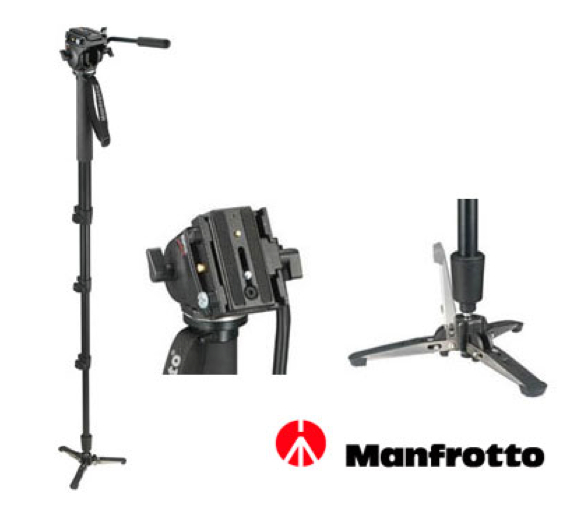
Both B Hague and SRS Microsystems are currently selling our favourite monopod for under £100 (about half price). The Manfrotto 561B is a really nice, all round monopod that has three little feet at the bottom, so it is much more stable than ordinary monopods.

We think that everyone shooting video (and most stills photographers) should have a monopod in their arsenal, because they are ideal for fast moving situations, where you might not have time to set up a tripod, put the camera on and level it. You can also use them for getting really high shots (holding them above your head if necessary - perfect for anyone doing news or red carpet events where there are a mass of other cameras between you and the subject), and you can use them as a budget stabiliser: just carrying the camera on the monopod, with the weight of the leg beneath it will give some stability to your shot. Even better, you can hold it upside down (rotating the picture in the edit), and use it for really low, ground-skimming shots.

The 561B supports up to 4kg (almost any compact camcorder or DSLR), extends up to 2m high from a minimum height of 76.5cm, and the aluminium leg telescopes in four sections. It weighs 1.91kg, and comes with a fluid tripod head with a tilt range of -60° to +90°, with counterbalance and fixed drag, plus a quick release camera plate. Having the little feet at the end also allows you to swivel it about and tilt the monopod forwards, back or side to side.

There is also a version for heavier cameras (up to 8kg), the Manfrotto 562B, although it doesn't extend as high (from 69cm to 193cm) - best price for it seems to be about £120, from several places found via  Google shopping.

By David Fox

September 27, 2010

Cartoni swings nodal head towards 3D

The "first specifically designed nodal pan and tilt professional support for 3D rigs" was launched by Cartoni at IBC.

The Lambda Twin 3D Head takes its versatile Lambda Nodal Head concept and applies it to 3D Rigs for stereoscopic parallel and beam splitter shooting styles. It can take full-sized HD cameras like the Alexa, Genesis, Red One, Epic, or F35.

It is essentially a double Lambda face-to-face, connected in the middle, featuring a U-shaped swinging platform suitable for under-slung shots supporting 3D Rigs up to 90kg, where it can allow 3D Rigs to be positioned all the way to the ground. Its design allows the optical plane to coincide with the rotation centre and the centre of gravity and it can both pan and tilt through a full 360°.
 
It has also introduced the new Airfloater (right), which can facilitate moving heavy cameras (up to 150Kg) to give realistic point-of-view style shots without putting the strain on a cameraman's back. It can simulate an active shoulder shot from a tripod or camera mount, and offers considerable freedom of movement as it can pan 360° and tilt 18° in any direction.

It has a variety of base attachments: Chapman/Whitworth bolt; four bore Vinten holes; 300mm Mitchell with castle nut; and has a quick-release base plate. It weighs 15kg and is nearly the same dimensions as a conventional fluid head (at 25cm high and 34cm wide).

By David Fox

New heads show Vision + intelligence

Vinten launched three new tripod heads at IBC, including one suitable for lightweight camcorders and HD DSLRs, plus two models for outside broadcasts and live events.

Its new Vision Blue is a budget high-performance tripod head aimed at "the lightest of camcorders and DSLRs equipped for video", and "is designed to deliver all the quality and performance users have come to expect from a Vinten Vision head," incorporating infinitely adjustable, Perfect Balance and LF drag technology. This functionality was previously only available with its more expensive Vision 3AS and above. It can carry payloads between 2.1 - 5kg -we used one at IBC with a Canon XF305, and, as you'd expect with Vinten, it was very nice.

“All professional camera operators want the same things: smooth, perfectly balanced movement, fast set-up and security against unwanted movement; and a reliable product that will provide long service,” said Peter Harman, Vinten product manager. “That is true for all our customers, but up until now there has been a gap in the market for a broadcast quality tripod system that can genuinely balance the smaller, lightly accessorised camcorders that are so common today, without any compromise on creativity."

Its new Vector 750i (pictured) blurs the distinction between Vinten and its sister company, Vinten Radamec, bringing the sort of electronic intelligence associated with VR's studio robotics to the realm of outside broadcasts and live events. The 750i is Vinten's first encoded pantographic head, and was developed with OB customers, such as SportVision in the US and Telegenic in the UK. It has a new Intelligence Module allowing semi automatic set-up, slide plate tracking and kinematic compensation, to ensure stable and precise placement of virtual graphics into a live environment.

The Vector 430 is a compact head with a very wide payload range (from 10kg to 43kg), for productions or rental companies working with multiple camera set-ups who can now use a single head when two may have been required before. It is also available with an encoder output as the Vector 430i, which can have an optional inclinometer to measure any platform movement.

"These two new Vector heads have been developed to meet real user requirements, to give them the operational flexibility they need in the studio or out on the field, and seamlessly integrate virtual reality graphics into live production," said Harman.

By David Fox

August 27, 2010

Budget buster lights and camframe

We bought a couple of little LED lights from the 7Dayshop for £20 each that are a useful addition for video or stills photography.

Lights off, F5.6, 0.3s, 400 ISO
The 64x LED Video/Camcorder and Photo Modelling Light is fairly basic - it doesn't have a dimmer (just two settings, low with 36 LEDs lit or high with all 64). It fits into a hot shoe, but does come with a handy bracket that allows you mount it off to the side of the camera (you screw it into the camera's tripod mount - especially handy on the many small camcorders that don't have hot shoes). With two you can mount them either side, which is the way we'll usually use them - typically to shoot product shots at exhibitions (which are often poorly lit with black products often displayed on a black background...). Flash guns can be too harsh, especially the camera's built-in flash.

Lights low, F5.6, 1/8th second
The little LED lights can also be overkill if you are in close, when switching to low mode is advisable. We'll put a little pouch of Half Tough Spun filter (from Lee Lighting) over each, to diffuse and soften the effect, especially necessary if shooting people. The three photos on the right are shots of Panasonic's little HDC-SD700 camcorder taken in poor light without the lights, then with them on low and on high, from about 60cm away (as ever, click pic to see full size).

Lights high, F5.6, 1/10th second
The four AA batteries should power it for two to four hours (depending on the mode used). The colour temperature is claimed to be 5,500K (which seems about right), with an output of 480 lumens. It weighs only 198 grams and is prety small, so it won't take up much space in your camera case - although you'll have to take out or reverse a battery for transport as the on/off switch is annoyingly easy to push on...

We have better, fully dimmable lights for video (such as the excellent Dedolight Ledzilla), but these are great value as a simple light for either video or stills (and having just broken a previous LED light used for stills, we needed a replacement). You can also stack several of them together to make one big panel (or pop them around a room or location for a nice moody effect - they can also mount via a standard 1/4-inch socket).

Hague DSLR Camframe

The Hague Digital SLR Camframe in the photo above (with the 7Dayshop lights and Canon EOS 7D) is another new addition to the UrbanFox.TV equipment collection (we wrote about its introduction in June). There are numerous DSLR rigs and "cages" available - almost all of them fairly expensive for what are relatively simple pieces of metal. VFGadget's new DSLR SwissCage Kit costs about $560, while the Letus DSLR Camera Cage costs $699 plus. Both are beautifully made and versatile, but the Hague Camframe does essentially the same job and cost us £65. It makes it easier to hold the camera for low shots (it has a handle at the top of the rig) and you can hold it with both hands in the driving position for fairly stable shots in more normal use.

It can also sit on a tripod and has hot shoes and mounting points for lights, a monitor (very useful if you do low angle shots) and an audio recorder. It was pretty simple to set up and get the right balance point for the 7D (you need a screw driver - or just a coin for the camera plate).

By David Fox

April 29, 2010

Bag yourself a tripod

If you shoot video on anything more professional than an iPhone, then you'll probably have a fair bit of kit to carry round, and need something to support the camera while you are shooting. Now, what if the bag you use to carry everything could also, somehow, provide the support for the camera? That's what the people at Petrol Bags thought when they came up with their new Cambio Camera Carrier/Support System, which converts from a trolley bag into a sort of tripod.

It's not Petrol's first attempt to give its bags a support function. Have a look at the Petrol Pillow Staybag, which can provide support where using a tripod isn't possible (such as strapped to a moving car, on rocks or other uneven surface) where the camera rests on a pillow of Steadi-Balls that moulds to its shape and that of the surface it's on, with straps to attach the bag to the car (or whatever).

The Cambio has an extendable centre column (up to 142cm) that is usually used as the trolley bag handle (also useful for those of us that find most trolley bag handles too short). You can screw a tripod head into the handle (using a 75mm bowl), and it will support cameras weighing up to 4.5kg, including the head (so will take most budget camcorders – up to a JVC HM700 – and any HD DSLRs)

The wheels extend to the sides, and come with integral chocks to prevent movement, and you pull out a leg from the centre of the bag to create the tripod.

The Cambio will cost $699 for the bag, or $799 for a usable system including an easily attached lightweight micro-fluid head. For the same money, you could get a pretty good, lightweight, compact three-stage tripod and a separate trolley bag, and have greater flexibility. However, the Cambio can be taken as carry-on luggage, and with the ever greater restrictions being placed on airline baggage, that could be the deciding factor.

Have a look at Petrol's video of the Cambio in action to see how it works.

By David Fox

March 27, 2010

Solo to so high

Miller Camera Support has extended its Solo DV tripod range with a new three-stage version with a 75mm bowl - we use the older two-stage version, which is a very nice tripod. The carbon fibre model has been designed with Miller's recent Compass 15 and 20 fluid heads in mind and now goes up to 187cm (plus head), to give a lens height of about 2m. It's minimum height is just 22cm (which is shown in the hands of Greg Neal, Miller's General Manager, above), and it packs small for carrying.

It retains the Solo's foam "leg warmers", which make it a lot more comfortable to carry on your shoulder (although there is also an air-cushioned carrying strap), and has rubber feet with a retractable spike. It can carry up to 20kg and needs no spreader.

By David Fox