Showing posts with label HD. Show all posts

April 14, 2015

Blackmagic Micro Studio Camera 4K

The “world’s smallest Ultra HD live studio camera”, the Blackmagic Micro Studio Camera 4K, has been launched by Blackmagic Design. The tiny Ultra HD and HD camera will be available in July for $1,295/£929/€1,545.

Although it will work at no more than 30 frames per second in Ultra HD, which would make it rather poor at capturing sports action (which is where Ultra HD will inevitably make its initial impact for live production), it would be useful for studio programmes, such as chat shows, and its combination of size, facilities and price will make it a great buy for HD production, particularly as its UHD capability should give it a longer life.

Blackmagic Ursa Mini 4.6K camera


Blackmagic Design’s new Ursa Mini is a much more compact and lighter weight version of its large Ursa Super 35 digital film camera, and should appeal to a wider range of users, with prices starting at $2,995/£2,149/€3,519 for the 4K EF-mount model. It can also come with a 4.6K image sensor, with either EF or PL lens mounts, switchable global or rolling shutter, up to 15 stops of dynamic range, a 5-inch fold out viewfinder and dual Raw and Apple ProRes recorders.

April 13, 2015

Blackmagic Micro Cinema Camera


Blackmagic Design has announced what it claims is “the world’s smallest digital film action camera.” It also boasts an “innovative remote control”. The Blackmagic Micro Cinema Camera has a Super 16mm-size sensor (12.48mm x 7.02mm) with 13 stops of dynamic range plus a new expansion port that provides access to many of the camera’s functions via widely-used wireless remote control systems, such as those for model aircraft. It will be available in July for $995/£709/€1179.

The expansion port features PWM and S.Bus connections that are used on model aircraft remote control gear for connecting to servos to control the aircraft. Such systems cost little as they are consumer hobby products and feature multiple “channels” that can be connected direct to the camera itself. These channels can be mapped to any camera or lens setting (such as iris, focus, audio levels, and start and stop recording) and then remote controlled via the radio controller. Because a standard, easy-to-solder DB-HD15 connector is used, even simple wire cables and switches can be created for controlling the cameras.

Sony HDC-4300 Ultra HD camera


Sony's new HDC-4300 system camera, aimed at sports and events broadcasting, is touted as “the world’s first camera to use three 2/3-inch 4K image sensors” [the Hitachi SK-UHD4000, which is already in use, has four sensors: one red, one blue and two green for extra sensitivity].

The HDC-4300 also offers up to 8x Super-Slow Motion in HD (at frame rates up to 479.52/400fps), which will make it a useful HD camera to have for today’s mainstream productions. It can do 50/60p in Ultra HD. Both the 4K and 8x capabilities are on a paid-for license (which can be bought on a weekly, monthly or permanent basis), so if you don’t need them from the start, you don’t need to pay for them until you do. It comes standard with 2x and 3x HD recording.

November 12, 2014

JVC's 4K GY-LS300 + GW-SP100

JVC has launched two new large sensor (Super 35mm) Ultra HD cameras with interchangeable Micro Four Thirds lens mounts. The GY-LS300 camcorder (pictured below), and the GW-SP100 miniature camera (above) and separate recording system, are part of its new range of 4Kcam camcorders. The other two (the live streaming GY-HM200 and compact GY-HM170) use smaller 1/2.3-inch sensors.


JVC's GY-HM200 + GY-HM170 4Kcam compact UHD camcorders

JVC Professional has launched its new 4Kcam (Ultra HD) product line, including two new large sensor cameras (the GY-LS300 and GW-SP100 - dealt with elsewhere), and two smaller models: the GY-HM200, which includes HD streaming and an SDI output; and the compact GY-HM170. All four should arrive early in 2015.

The GY-HM200 (pictured above) and GY-HM170 are essentially the same, but the HM200 will be the one to choose if you need to deliver breaking stories for broadcast or the web via WiFi, internet or mobile (3G or 4G) connections, or if you are working with other (SDI-based) broadcast equipment.

September 07, 2014

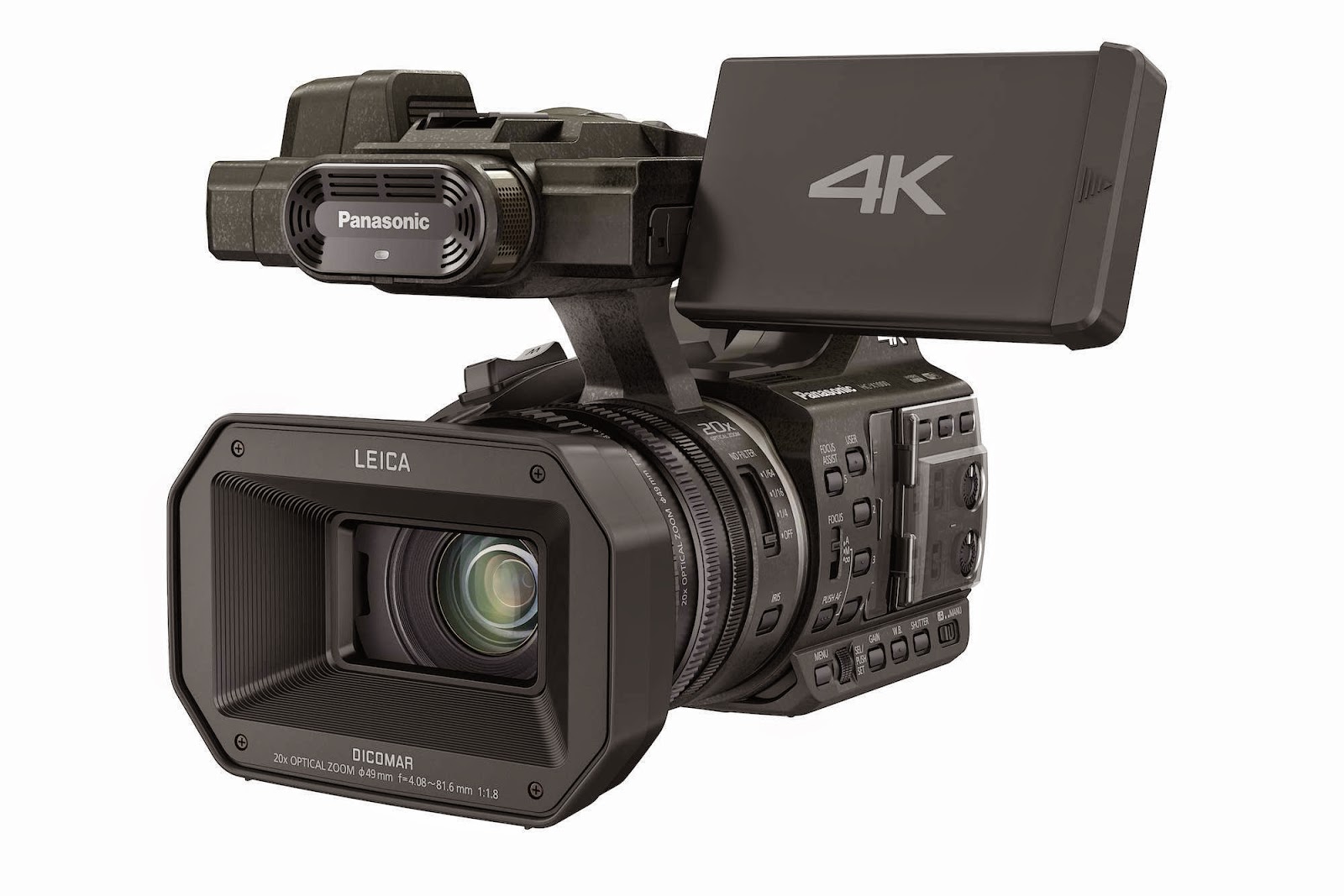
Panasonic HC-X1000 4K camcorder

Panasonic’s new HC-X1000 Ultra HD 4K camcorder is its first prosumer model that can record 4K 60p/50p video on an SD card.

It can record both UHD (3840x2160) at 50/60p and Cinema 4K (4096x2160) at 24p in MP4 at up to 150Mbps (50/60p) or 100Mbps (24p), plus .mov or MP4 in HD, which can use all-Intra compression for a maximum bit rate of 200Mbps, as well as AVCHD (1080p) at up to 28Mbps. Even if you are shooting for HD, recording in Ultra HD can be useful during editing, as you can then zoom in to a one-quarter crop without losing any HD resolution, or pan across the picture to follow movement.

April 07, 2014

Panasonic VariCam 4K + high speed


Panasonic has launched two new VariCam models: the VariCam 35 (shooting 4K Raw) and the high-speed (HD) VariCam HS.

The PL-mount VariCam 35 (AU-V35C1) uses a newly-developed super 35mm MOS image sensor (4096x2160 - 17:9) and can shoot 4K, UHD, 2K and HD, making it suitable for high-end filmmaking, commercials and episodic production as well as live 4K events.

April 08, 2013

Sony PMW-400 XAVC camcorder

Sony gave its XAVC codec another boost at NAB in Las Vegas with the introduction of a new broadcast camcorder that supports it. It also extended XAVC downwards for prosumer and consumer users. In other news, Sony also introduced a new studio/OB camera.

The new PMW-400 shoulder-mount camcorder (pictured above) is an “affordable” broadcast camera with three 2/3-inch high quality Exmor CMOS sensors – boasting good low-light sensitivity of F12 at 59.94Hz and F13 at 50Hz.

March 25, 2013

Bradley Eybe mini remote camera


Bradley Engineering is introducing a new integrated mini camera, The Eybe, at NAB that should ship in May, with orders already in from broadcasters in the US and Britain who were involved in its development.

March 18, 2013

Datavideo MS-3000 production unit


A new, low-cost modular production unit that can be used as a flyaway or be quickly fitted in a van has been unveiled by Datavideo. The MS-3000 Portable Production Unit will cost from about £12,000-13,000 for a full, turnkey system.

It sold the first one at BVE for live events production with eight cameras, and the system will be available as a completely customisable package, including free fitting of equipment a buyer already has, according to Allan Leonhardsen (pictured), sales and marketing director of Holdan, the Datavideo distributor, which will assemble the unit at its UK facility.

The PPU is based around the SE-3000 8- or 16-channel 2M/E broadcast vision mixer (which costs from about £9,000 and has two mix/effects channels, full 3D effects, transitions, picture-in-picture and sophisticated keying, including chromakey effects), and will almost certainly include talkback, hard disk recorders, vectorscope and waveform monitors, and power distribution sensors.

It is designed to be easy to install in a small van or temporary studio. As a single cased unit, running on caster wheels, it can be rolled in to place to provide instant television and AV facilities.

“We want it to be that you turn up, plug it in, and be live in seconds,” explained Leonhardsen. “We’re not using systems like embedded computers that take a long time to boot up. We want to make sure that if you lose power, you are back on line in five to ten seconds, maximum. It’s very much aimed at the live market, or anyone who wants stability.”

Holdan hopes to create set configurations, to make it easy for customers to specify and check price points, and talked to prospective users at BVE to find out what they’d need in such a package (one item being coffee cup holders – so users are less likely to spill drinks on it), but he expects that almost everyone will want to choose their own configuration. As it will be created from a kit of modules, it will be possible to keep prices low despite the customisation.

“We can create integrated solutions but we don’t believe in it,” he added. “We don’t want it to happen that one item goes down and the whole system goes down, which is why we are using independent modules. We believe in stability and non-embedded functionality, so that independent items do independent jobs. If a hard disk recorder goes down, you can simply replace it rather than sending the whole thing back.”

Although Datavideo manufactures all the items, customers won’t have to specify them and can have a unit from another manufacturer fitted instead.

At BVE it showed a flyaway-style configuration with two 17-inch LED HD monitors, the SE-3000 switcher, dual-screen vectorscope test devices, a 16-way intercom, audio mixer and hard disk recorders. Units for live encoding, real-time graphics or additional media playout facilities can simply be inserted into the rack enclosure. Power for the PPU is supplied by a Datavideo central distribution system, which operates from 110-260v. This can have power outlets on the back for the cameras, tally, talkback and prompter (through a single multicore cable), and can be fitted with up to three redundant power supplies.

For use in a van, it has a system that clicks into the normal seating rail system, so that a people carrier can be turned into an OB van (and back) in about ten minutes – it has already used this system for a few vans in Europe and the Far East, which Leonhardsen sees as being ideal where an OB van is only needed occasionally, or to allow the system to be moved between studio and OB use.

Holdan has put up a video of the Datavideo equipment, in the Mercedes Sprinter van shown at BVE (and seen in the background of the first photo), giving more details on its benefits and how it works.


Studio in a briefcase

Also new at BVE was the Datavideo HS-2800 portable integrated production studio (pictured). The briefcase-style HD production switcher can be up and running on location in a matter of minutes, and has eight digital inputs, a built-in multi-view video monitor and 10-bit video support.

It supports multi-camera shoots, blending video sources, audio feeds, logos and graphics, and is designed for small-scale live production, or AV use for events or corporate production.

“With HD-SD conversion, downstream keying and dual picture-in-picture functionality, producers can deliver very polished TV for multiple audiences,” said Leonhardsen.

Features include high-quality digital video effects, multiple XLR inputs, a 17.3-inch monitor to display input sources, programme preview and the live programme, and an eight-way intercom system complete with headsets and tally lights.

By David Fox


March 13, 2013

JVC GY-HM70 shoulder camera


The new JVC GY-HM70 AVCHD camera should be of interest to many of our readers, as our now-ancient (October 2010) post on AVCHD shoulder mounted camcorders is our most popular ever…

The GY-HM70 will ship in May, and has a list price of $1,995 (apparently the UK street price is likely to be under £1,200), and some nice features, even if it doesn’t have XLR audio input.

It is designed principally for event production, and to make it useful for covering long-form events, such as weddings or conferences, it has hot-swappable batteries (pictured below - a first in this price bracket), so you can keep shooting continuously, without interruption. 

Being shoulder-mounted, it should also be a lot more comfortable for long-term use than more compact cameras (although it isn’t particularly big), and is reasonably light, weighing about 3kg (6.7lb) with one battery attached.

It can record 1920x1080 HD at up to 50p or 60p in AVCHD Progressive, to dual SDHC/SDXC memory cards (Class 4/6/10) at up to 28Mbps. It will also shoot at 250 frames per second at 720x576 (for 50Hz/Pal production) or 300fps at 720x480 (for 60Hz/NTSC countries), and offers 50/60i shooting or SD at lower bit rates. 

Interval recording in steps from one second up to 80 seconds is also an option, as are still images at up to 4000x3000-pixel resolution. Stills in 12Megapixel can be shot at the same time as video or stills can be shot at 2Megapixel resolution.

The camera should also be pretty useful in low light. It uses JVC's Super LoLux technology to enhance image quality and offer more accurate colour capture indoors or in dark situations (there is a minimum illumination of 1lux, which is certainly good, but hardly exceptional).

The F1.2-F5.6 GT Lens has a 10x optical zoom, plus a 16x “dynamic zoom” that only works with the optical image stabilisation turned off and makes use of the overabundance of pixels on the sensor by reducing from 5.4Mpixels to 2.07Mpixels (there is also a 200x digital zoom). 

The lens delivers a not-particularly wide wide-angle of 29.5mm – to 476mm if dynamic zoom used (35mm-equivalent), and was developed specifically for the 1/2.3-inch 12Megapixel back-illuminated CMOS sensor (apparently the same sensor used in JVC’s GY-HMQ10 small 4K handheld camcorder), which is claimed to deliver “high resolution, high sensitivity, and excellent colour reproduction.”

The camera features manual or auto focus (with focus assist), manual iris and shutter, manual or automatic white balance, and optical image stabilization.

There is a 3-inch 16:9 230K-pixel Touch Screen LCD display plus a 0.24-inch LCOS 16:9 260K-pixel colour viewfinder; an internal stereo microphone (plus a mini-jack microphone input); remote-control input; while outputs include an HDMI Mini connector and RCA video and audio ports. It comes with an AC adapter (AP-V20); battery pack (BN-VF823); composite/audio cable (RCA x 3) and USB cable.


By David Fox

BBC buys 500+ GY-HM650 cameras


JVC has recently made a big breakthrough in broadcast news use with the order of more than 500 units of its GY-HM650 ProHD network-enabled camcorder by BBC News for use in newsgathering throughout the UK and globally.

The lightweight cameras record HD or SD in multiple file formats, including native XDCAM EX (.MP4), Final Cut Pro (.MOV), and AVCHD, to SD cards. The 650 also supports MXF files for metadata.

One of its advantages for news is that it has dual codecs, so that it can record full HD files on one memory card, while simultaneously creating smaller, web-friendly files (1/4 HD or SD) on a second card. It also has built-in FTP client and network connectivity, so that it can deliver the footage back to a station without a microwave or satellite connection (all it requires is a WiFi connection or mobile broadband).

It has a secure web server built-in, to allow you to take full control of the camera – including zoom, Rec start/stop and metadata editing – via any browser-enabled device such as an iPad or smart phone.

Other features include: three, 1/3-inch 12-bit CMOS sensors, each with 1920x1080 pixels; a 29mm-667mm (35mm equivalent) Fujinon 23x autofocus zoom lens with optical image stabilizer; manual focus, zoom and iris rings, plus three ND filters; auto-focus with face detection; good low-light performance (F12 at 2000 lux in extended mode); a 1.22MP colour viewfinder and 3.5-inch LCD; a second trigger and servo zoom control on the built-in handle to make it easy to record while holding the cameras at low or high angles; Pre Rec to continuously record and store up to 15 seconds of footage in cache memory to help prevent missed shots of breaking events; built-in stereo microphone plus two XLR inputs with phantom power; separate input for a wireless mic receiver; LANC remote connector; time-code synchronization input; plus HD-SDI and HDMI outputs. It also has Flash Band Correction, to avoid rolling shutter problems if you shoot an event there are flash guns going off.

The camera has been tested by Alan Roberts (whose reports are always worth reading) and met the EBU’s criteria under EBU Tech 3335 for journalism use (Tier 2J), and will also meet the requirements for general long form HD programming (Tier 2L), when used with a suitable external recording device supporting 50Mbps or greater recording (it records up to 35Mbps internally).

By David Fox

March 11, 2013

New slomo PoV with Polecam + Pico


High-speed cameras are small enough now to be usable on a hand-holdable jib arm, such as the lightweight Polecam, for use in places and ways they couldn’t have been previously.

The LMC Antelope Pico Point-of-View camera is particularly suitable for live sports production, and has been used for the German Bundesliga and Winter sports – a Pico was used on a white Polecam (to disappear into the background) at the start gates at the Alpine Skiing World Championship in Schladming. Polecam’s Founder, Steffan Hewitt (pictured above at BVE), also recently used the Pico in China, to cover the Rory McIlroy/Tiger Woods Duel at the Jinsha Lake Golf Club in Hengzhou.

“We had a full-size Polecam, with the Pico, and a Telecast Fiber PoV system – because the distance between the holes and the truck was kilometres, so we had to use fibre,” he explained.

The camera was primarily used above the players as they tee’d off, for slow-motion shots showing how their swings differed, for replay analysis. Because the system was so light, Hewitt, who was on his own, was able to just jump in a golf buggy between holes.

The Pico, which can deliver up to 340 frames per second from its 2/3-inch sensor, “worked great. It looked really good,” said Hewitt. “It’s the only really small high-speed camera that I know of.”

As it was on the Polecam, he could drop it right to the level of the green, where it was possible to see all the undulations that aren’t evident at normal camera height.

The current version of the Pico works with a pair of cables, but the next one will just require a single coax cable between the camera head and the CCU. “This will allow us to have much greater distances between the two, and use a longer Polecam,” he explained.

It will also be able to do live broadcast HD as well as slo-mo at the same time, so you can continue shooting HD while the high-speed shots are being cached for replay (which the current version can’t do), making it a much more practical proposition. “The new Pico will genuinely be live friendly.”

Given these developments, which should emerge at NAB in April, “I’m really excited about doing the high-speed stuff,” he added.

The slightly larger Phantom Miro slo-mo camera, from Vision Research, can also work on the Polecam (Vision Research were showing just such a package at BVE - pictured above), but it can’t be used as a direct feed for live production, although it does go up to 1,500fps.

Using the Polecam, operators can position the camera in places it wouldn’t normally be easy to go, such as over water, into a bird’s nest or in dangerous areas, to get close to the action.

One Polecam, being used with a Pico to cover a Bundesliga match, got closer to the action than it should have. During the warm up, the operator was rehearsing a shot above the goal, when one of the players used it for target practice, hitting it straight at the camera in beautiful slow motion.

“It completely bent the head in half. It cost £2,500 to completely rebuild the head, mainly with new parts,” said Hewitt.

By David Fox

February 22, 2013

Antelope slows down skiing + golf


LMC LiveMotionConcept supplied multiple Antelope UltraSlowMotion systems plus various analysis tools for the Austrian broadcaster ORF for the Alpine Skiing World Championships in Schladming. It also supplied a wireless slo-mo system for the recent Ladies Masters European golf.

In Austria, it supplied the host broadcaster with two mobile production vehicles, one of which had two Antelope MkIIs UltraSlowMotion systems and one Pico PoV UltraSlowMotion on board.

The MkIIs systems were moved between the men’s and women’s slopes every day with the help of helicopters. During the event they recorded at up to 2,500 frames per second. Thanks to the new enhanced detail function, which is implemented in the latest version of the MkIIs CCU, it was possible to show even little details of the action during each skier’s run.

The Antelope Pico (pictured above) was mounted in the middle of the main grandstand to record crowd reaction at up to 340fps. This was the first time at a major FIS skiing event that this sort of emotional replay was shot at high speed.

A brand new version of the Pico will be available just before NAB. It’s based on an improved 2K high-speed chip and supplies live video output in all HD formats plus a de-flickered replay channel with up to 340fps.

LMC also supplied a special Antelope replay feed, which was delivered to the “ORF House” in Schladming using Riedel Communications’ MediorNet real-time fibre network. A huge LED Cinemascope display was used to show this impressive replay feed to spectators at the championships throughout the day.

The second LMC vehicle was in charge of the analytical content for the world feed and ORF’s national programme.

LMC supplied a Dartfish system to record the clean world feed, plus feeds of three isolated analysis cameras, to produce analysis clips as either Simulcam (where the races of two individual competitors are composited together to compare them side by side) or Stromotion (where a skier’s progress is seen as a sequence of stills composited together). The isolated camera feeds were pre-cut on a LGZ Replay System.

The finished analysis sequences were clipped on an EVS XT2HD system and played out both into the national ORF outside broadcast truck and into the two international OB trucks for the women’s and the men’s world feed signals.

LMC also installed a Paint Touchscreen in the ORF studio. Its switchable input gave the studio experts an opportunity to graphically enhance their in-depth analysis and actively step in and show where a split of a second might make a difference.

Ladies Masters on AIR

LMC also recently deployed an Antelope AIR for the second time at the Ladies European Tour golf finals in Dubai. The Omega Ladies Masters is the grand finale of the busy LET season.

LMC's CEO Felix Marggraff, who is also the Ladies European Tour TV director, used the Antelope AIR not just as a live replay camera but also to record graphic backgrounds or even to shoot features with the players.

“The Antelope AIR is a great camera to show not just technical aspects but also the beauty of the sports” said Dirk Glittenberg, CEO of U.COM Media, the production company in charge of all LET media coverage.

The Antelope AIR is the wireless version of the MkIIs and fully remote-controllable. Both HD-SDI video and full telemetry are received and operated from the TV compound. The camera operator has full freedom on the golf course and can concentrate on the images.

“It’s great that our cameraman does not have to fiddle around with triggering, shading or any other technical stuff,” said Marggraff, who has directed the live and highlight coverage for LET since 2009.

The Antelope AIR includes all the functions of the MkIIs, such as enhanced detail, multi matrix, de-flickering and intuitive remote and operating controllers.

The World Feed Live Production of the 2013 season will start at the South African Woman’s Open on 19April.

Related posts: Fan riot destroys 1st Antelope camera, Tiny HD camera blends in and World first ultra-slowmo PoV camera

By David Fox

October 30, 2012

Sony PMW-F5 + F55 4K cameras


Sony has announced two new 4K cameras (the PMW-F5 and PMW-F55), plus the impending arrival of the 4K upgrade for the NEX-FS700, as it begins to get serious about moving beyond HD. The new cameras will use a new codec: XAVC. All the cameras use single Super35-sized CMOS sensors.

Sony started its move into 4K (4096x2160 pixels) with the F65 last year, and now has a range of 4K-capable equipment, including domestic and professional LCD and projector displays.

The high-end F65 is well regarded in the film industry, and the camera has been used on such movies as Oblivion and After Earth.

In fact, the F65 is now going beyond 4K, following its version 3.0 upgrade it will also be able to shoot 6K and 8K Raw (it uses a full 8K/20-megapixel sensor). It will also be able to shoot at up to 120 frames per second in 8K. It can be fitted with a new 0.7-inch OLED viewfinder (the first such for this type of camera), and has received several other film-related additions, such as anamorphic lens support.

However, as the F65 moves even further upmarket, the F55 and F5 should slot seamlessly in underneath it.

Open codec architecture

The cameras will support four codecs: XAVC, for high frame rates and 4K, MPEG2 at 50Mbps, MPEG4 SStP (Sony’s SR Master codec) and Raw 4K “by the switch of a button, depending on what job you want to do,” said Olivier Bovis, Sony’s Head of AV Media.

The F5 and F55 will need the new AXS-R5 recorder for Raw, but everything else will be recorded internally on a new, faster, memory card: SxS Pro+, which will support higher frame rates and bit rates – it is about 20/30% faster than an SxS Pro card at writing/reading and comes in 64GB and 128GB versions.

The F55 will be able to simultaneously record both MPEG2 50Mbps and XAVC 4K to the same SxS Pro+ card, which means you can have a readily usable 50Mbps version for offline editing in a 4K production, or just hold an archive of 4K shots for the future while shooting for today’s broadcast standards. You should also be able to record Raw 4K at the same time to the R5 recorder.

Internally, the F55 will be able to record HD (1920x1080), 2K (2048x1080), QFHD (Quad Full HD - 3840x2160), and 4K, while the F5 will be limited to 2K and HD, but once you add the R5 both will record Raw 4K and higher frame rates.

The F55 “has a very wide colour gamut [same as the F65] and high frame rates: up to 180fps in 4K and up to 240fps in HD,” said Bovis. It also has a Global Shutter to avoid any rolling shutter skew effect or flash banding. The F5 will shoot at up to 120fps in HD. The F65 can shoot at up to 180fps at 4K and up to 240fps in 2K Raw.

The cameras are promised to offer a wide dynamic range (14 stops), high sensitivity, and low noise.

Viewfinders + monitors

Thanks to a new digital interface, the PMW-F5 and F55 will also be able to use the new DVF-EL100 1280x720 OLED viewfinder. There is also a new 3.5-inch 960x540-pixel LCD viewfinder (DVF-L350), offering 10x the contrast of previous Sony LCD viewfinders plus a flip-up eyepiece for direct monitoring, and a 7-inch 1920x1080 LCD on-camera monitor (DVF-L700).

The PMW-F55 can also connect to Sony’s new 4K 30-inch 10-bit LCD monitor (PVM-X300) for on-set monitoring, dailies and editing using four 3G-SDI interfaces to monitor pictures at 4096x2160 resolution at up to 60p while recording and playing back XAVC 4K images. It can also be connected directly to the 84-inch BRAVIA 4K LED TV for monitoring, but at a resized horizontal resolution of 3860 pixels.

Batteries + rigs

The F5 and F55 also use compact new Olivine (Lithium Iron Phosphate) batteries that promise twice the lifetime of conventional Lithium Ion cathodes and provide an hour of power for Raw recording when using the R5 with either the F5/F55 (Raw is more power hungry than the other codecs). There is also a new 2x faster battery charger.

The cameras will also have a new shoulder rig, “so you can easily use it shoulder mounted. It’s very modular in how you want to use it,” said Bovis.

PL-mount lenses

The F55 and F5 cameras come with a PL lens mount, for use with high-end cine-style lenses, but Sony is also launching six new CineAlta T2.0 PL-mount lenses for the cameras (20, 25, 35, 50, 85 and 135mm).

Each is certified for 4K and is designed to minimize geometric distortion, vignetting and breathing. A 9-blade iris should deliver pleasing bokeh (out-of-focus effects), and the focus rings rotate 240°. For easy lens changes, each has the same external diameter, matte box diameter, and gear locations for follow focus and aperture. All are the same lenght except for the 135mm. 

The cameras are fitted with a native FZ mount (but the PL-mount adaptor is supplied), so users will also be able to fit other adaptors for Canon EF, Canon FD, Nikon DX, Nikon G, Leica M and even 2/3-inch B4 lenses.

Availability

The F5, F55, F65 upgrade, and lenses should be available by the end of January, but 2K and QFHD recording for the PMW-F55 and 2K for the PMW-F5 will be available through a firmware upgrade. Frame rates higher than 60fps will also require a firmware upgrade.

Prices should be announced in November.

NEX-FS700 + HXR-1FR5

At its introduction, last April, Sony promised that the NEX-FS700 would be able to record 4K, and soon it will, using the new HXR-1FR5 interface unit, which has 3G HD-SDI input, to deliver Raw data, and the new AXS-R5 recording unit – which uses a new generation of Access Memory Card with 512GB of storage. It will also require a firmware upgrade.

Although the FS700 can already record high frame rates in HD, it won’t have that feature in 4K, where the available frame rates will be 23.98p, 25p, 29.97p, 50p and 59.94p.

The HXR-IFR5 and firmware upgrade should be available between April and June 2013.

By David Fox