Showing posts with label CMOS. Show all posts

November 12, 2014

JVC's 4K GY-LS300 + GW-SP100

JVC has launched two new large sensor (Super 35mm) Ultra HD cameras with interchangeable Micro Four Thirds lens mounts. The GY-LS300 camcorder (pictured below), and the GW-SP100 miniature camera (above) and separate recording system, are part of its new range of 4Kcam camcorders. The other two (the live streaming GY-HM200 and compact GY-HM170) use smaller 1/2.3-inch sensors.


JVC's GY-HM200 + GY-HM170 4Kcam compact UHD camcorders

JVC Professional has launched its new 4Kcam (Ultra HD) product line, including two new large sensor cameras (the GY-LS300 and GW-SP100 - dealt with elsewhere), and two smaller models: the GY-HM200, which includes HD streaming and an SDI output; and the compact GY-HM170. All four should arrive early in 2015.

The GY-HM200 (pictured above) and GY-HM170 are essentially the same, but the HM200 will be the one to choose if you need to deliver breaking stories for broadcast or the web via WiFi, internet or mobile (3G or 4G) connections, or if you are working with other (SDI-based) broadcast equipment.

September 07, 2014

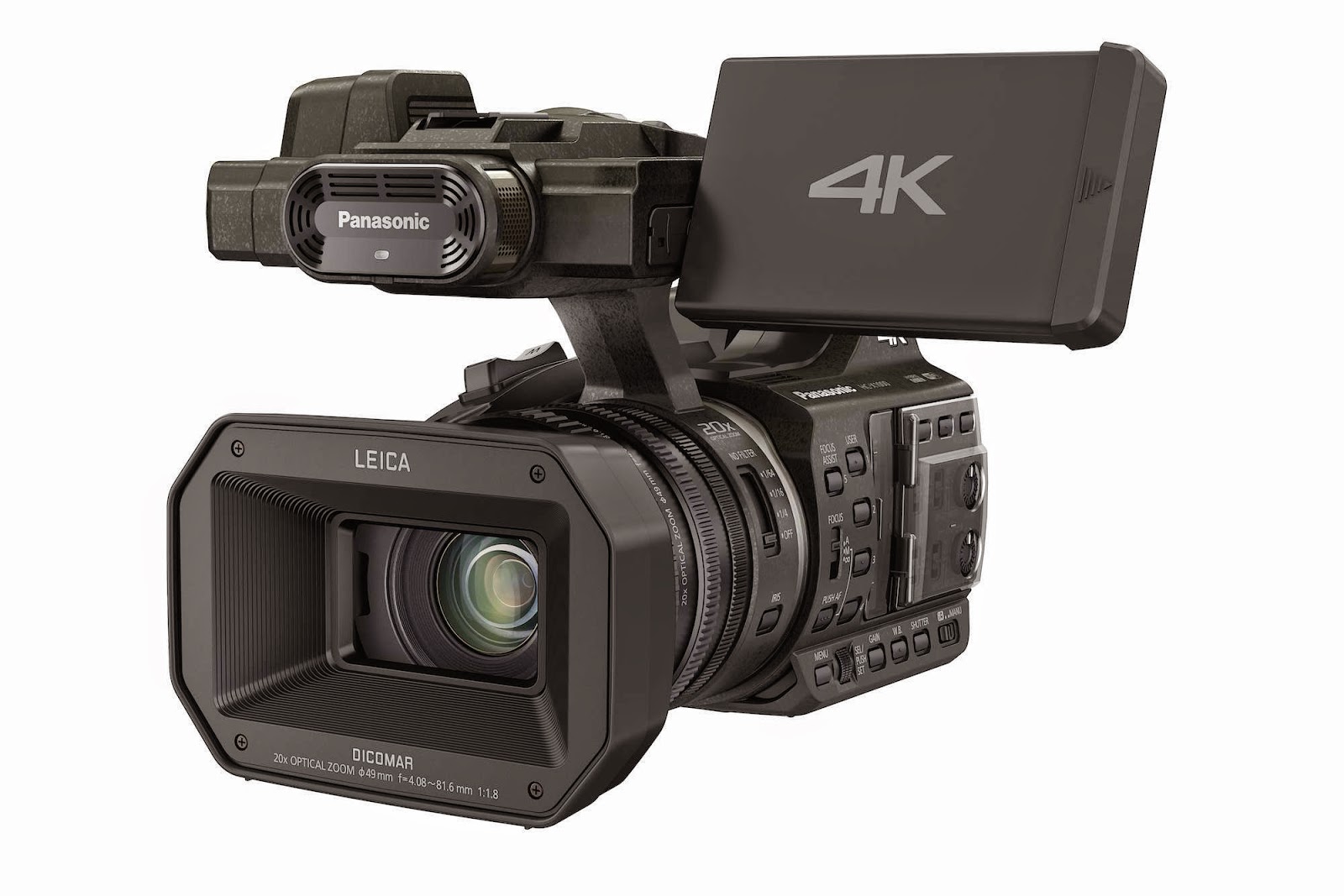
Panasonic HC-X1000 4K camcorder

Panasonic’s new HC-X1000 Ultra HD 4K camcorder is its first prosumer model that can record 4K 60p/50p video on an SD card.

It can record both UHD (3840x2160) at 50/60p and Cinema 4K (4096x2160) at 24p in MP4 at up to 150Mbps (50/60p) or 100Mbps (24p), plus .mov or MP4 in HD, which can use all-Intra compression for a maximum bit rate of 200Mbps, as well as AVCHD (1080p) at up to 28Mbps. Even if you are shooting for HD, recording in Ultra HD can be useful during editing, as you can then zoom in to a one-quarter crop without losing any HD resolution, or pan across the picture to follow movement.

April 07, 2014

Panasonic VariCam 4K + high speed


Panasonic has launched two new VariCam models: the VariCam 35 (shooting 4K Raw) and the high-speed (HD) VariCam HS.

The PL-mount VariCam 35 (AU-V35C1) uses a newly-developed super 35mm MOS image sensor (4096x2160 - 17:9) and can shoot 4K, UHD, 2K and HD, making it suitable for high-end filmmaking, commercials and episodic production as well as live 4K events.

March 25, 2013

Bradley Eybe mini remote camera


Bradley Engineering is introducing a new integrated mini camera, The Eybe, at NAB that should ship in May, with orders already in from broadcasters in the US and Britain who were involved in its development.

August 17, 2012

Sony NEX-EA50 NXCAM camcorder

Sony’s new NEX-EA50 answers a demand that many camcorder users have for a large-sensor, low(ish)-cost camcorder you can use on your shoulder without having to buy some sort of rig. Certainly, our most popular post ever is one from two years ago on Shoulder-mounted AVCHD cameras – which is exactly what this is…


As the newest addition to the NXCAM range, the NEX-EA50 has a new form factor that should be more comfortable to hold however you like to shoot.

When its shoulder pad is extended, the camcorder can be balanced on the shoulder for extra stability, making it a lot easier to hold for long shooting times. When the shoulder pad is in its original position, the camcorder is compact enough for any style of handheld use.

Many of its specifications seem similar to the NEX-FS100, but it doesn't appear to use the same sensor. The camcorder, due to ship in October, features a large format sensor, E-mount lens system, shooting Full HD movies (and high-quality still photos), but is promised to meet a “more affordable price point than ever before” - about £2,700 - Creative Video has it for £2,499 + VAT, which is less than €3,200/$4,000.

The Exmor APS-C/Super35mm-sized HD CMOS sensor is claimed to offer low noise and high sensitivity in low light conditions. It also enables 1080 progressive and interlace recording with 50/60Hz selection at 50p/25p/50i or 60p/30p/24p/60i. It records AVCHD 4:2:0 at up to 28Mbps. It can also record standard definition MPEG-2.

“This all-in-one camcorder brings a new level of creativity to a wider range of professional users than ever before,” said Bill Drummond, Sony Europe. “It combines affordability and high performance with a range of versatile, professional features for many applications, including event production, budget movie making and corporate production.”

It will capture 16.1 megapixel still pictures and has a built-in mechanical shutter so it can deliver high shutter speeds while capturing stills.

The camera can be used with any Sony E-mount lens, which enables auto focus, auto exposure and stabilisation during shooting. It has a short flange back distance, so it is possible to attach Sony A-mount lenses via the LA-EA2 lens mount adapter, or a wide range of other manufacturer’s lenses using third-party adapters.

The NEX-EA50 comes with the newly developed Power Zoom E-mount lens E PZ 18-200mm F3.5-6.3 OSS SELP18200. The 11x zoom includes auto focus, continuous variable iris and Optical Steady Shot image stabilisation with Active Mode, which should give a more stable shot.

The lens is electronically controlled via either the zoom rocker lever on the camcorder grip or the top handle, offering either a constant zoom speed or smooth, slow zoom.

Other camera functions include: two-channel XLR audio (an ECM-XM1 Shotgun microphone is included with the NEX-EA50H); Linear PCM audio; time code; user bit; built-in GPS; six assignable buttons; HDMI Type A, component (3xRCA) and A/V (RCA) outputs; 3.5-inch 1920x480 LCD; and Face Detection autofocus.

For recording, Sony’s HXR-FMU128 (128GB) flash memory unit (which costs about £600/€750/$1000) can dock directly to the camcorder for simultaneous backup recording. The camcorder is also compatible with Sony’s new Mirroring Memory Stick (MS-PX64/32/16), the world’s first memory card with mirroring. This enables the card to deliver higher reliability and data security through a dual recording (mirroring) function. The PX Series cards will be available from September, in 16GB, 32GB and 64GB versions. It can also record to SD cards.

By David Fox

July 26, 2012

Sony PMW-200 XDCAM camcorder

Many fans of Sony’s venerable PMW-EX1R looked at the introduction of the 50Mbps single-sensor PMW-100 and wondered when Sony would bring 50Mbps recording to their camera. Well, now it has… mostly. The new PMW-200 does have three half-inch Exmor CMOS sensors and full HD 4:2:2 5 50Mbps recording (as required by pretty much every broadcaster as the minimum bitrate for HD), but the form factor familiar to EX1 users has changed slightly. The PMW-200 is a somewhat more compact body, similar to the PMW-100, so it could take a little time to get used to new ergonomics.

Sony has taken a long time to offer 50Mbps in a decent lower-budget camera. Canon’s XF300/XF305 and Panasonic’s AG-HPX250 have had the field to themselves for a long time. It has meant that EX1 users have had to fit external recorders if they were shooting for broadcast. However, both the XF300/XF305 and the HPX250 use 1/3-inch sensors, but some broadcasters, such as Sky, believe half-inch chips are the minimum standard for HD (they often also ask for 100Mbps recording, so it may not be the end for all external recorders). The half-inch sensors should also deliver better low-light performance than their smaller rivals. Of course, if you already own an EX1R and an external recorder, the PMW-200 is not so much an improvement as a potential B-camera.

The XF range is currently the most popular for low-budget broadcast work, not just because it meets most broadcasters’ requirements, but also due to it using low-cost Compact Flash cards. The HPX250 uses Panasonic’s more expensive P2 cards, while the PMW-200 will primarily use SxS cards, which are only slightly cheaper than P2 – although at least the PMW-200 offers the option of using lower-cost SD, Memory Stick and XQD cards using an adaptor.

Besides 50Mbps, Sony covers all the legacy formats it is famous for, including 35Mbps MXF, 35Mbps/25Mbps MP4 and DVCAM. So if you still occasionally have to work in a Standard Definition environment and can’t edit in HD before outputting SD, then you are covered. Unfortunately, this flexibility uncovers one of the bugbears we’ve found using the PMW-100 – having to choose to format the cards using either UDF or FAT. Unhelpfully, the PMW-100 manual didn’t explain why you’d want to do that, so we had to work it out. If you want to record in 50Mbps (HD422) or 35Mbps (HQ), you have to choose UDF. You can’t record 50Mbps in FAT, but you can record 35Mbps (HQ) or 25Mbps (SP). It’s something you shouldn’t have to think about, but you do….

There is a slip-ring on the lens to switch between 
auto-focus (AF/MF - above) and full manual focus (below) 

Zoom lens: While the PMW-100 has a not-particularly-wide 10x zoom lens, the PMW-200 has a much better Fujinon 14x zoom, that goes from a very-nearly-wide 31.5mm to 440mm (35mm equivalent). You’ll still probably want a wide-angle adaptor for it, but you’ll probably only really need it in confined spaces.

The lens has three independent rings for zoom, focus and iris adjustment, plus greater precision through indications of ring positions on the 3.5-inch (852x480) LCD screen.

Recording: It has some frame rate flexibility with its Slow and Quick motion function which goes from one to 30 frames per second in 1080p, or 1fps to 60fps in 720p mode (but only if recording to an SxS Pro or SxS-1 card – and you can immediately play it back without using an external converter or processing on your editing system.

Most new professional camcorders now have cache record, which continually buffers what you are pointing at in its memory, but the PMW-200’s is longer than most at 15 seconds, which it will then write to your card once the record button is pressed, which is great for news or reality programmes – although it does assume you have the camera switched on eating battery power…

Other features: genlock and timecode interfaces for multi-camera operations; four-channel 24-bit Linear PCM 48kHz audio; dual XLR audio inputs; dual card slots; two ND filters (1/8ND and 1/64ND); optical SteadyShot; shutter angle as well as shutter speed settings; HD/SD-SDI, HDMI USB and iLink (IEEE1394 – HDV and DV) interfaces; five assign buttons.

Price/Availability: The PMW-200 weighs about 2.3kg (plus battery and cards, etc) and should be available from mid-September. There was no price in the press release, but CVP had it for pre-order at £5,160.00 + VAT (€6,580 or under $8,000 - essentially the same list prices as the EX1R is now).

There will also be a WiFi remote control from an iPad, iPhone or Android device (adaptor CBK-WA01 required), which is scheduled to be available by December with a free firmware upgrade (workflow above), including the ability to add metadata as used in Sony's successful XMPilot workflow.

“With the new PMW-200, we are putting one of the most versatile handheld camcorders we’ve ever developed onto the market,” said Bill Drummond, Strategic Marketing Manager, Professional Solutions, Sony Europe.

“The PMW-200 combines exceptional picture quality, seamless HD422 50Mbps workflow and a whole host of other useful features, with an ergonomic form factor. The result for users is an agile, lightweight solution that meets their varied needs and is the perfect partner for shoulder camcorders such as the popular PMW-500. It is also the ideal A-camera in its own right for HD broadcast production.”

Freelance cameraman, Alister Chapman, has done a good video overview of the PMW-200 and runs through the new features and how they can be used:


By David Fox

April 03, 2012

New Sony NEX-FS700 4K camcorder

Sony has unveiled a new higher-resolution, higher framerate camcorder for about £6,000/$8,000/€7,500 + tax (or about a thousand more with 18-200mm lens). 

The NEX-FS700 will record full HD at up to 200 (50Hz) or 240 (60Hz) frames per second for 4x or 10x slow motion (depending on your base rate) and will eventually be able to record 4K (with a firmware upgrade and on an external recorder).

The FS700 improves in several ways on the existing NEX-FS100, and compares favourably with JVC’s new small-sensor 4K GY-HMQ10 camcorder (although the FS700 is about twice the price).

It has a Super 35mm (APS-C sized) CMOS sensor using a new 4K Exmor design with 11.6 million pixels (which can also be used for stills). It also has 3G HD-SDI output (which allows it record 4K externally) and built-in ND filters (unlike the FS100). There are also more creative options and shooting styles, as well as enhanced ergonomics, based on customer feedback.

“The NEX-FS700 opens the door to a new world of creative shooting,” said Bill Drummond, Strategic Marketing Manager, Sony Europe. “You can record beautiful high speed Full-HD movies with the freedom of choosing interchangeable lenses. The NEX-FS700, with its super slow motion mode, is ideal for pop promos, commercials and documentaries as well as sports and a variety of events productions.”

It doesn’t look like it will have the creative control of the PMW-F3, but the higher frame rates and/or resolution will probably make it more useful for many types of production – although once you factor in the cost of an external recorder, it may not be that much cheaper than the F3.

The it can deliver HD at 100/120 and 200/240 frames per second in bursts of 8 or 16 seconds respectively. It will also do 400/480fps HD at a lower bitrate and 800/960fps at reduced resolution and bitrate – the camera is 50hz/60hz switchable.

The NXCAM’s E-Mount can be fitted with virtually any SLR or DSLR 35mm lenses, thanks to inexpensive adapters, without optical degradation. With the FS100, the design hadn’t enough room to allow the fitting of neutral density filters, which are important to allow those wide-open F stops that give shallow depth of field, but the FS700 has a newly designed ND filter wheel that rotates across the sensor like a turret, with positions for Clear, 1/4 (2 Stop), 1/16 (4 Stop), and 1/64 (6 Stop).

The NEX-FS700’s 3GHD-SDI and HDMI connectors can output full HD 50p and 60p, plus 60i, 24p, 25p or 30p frame rates with embedded time code and audio. 3G HD-SDI can output native 23.98, 25, 29.97 progressive signals, but users can choose to output PsF over the 3G HD-SDI, and virtually any external recorder can be connected. A future firmware upgrade will enable the NEX-FS700 to output 4K bit-stream data over 3G HD-SDI when used with an optional Sony 4K recorder, which will no doubt make it a useful addition to the new 4K F65 as a B-roll or crash camera. Of course, the F65, of which Sony has now sold about 500 worldwide, is an 8K sensor, making use of all those extra pixels to deliver much higher quality, whereas the 4K sensor on the FS700 is ideally used for HD (in the same way as the 4K sensor on the Canon C300).

Users can save up to 99 camcorder profile settings on an MS or SD memory card and copy the same setting to multiple units. It also uses the MS or SD cards for internal media recording at AVCHD 24Mbps or 28Mbps.

The handle includes an “active grip” with four buttons for commonly used functions – expanded focus, auto iris, still capture and Recording Start/Stop – so handheld users can operate the camcorder more easily than the FS100. Function buttons have also bee enlarged to make operating easier, even while wearing gloves.

The NEX-FS700 is planned to be available in June 2012.


Introducing the Sony NEX-FS700 from Sony Professional on Vimeo.

By David Fox

March 14, 2012

Panasonic HPX250 review

The BBC used to publish a list of approved cameras for HD production. It meant that users could buy a camera knowing it would be approved for use on anything they shoot for the BBC (and now pretty much any European public broadcaster as the list has been adopted by the European Broadcasting Union). It has certainly reduced levels of fear, uncertainty and doubt when faced with a major equipment investment and helped sales, especially of cameras at the budget end.

Before the list moved to the EBU, the last addition was the Panasonic AG-HPX250, which is retailing around £3,600 plus VAT. It is a direct rival to the Canon XF300 and XF305 (£4,400 and £5,040 +VAT respectively), and the lowest cost camera on the list. Its form factor makes it particularly suitable for observational documentaries. We have done a side-by-side comparison of the HPX250 and XF305 on our Canon XF Notebook site.
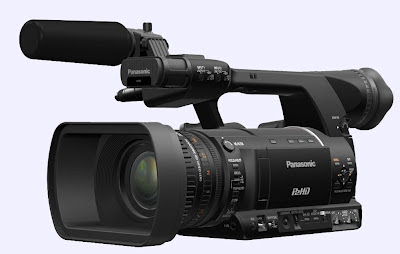

Panasonic AG-HPX250 Camera 

The HPX250 has three 1/3-inch, MOS sensors at full-HD 1920x1080 (2.2 megapixels). The HPX250 is 50Hz/60Hz switchable so you have a choice of 25p, 50i, 30p, 60i and 24p. It records AVC-Intra, DVCPRO HD, DVCPRO50, DVCPRO25 and, should you need it, DV on to P2 cards. This means it can record up to 10-bit 4:2:2 and 100Mbps. And if that is not enough, you have an HD-SDI output for even higher quality recording to a separate field recorder.

The camera’s form factor is nothing new compared to the typical camcorder of the last six years, with a viewfinder (EVF) at the rear and pop-out LCD screen on the side. The handle on the top houses most of the audio controls and the two XLR audio sockets. This camera neatly fits into the Panasonic range. If you are a HVX200 owner looking to upgrade or add to your kit, the HPX250 would feel familiar and be an easy transition.

It weighs 2.5kg (5.5lbs), a little lighter than the 2.7kg Canon XF305, but neither are shoulder mounted, which will mean the usual aching arms and shoulders on prolonged shoots.

Lens check

Most manufacturers have ditched the separate iris control on a little fiddly dial (as seen on Sony's Z1). Iris is where it should be – on the barrel of the lens behind the zoom and focus. The iris has a good positive feel to it and opens to F1.6, but as you zoom in it will ramp down to F3.2 at full telephoto.


Focus, Zoom and Iris control 

The camera has a good 22x optical zoom from 3.9mm-86mm, which is equivalent to a 28-616mm lens on a 35mm DSLR. There is also a 2x, 5x and 10x digital zoom.

The focus ring, however, was a bit of a disappointment, coming in a non-stop infinity ring mode only. I would have expected Panasonic to copy Sony (EX1) and Canon (XF300/305) and offer the option of a focus ring with hard end stops for a more repeatable focus pull. But, what is there is fine with no lag or stickiness.

If I have to be picky, one problem is that Peaking only comes in white. I always prefer to use a red peaking as it makes focusing so much more obvious and a lot easier.
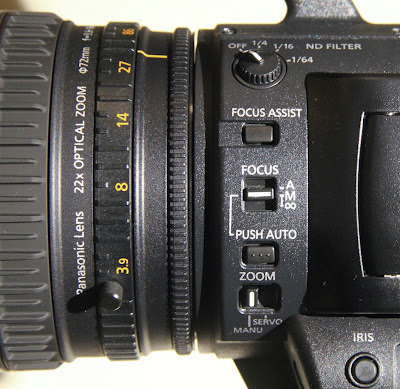


That said, to help with focusing you do get the usual Push Auto button, which switches the camera from manual to auto focus while you press it down. Plus, there is a Focus Assist button that magnifies the centre of the screen to help you check your focus. This feature shouldn’t be confused with the MF ASSIST mode available in the menus, which increases the sensitivity of the focus ring for fine tuning your focus. If all that wasn’t enough, there is also the focus bar that indicates how sharp the image is – the longer the bar the more in focus you are. Nudge the focus ring too far and the bar starts to shorten as you go out of focus.

Gain control

Gain comes in the usual low, medium and high setting from 0dB to 18dB in 3dB increments. If you are in the dark with no possibility to use lights there are super gain options of 24 and 30dB.There is no negative gain, which seems to be pretty standard on most rival cameras, and there is no way to limit the auto gain, which is a bit disappointing.

Shutter framed

The shutter control design and implementation is a bit worrying. The shutter / F.rate dial is used to change the shutter speed and frame rate – this seems very dangerous. As you turn the dial it goes from shutter to synchro scan then Frame rate – and finally lock. Being lockable is useful to prevent accidentally changing anything, but the lock also activates after 12 seconds of inaction. This made changing things annoying and fiddly – hesitate too long and you have to unlock again.
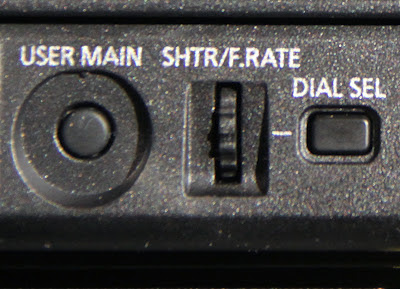

Shutter and Frame rate on the same control 

But, I really do think it is a bad idea to have both shutter and frame rate on the same control - these two things need to be kept separate. If you weren’t paying attention or a beginner mixed up their shutter speeds with their frame rates – it could all end in tears.

There are, however, a wide range of frame rates to choose from, useful for off-speed (slow motion or fast motion) effects.

Frame rates

50Hz mode
59.97Hz Mode
1080p
1/2/4/6/9/12/15/18/20/21/
22/23/24/25 frames per second

720p
1/2/4/6/9/12/15/18/20/21/
22/23/24/25/26/27/28/30/
32/34/37/42/45/48/50 fps

1080p
1/2/4/6/9/12/15/18/20/21/
22/24/25/26/27/28/30 frames per second

720p
1/2/4/6/9/12/15/18/20/21/
22/24/25/26/27/28/30/
32/34/36/40/44/48/54/60 fps


ND filters

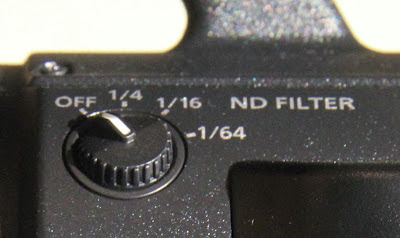
The HPX250 has the now almost standard three ND filters, coming in at 1/4ND, 1/16ND, and 1/64ND, controlled by a rotary dial (as pictured below).


Exposure

The HPX250 comes with two sets of zebras that can be set from 50% to 109% in 1% increments, which is nice. You can see Zebra1 and Zebra2 at the same time, just Zebra1 on its own, or you can choose the ‘spot’ option and see the level between Zebra1 and Zebra2. I’m not sure if I’d use the spot function but some may find it handy.

There is also a useful Y get function that you can assign to an assignable button. It will show the brightness at the centre of the screen – making the camera a useful spot meter.

New cameras now have a waveform monitor and vectorscope. I like to use my waveform to check on black and white crushing and the vectorscope can be handy when doing a white balance – to confirm you’ve done it right.

The camera does have a Full Auto Mode – or panic mode as I like to call it. In this mode the camera switches Focus, Iris, gain and white balance to Auto, but not Shutter and audio. This is different from Sony and Canon where the Auto Mode controls Iris, gain, shutter and white balance.
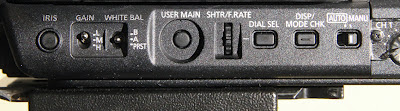

Full Auto or Manual 

If you are a wedding videographer or do red carpet events, you’re used to flash guns going off around you. Unfortunately, if you are recording video those flashes can cause problems. This is called Flash Banding and you’ll see the brightness at the top of the screen won’t match that at the bottom. The HPX250 does have a very interesting feature called Flash Band Compensation or FBC. This compensates for and minimises the banding when a flash photo is taken in the camera’s vicinity.

White Balance

The HPX250 has the usual preset white balances set to 3200K and 5600K – they have made it easy to toggle between them by pressing the AWB button. You also get the standard A and B manual white balance memories. However, the B memory can be assigned to do an Auto white balance or if you prefer you can assign auto to one of the user buttons.

The camera also has the option to do a black balance by holding down the AWB button for two seconds. I suspect a few operators will do this by accident – but it certainly won’t hurt to do an extra one every now and then.

Audio

There are no big surprises with the audio: two XLR sockets, which can be independently switched to line or mic input with switchable phantom power (+48v). It will do the usual 48KHz at 16 bits – but it is nice to see four channels are available, even if only to use as a back up.
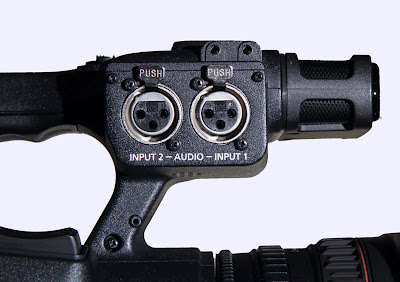

Two XLR sockets on the HPX250 


Line and Mic level selection - with 48v Phantom power
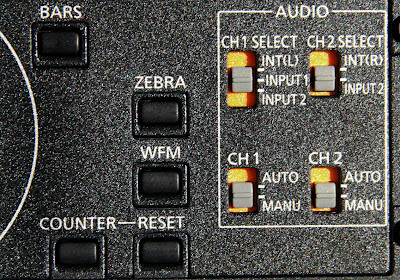


Audio input/output selection 

Often the audio volume indicator is a bit small at the bottom on the screen – but you can assign MAG A.LVL to a user button and magnify the meters on the LCD screen – which is a nice touch.
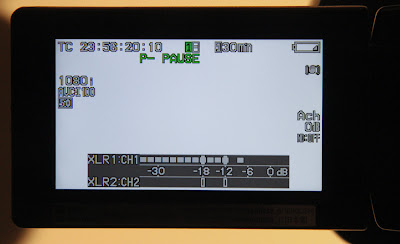

Audio levels - loud and clear 

On the Menu

Moving around the menu is simple with the joystick like Operation lever on the side of the camera. Menus across all the manufacturers are fairly similarly laid out these days – which makes finding your way around pretty easy.
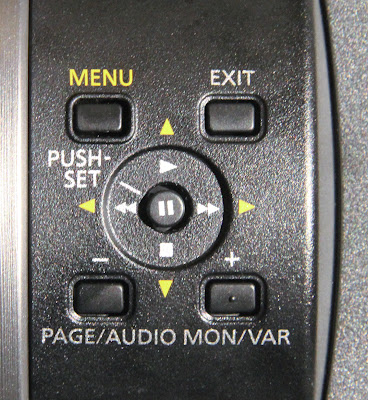

Easy joystick operation to navigate the menu 


Recording media

Two P2 card slots 

The HPX250 has two P2 card slots. P2 isn’t the cheapest recording media, but it is very reliable and unlike Compact Flash has “write protect” to stop you accidentally deleting your media.

However, you need to factor the cost of P2 into the purchase price. A 32GB P2 card is around £375 inc VAT while a 64GB card could set you back £550 inc VAT, although there are good deals if you buy a couple of 32GB P2 cards with the camera.

In comparison a 32GB Compact Flash card for Canon's XF305 would be about £95 inc VAT.

Recording times for HD 1080i, 720p

Recording Format
Recording time on 32GB card
Recording time on 64GB card
AVC-I 100
DVCPRO HD
32mins
64mins
AVC-I 50
64mins
128mins
Recording times are for HD 1080i and 720p

The camera works in relay recording mode – first recording onto one card and then on the next once the first is full. With hot swapping you could keep recording until your battery runs out.

The Pre-Rec option is one of my favourite features of tapeless recording. If you’re worried you’ll miss something then switch on the pre-rec and you will not only get the video after you’ve hit the record button but also the three seconds before too. Everyone will think you are psychic.

For those of you who want to do timelapse there is interval recording – plus one shot (frame recording) for animation.

The modes to be wary of are loop and one clip recording. In loop recording mode the empty space on card A is filled then it moves onto card B. When B is filled – the camera does not stop but goes back to card A again and overwrites what it  recorded earlier… then back to overwrite card B – ad infinitum. I can’t think of a use I would have for this. I suppose if you have no idea when an event will happen you could leave the camera in loop mode. But, you would have to ensure you had stopped loop recording once you’ve got what you want – otherwise the camera will head back and overwrite it.

I have had a few trainees who don’t like the fact their video is split into individual clips each time they start and stop recording. So, I guess the ‘one clip recording’ option is for them. In this mode the camera compiles all your video into a single clip.

This feature worries me a lot and I won’t be recommending it to my trainees. Imagine if you do 20 shots in the normal way and one is corrupt. That has happened to me. It is annoying, but at least I still have 19 healthy clips. I assume that if I used the one clip recording option, I would have had one large corrupted file. No, this just sounds like a bad idea.

As well as P2, the camera also uses SD/SDHC cards for recording and loading scene and user files and uploading metadata. This is handy if you have more than one camera and want to swap and synchronise settings. Or maybe your colleagues have sticky fingers and like to change camera settings – this way you can save your settings and load them each time you shoot.

Scene files

If you prefer to tweak the look of your images before the edit, then Panasonic offers six scene files. F1 is for normal everyday shooting; F2 for shooting under fluorescent lighting; F3 for increasing the range of resolution, colour and contrast; F4 increases the contrast in dark areas (increasing black stretch); F5 gives a film look with contrast tweaked; while F6 gives a film look with dynamic range tweaked.

Scene File options 

I must admit I prefer to do very little in the camera to change the look of my pictures. I think if possible you should do that sort of thing in post.

Time code

One advantage of the HPX250 is the inclusion of Timecode in/out connectors for synching timecode across cameras. If you regularly work with more than one camera and have to synch them up later in the edit – synching with time code speeds up the process.

Time code in/out and Genlock 

OK so when did you last use User Bits? I’m starting to wonder why manufacturers still include them as I don’t know anyone that uses them. But, at least Panasonic has found a good use for them – to record your frame rate choices. But if your NLE doesn’t import that information – then it is rather academic.

Who will buy

If you need 100Mbps in a small, relatively inexpensive camera. This is definitely worth a look.

I was training at a production company last week and they were shooting on a Sony EX3 and a NanoFlash because the broadcaster had stipulated recording at 100Mbps. Now the EX3 is a good camera (if a little old) and the NanoFlash does a good job – but for observational documentaries that was a lot of weight to be carrying around. The XF300/305 was no use – as they record at 50Mbps. In that case, the Panasonic HPX250 seems a no brainer. Not too heavy and no external recorder to worry about - although some broadcasters won't accept its 1/3-inch sensors as HD.

The Flash Band Compensation is a fantastic feature for wedding videographers or anyone covering red carpet events with lots of flash photography. 

The genlock and timecode in/out features are a boon for anyone thinking of working multicam either on location on in a studio through a vision mixer (its main rival, the Canon XF300 doesn't have them, you have to spend extra on an XF305).

The Panasonic HPX250 is an interesting camera and certainly worth shortlisting if your budget is less than £5,000.

[[UPDATE: Panasonic has released 18 new, free, downloadable scene styles for the HPX250]]

By Christina Fox

-------------------------- In response to comments  - some setting is currently preventing us from adding a comment below - so we're adding this comment here:

OnThePulse said it doesn't do 1080p, but according to Panasonic (in the HPX250 manual), the variable frame rates it does in 1080p are: 12, 15, 18, 20, 21, 22, 23, 24, 25fps in 50Hz mode, and 12, 15, 18, 20, 21, 22, 23, 24, 25, 26, 27, 28 and 30fps in 60Hz mode.

Jonathan, thank you for your kind remarks. We agree about the price of P2, but given the cost of the camera, it can still make financial sense if you get a bundle deal and manage you media very carefully.

January 12, 2011

Tiny new Canon XA10 pro camcorder

Canon has developed its smallest-ever pro camcorder, the XA10, based on its new XF100/XF105 models, but without the 50Mbps recording.

The XA10 weighs just 820g, and the combined handle, XLR audio block, and built-in infra-red LED light, can be removed to make it even smaller and as unobtrusive as any consumer handycam if it is needed for undercover filming.

It uses the same lens, sensor, digital processor and focusing system as the XF100, in a smaller unit (the XF100 is already pretty small but almost twice the size of the XA10). It has a built-in 64GB solid-state drive (recording almost six hours at its highest 24Mbps bit rate) and has three seconds of cache recording. There are also two SD card slots, which can be used in relay or back-up modes where the XF100 uses larger CF cards and has no built-in drive.

The XA10 was launched at last week's Consumer Electronics Show in Las Vegas and should cost less than $2,000. It is attracting interest from professional users, such as UK rental house, Hireacamera.com, which sees it as the perfect replacement for the venerable Sony HVR-A1. "Our Sony A1s have been incredibly popular but we have for a while been waiting for something with which to replace them and here it is," it posted on its website. "We will definitely be stocking it from launch."

It uses a 1/3-inch CMOS sensor, records 1080p HD video in AVCHD or H.264 at 24 or 25p, 50i (or 30p/60i), and boasts good low light performance, down to 1.5 lux, as well as shooting infrared (like the XF100), helped by a diffuse LED IR emitter in the handle and a flip-up IR filter in front of the sensor. The 10x f1.8 30.4mm zoom lens has an 8-blade iris for an attractive bokeh (background blurring) effect. It can be used with Canon's new WD-H58W wide-angle adaptor, or other 58mm adaptors.

There is a 3.5-inch, 920K dot resolution, touch screen LCD, which can be used to select a subject for focus tracking and subject-specific auto exposure (which should mean that a white car crossing the background won't cause the exposure to change).

Advantages of XA10 compared to XF100/XF105:

  • Price - Under $2,000 (probably about £1,600) whereas the XF100 costs about $3,300 (or about £2,500) while the XF105 costs about $4,000 (or £3,200).
  • Size - The XF100 is hardly large, but the XA10 is barely bigger than a consumer camcorder, especially when the handle/audio block is taken off.
  • Internal memory - 64GB flash memory gives almost 6 hours of recording.
  • SDHC card slots (2) - adds flexibility of second media type, widely available at reasonable prices.
  • AVCHD - 24Mbps can give excellent pictures, especially if you aren't shooting fast-moving highly-detailed images, and takes up less than half the space of the XF's 50Mbps codec.
  • Easy to use - Those consumer camera features, such as touch auto focus and exposure, can be very useful. It is a pity that more professional cameras don't use a touch-screen interface.

Disadvantages of XA10 compared to XF100/XF105

  • Size - If you want to look professional and be taken seriously, the XF100 is about the minimum you should aim at. Also, a slightly heavier camera can be easier to keep steady - we've been using an XF105 for a few weeks and it sits very nicely in the hand if you need to go handheld.
  • SDHC - SD cards are tiny, and therefore even easier to lose than a Compact Flash card (which the XF range can take two of).
  • AVCHD - If you are shooting for broadcast, 24Mbps H.264 is just too compressed to hold up after being subjected to further compression for transmission - so you are more likely to see artefacts in detailed and/or fast-moving shots. The XF's 50Mbps codec has been accepted as HD quality by the BBC (although we don't know yet if the new single-sensor  XF100/XF105 will be too...). ALSO, AVCHD doesn't always play nicely with broadcast non-linear editing systems, such as Final Cut Pro, so will need to be transcoded.
  • 4:2:0 - The XA10 codec holds less colour detail than the 4:2:2 available to the XFs, which makes it a lot less suitable if you ever want to do green screen chromakey work.
  • Audio - The Dolby Digital two-channel (AC-3 2ch), 48kHz sampling used by the XA10 will probably be pretty good in reality, but the uncompressed PCM audio in the XF cameras will be even better.
  • Pro features - Although the XA10 is easier to use, the XF range has additional features that will prove very useful for many users, such as the variable frame rates (between 12 - 50 frames per second), or more assignable buttons (10 compared to 2).
  • 3D - The XF105 has a couple of 3D assist functions that make it very well suited for use in a 3D rig.
  • HD-SDI + Genlock - The XF105 also has these connections, allowing it to record at higher bitrates to an external recorder and to work well in a multi-camera shoot.

HF G10 costs even less...

Also new is Canon's high-end consumer camcorder, the $1,500 HF G10, which uses the same newly designed HD CMOS Pro image sensor as the XA10 to improve resolution, enhance low-light performance and expand dynamic range, thanks to using larger, more sensitive pixels – it is a native 1/3-inch 1920x1080 sensor rather than trying to cram more pixels into the sensor for higher-resolution stills images, as many camcorders now do. The sensor is also used in the three-chip XF300/XF305 models and is claimed to improve dynamic range by 280% compared to similar, more densely packed sensors.

The sensor is also used in the three models in Canon's compact new Vixia HF M-series camcorders (costing $650-$800 - the Canon HF M41 is pictured right). These will be able to be used with a $600 case waterproof to about 40m, for a reasonably priced underwater rig.

The HF G10 has 32GB internal storage plus two SD slots, 3.5-inch touchscreen, a built-in microphone that can zoom to match the lens (as on the XA10), and the same lens as the XA10. Useful pro features include: manual colour temperature adjustment (2,000K-15,000K in 100K increments), colour bars with test tone, manual shutter speed and aperture control, waveform monitor, a built-in Remote Control Terminal (which supports LANC protocol), and native 24p recording.

The XA10 and the other models mentioned should be available in March. The XF100/XF105 should start shipping before the end of January in Europe and in February for the US.

Also new from Canon is the Bluetooth-based WM-V1 Wireless Microphone usable at up to about 50m. The small microphone and receiver will be available in May for about $250.

By David Fox

December 21, 2010

Rolling shutter artefacts: fix it in post

HD DSLR and CMOS camcorders suffer from rolling shutter effects during camera moves – but this can now be rescued in post.

Anyone who pans a DSLR while shooting video will notice that any vertical lines in shot lean over. On some DSLRs you can barely move the camera without this happening. It is a fault inherent in the way CMOS sensors are read out. It can be addressed if the manufacturer uses higher clock rates, but is difficult to avoid completely.

It is, thankfully, something that can be fixed in post (although rarely perfectly), with a variety of software plug-ins. These range from high-end products, such as The Foundry's RollingShutter (costing £300 for After Effects or its own Nuke compositor); or more affordable varieties, such as CoreMelt’s Lock & Load X ($149 for Final Cut Pro and After Effects), and its latest $79 version, Lock & Load Express, which is the first stabiliser for Final Cut Express.

This sort of software can be surprisingly effective, even the stabilisation option in Apple's latest version of iMovie can restore demented verticals (as Philip Bloom demonstrates on his blog).

As a mid-range option, Lock & Load Express can give hand held footage "a professionally shot steady cam quality instantly without the need to set tracking points," claimed CoreMelt founder, Roger Bolton. It is not as sophisticated as the version for Final Cut Pro, which is claimed to be "one of the fastest video stabilizers available" at least 12 times the speed of FCP's built-in stabiliser (whereas the express version is just six times as fast as FCP), and offers more advanced tracking features (including keyframes and background processing). Lock & Load Express has presets for the main HD DSLRs, CMOS camcorders such as Sony's EX1, and the likes of Apple's iPhone or the Flip HD.

By David Fox

November 22, 2010

Sony shows Super 35mm NXCAM

Sony has shown a potential spoiler for Panasonic's AG-AF100/AF101 that boasts a larger Super 35mm sensor for desirable shallow depth of field shots and 50p recording.

This will be an entry-level digital cinema camera, recording AVCHD at 24Mbps – however, full details are still sketchy and where Panasonic offers 50p/60p recording (on its high-end consumer SD700 and TM700 camcorders) it uses 28Mbps MPEG4-AVC/H.264 recording, which is not part of the AVCHD standard. The S35 NXCAM will also have uncompressed 10-bit 4:2:2 output through HD-SDI and/or HDMI.

The camera will use an E-mount interchangeable lens system identical to the Alpha series lens system used on the NEX-5 and NEX-3 stills/video cameras and Handycam NEX-VG10. It will also be possible to fit A-mount lenses via a lens adaptor, and PL-mount lenses with another adaptor (which may be part of the package). There are also other third-party lens adaptors to allow the camera to be used with lenses from the likes of Canon, Nikon, Pentax and Leica.

Besdes 50p (and presumably 60p), it will also record 25p (and 30/24p), although Sony currently seems to be planning separate European (25/50p) and US (24/30/60p) versions rather than a single worldwide model.

It will use a Super 35mm-sized CMOS sensor, apparently the same sensor as on the PMW-F3, and record to SDHC or Memory Stick media. It will have two-channel uncompressed audio and its design is based on a lot of feedback it got at IBC when it showed the VG10, so it will have XLR audio connections, improved ergonomics, and a wider range of recording formats. List price should be about €6,000 and it is expected to ship sometime after NAB, which is in April.

Related posts: Sony PMW-F3: Budget filmmaking?, Panasonic AF100 / AF101 - the movieSony's HD DSLR in a HandycamSony embarks on 35mm camera development + Sony NEX-FS100 takes on DSLRs

By David Fox

September 18, 2010

Nikon D7000 full HD DSLR launched


Nikon D7000 Launch from UrbanFox.TV on Vimeo.

Nikon's new D7000 is not, as some rumours had it, a replacement for its D90, but will sit in the Nikon range above the D90 and below the D300s.

It is Nikon's second full HD DSLR, following the recently introduced D3100, but has a lot more to offer than the entry-level model.

In our brief tests of a pre-production model, there seemed to be a fair bit of noise from the auto-focus motor. At 1600 ISO, there was noticeable grain, but it wasn't objectionable – although a JPEG taken at the same setting exhibited less grain. As you'd expect with a CMOS sensor, there was skew caused by the rolling shutter, but this seemed to be less than was evident on the D3100, and barely noticeable at any sensible panning speed (and got lost in motion blur if panned much faster).

We shot several videos (which we can't show because it wasn't a production model), but the bit rates on these varied from 23.96Mbps to 27.82Mbps – a higher rate than on the D3100 (which averaged about 20Mbps), however, these were shot indoors, in an artificially lit room in fairly poor light (at ISO 1600), which would probably push the compression a bit higher than the better lit conditions we tried the D3100 out in. That said, the picture quality was good, with accurate colour rendition.

Price (list):
£1099.99 / €1303 (Body only) or
£1299.99 / €1540 (D7000 + 18-105mm VR kit lens bundle)
It should start shipping 29th October 2010.


Features include:
  • 1920x1080 @ 24 frames per second, 1280x720 @ 24, 25 and 30 frames per second;
  • MPEG4 AVC/H.264 compression using  .mov file format;
  • Stereo microphone mini jack input - recording 16-bit PCM audio at 48kHz;
  • 3-inch TFT LCD Monitor, with 921k-dot resolution;
  • Video clip trimming;
  • Mini HDMI output;
  • Simple, direct access, Live View and video recording control;
  • Tone and colour controls that let you set the look and mood of your pictures and movies before you shoot;
  • Good low-light performance (100-6400 ISO, extendable up to 25600 ISO);
  • Twin SD memory card slots (SDHC and SDXC) allow for extra storage capacity;
  • Bundled ViewNX 2 software, easy-to-use Windows software for editing photos and movies;
  • New image-processing engine, EXPEED 2, which delivers higher image quality and faster processing;
  • New 16.2 megapixel CMOS image sensor; 
  • Rugged, magnesium top and back with dust and moisture sealing;
  • Glass Pentaprism Viewfinder with 100% frame coverage and 0.94x magnification;
  • Newly developed AF system featuring 39 focus points, including 9 cross-type sensors in the centre;
  • AF-F during video recording, giving continuous focus;
  • Face detection with contrast AF that is claimed to be is faster than previously;
  • The ability to detect up to 35 faces within about 0.08 seconds, even if subjects are not directly looking at the camera;
  • Subject Tracking to keep moving subjects in focus;
  • New 2,016 pixel RGB metering sensor
Weight: 780g including battery.

Magnesium top and back
Level indicator
www.nikon.co.uk

[UPDATE: Nikon has posted a firmware update for the D7000 that reduces occasional video problems where shots of dark scenes or objects might exhibit bright spots]

Related posts: Nikon D3100 full HD DSLR + Nikon D3100 video interview

By David Fox

September 09, 2010

New Panasonic AF100/AF101(updated)

At IBC Panasonic is showing engineering samples of its new AF101 Micro Four Thirds-based camcorder (aka the AF100 in the US).


What's the big deal? Well, it is the DSLR spoiler.... and this is the first time we've seen it as a working model, we were told that the anti-aliasing technology they are developing to give it a significant edge over HD DSLRs isn't finished yet, so any opinions you might see about the pictures won't be the final word. Street price is likely to be under £4,000, so it should attract a lot of interest.

It is quite a boxy shape. Definitely not like a DSLR or the Sony Handycam NEX-VG10, but should fit into DSLR rigs or work like a conventional camcorder.


[UPDATE: Now we've had a chance to see the pictures it can produce, we're even more impressed. Someone from Panasonic in Germany shot a performance/theatre piece, with lots of nice shallow depth of field, and not a lot to trouble the codec. But, the pictures looked very filmic, there was no video harshness, the colours appeared to be very accurate. It was restrained, not flat, but not in your face. More interestingly, they'd given the camera to the ebullient Barry Green, of www.dvxuser.com, who had tried it on some of the pictures that normally cause aliasing on DSLRs, repeating patterns such as roof tiles and brickwork, and we didn't notice any aliasing at all - and on a big screen we would have. Although recording 24Mbps AVCHD does involve a lot of compression, the pictures stood up very well. Certainly, with the advantage of the AF101's HD-SDI output, being able to record to the Convergent Design nanoFlash, AJA's new Ki Pro Mini or Panasonic's own external AVC-I recorders, means that the codec choice shouldn't be a worry - just that you'll have to spend more on the extra recorder.]

[UPDATE AGAIN: We now have video - Panasonic AF100 / AF101 - the movie]

[FURTHER UPDATE: The new AF100A/AF101A can record up to 28Mbps internally and output 10-bit 4:2:2 via HD-SDI to an external recorder]

Key Specifications:

  • Micro 4/3-inch camcorder MOS sensor
  • Full 1080/720 - 60i, 50i, 30p 25p 24p
  • AVCHD 24Mbps
  • Variable frame rates
  • 2 XLR inputs with phantom power
  • SD cards
  • Shipping end of 2010


Panasonic were still building the stand so, they didn't have a lot of time to talk. Plus, apologies for the dark pictures but the stand wasn't lit. Hopefully during the show I'll get a chance to get a few well lit shots and some hands-on time with the camera.


We've previously written about the Panasonic AF100/AF101.  Plus, it has its own Panasonic micro site .

By Christina Fox