Showing posts with label lens. Show all posts

September 07, 2014

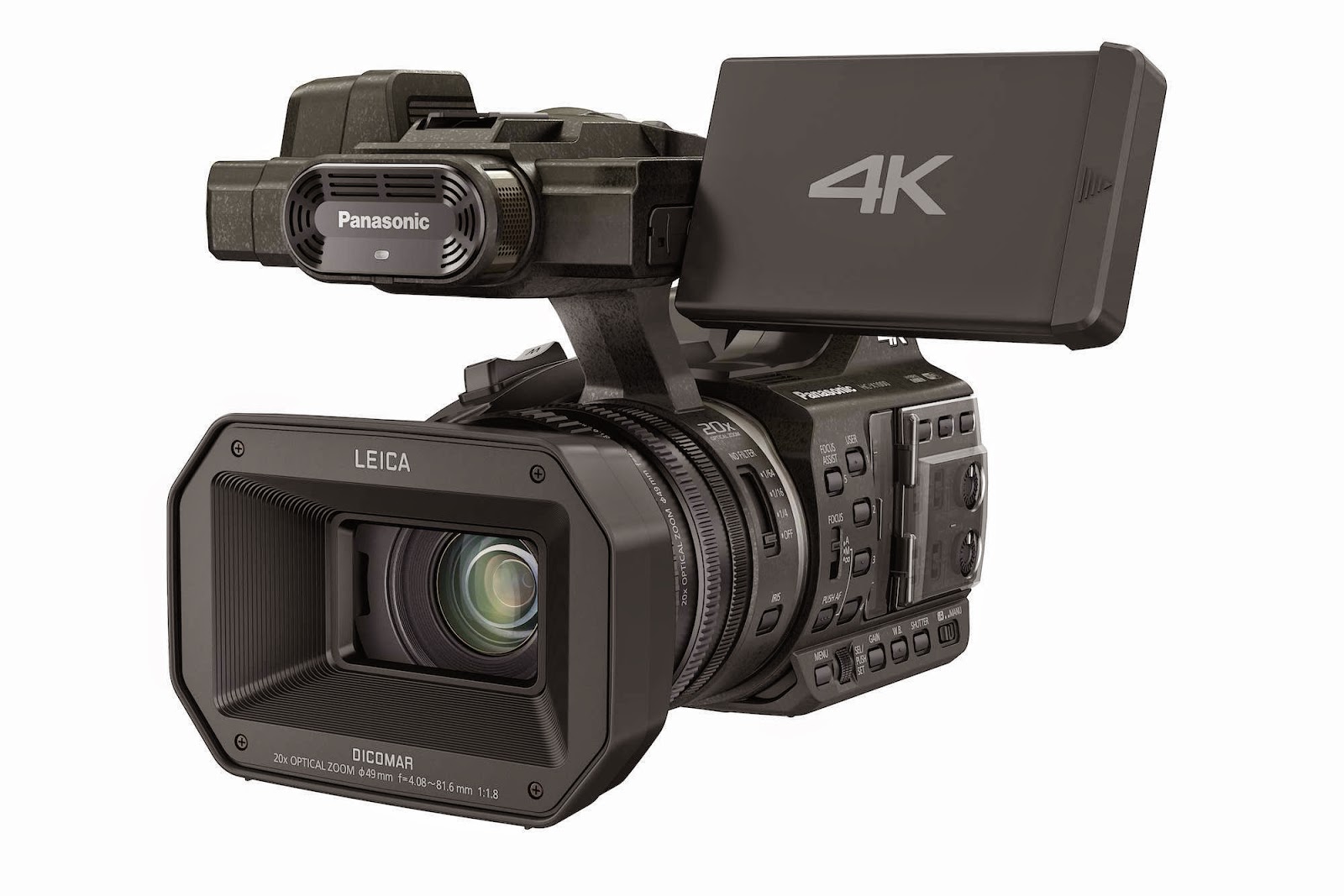
Panasonic HC-X1000 4K camcorder

Panasonic’s new HC-X1000 Ultra HD 4K camcorder is its first prosumer model that can record 4K 60p/50p video on an SD card.

It can record both UHD (3840x2160) at 50/60p and Cinema 4K (4096x2160) at 24p in MP4 at up to 150Mbps (50/60p) or 100Mbps (24p), plus .mov or MP4 in HD, which can use all-Intra compression for a maximum bit rate of 200Mbps, as well as AVCHD (1080p) at up to 28Mbps. Even if you are shooting for HD, recording in Ultra HD can be useful during editing, as you can then zoom in to a one-quarter crop without losing any HD resolution, or pan across the picture to follow movement.

April 09, 2014

AJA Cion 4K/UHD camera

Yet another non-camera maker has entered the camera market: AJA Video Systems has announced a very nice looking 4K camera that doesn’t cost much more than the Blackmagic Ursa, but has some nice features.

The AJA Cion has a Super 35mm-sized sensor, with global shutter and 12-stops of dynamic range, and records using various Apple ProRes codecs, including 12-bit 444. It builds on AJA’s excellent reputation for external recorders, such as the Ki Pro, Ki Pro Mini and, most recently, the 4K Ki Pro Quad, so it had already built the back-end of the camcorder.

March 13, 2013

JVC GY-HM70 shoulder camera


The new JVC GY-HM70 AVCHD camera should be of interest to many of our readers, as our now-ancient (October 2010) post on AVCHD shoulder mounted camcorders is our most popular ever…

The GY-HM70 will ship in May, and has a list price of $1,995 (apparently the UK street price is likely to be under £1,200), and some nice features, even if it doesn’t have XLR audio input.

It is designed principally for event production, and to make it useful for covering long-form events, such as weddings or conferences, it has hot-swappable batteries (pictured below - a first in this price bracket), so you can keep shooting continuously, without interruption. 

Being shoulder-mounted, it should also be a lot more comfortable for long-term use than more compact cameras (although it isn’t particularly big), and is reasonably light, weighing about 3kg (6.7lb) with one battery attached.

It can record 1920x1080 HD at up to 50p or 60p in AVCHD Progressive, to dual SDHC/SDXC memory cards (Class 4/6/10) at up to 28Mbps. It will also shoot at 250 frames per second at 720x576 (for 50Hz/Pal production) or 300fps at 720x480 (for 60Hz/NTSC countries), and offers 50/60i shooting or SD at lower bit rates. 

Interval recording in steps from one second up to 80 seconds is also an option, as are still images at up to 4000x3000-pixel resolution. Stills in 12Megapixel can be shot at the same time as video or stills can be shot at 2Megapixel resolution.

The camera should also be pretty useful in low light. It uses JVC's Super LoLux technology to enhance image quality and offer more accurate colour capture indoors or in dark situations (there is a minimum illumination of 1lux, which is certainly good, but hardly exceptional).

The F1.2-F5.6 GT Lens has a 10x optical zoom, plus a 16x “dynamic zoom” that only works with the optical image stabilisation turned off and makes use of the overabundance of pixels on the sensor by reducing from 5.4Mpixels to 2.07Mpixels (there is also a 200x digital zoom). 

The lens delivers a not-particularly wide wide-angle of 29.5mm – to 476mm if dynamic zoom used (35mm-equivalent), and was developed specifically for the 1/2.3-inch 12Megapixel back-illuminated CMOS sensor (apparently the same sensor used in JVC’s GY-HMQ10 small 4K handheld camcorder), which is claimed to deliver “high resolution, high sensitivity, and excellent colour reproduction.”

The camera features manual or auto focus (with focus assist), manual iris and shutter, manual or automatic white balance, and optical image stabilization.

There is a 3-inch 16:9 230K-pixel Touch Screen LCD display plus a 0.24-inch LCOS 16:9 260K-pixel colour viewfinder; an internal stereo microphone (plus a mini-jack microphone input); remote-control input; while outputs include an HDMI Mini connector and RCA video and audio ports. It comes with an AC adapter (AP-V20); battery pack (BN-VF823); composite/audio cable (RCA x 3) and USB cable.


By David Fox

BBC buys 500+ GY-HM650 cameras


JVC has recently made a big breakthrough in broadcast news use with the order of more than 500 units of its GY-HM650 ProHD network-enabled camcorder by BBC News for use in newsgathering throughout the UK and globally.

The lightweight cameras record HD or SD in multiple file formats, including native XDCAM EX (.MP4), Final Cut Pro (.MOV), and AVCHD, to SD cards. The 650 also supports MXF files for metadata.

One of its advantages for news is that it has dual codecs, so that it can record full HD files on one memory card, while simultaneously creating smaller, web-friendly files (1/4 HD or SD) on a second card. It also has built-in FTP client and network connectivity, so that it can deliver the footage back to a station without a microwave or satellite connection (all it requires is a WiFi connection or mobile broadband).

It has a secure web server built-in, to allow you to take full control of the camera – including zoom, Rec start/stop and metadata editing – via any browser-enabled device such as an iPad or smart phone.

Other features include: three, 1/3-inch 12-bit CMOS sensors, each with 1920x1080 pixels; a 29mm-667mm (35mm equivalent) Fujinon 23x autofocus zoom lens with optical image stabilizer; manual focus, zoom and iris rings, plus three ND filters; auto-focus with face detection; good low-light performance (F12 at 2000 lux in extended mode); a 1.22MP colour viewfinder and 3.5-inch LCD; a second trigger and servo zoom control on the built-in handle to make it easy to record while holding the cameras at low or high angles; Pre Rec to continuously record and store up to 15 seconds of footage in cache memory to help prevent missed shots of breaking events; built-in stereo microphone plus two XLR inputs with phantom power; separate input for a wireless mic receiver; LANC remote connector; time-code synchronization input; plus HD-SDI and HDMI outputs. It also has Flash Band Correction, to avoid rolling shutter problems if you shoot an event there are flash guns going off.

The camera has been tested by Alan Roberts (whose reports are always worth reading) and met the EBU’s criteria under EBU Tech 3335 for journalism use (Tier 2J), and will also meet the requirements for general long form HD programming (Tier 2L), when used with a suitable external recording device supporting 50Mbps or greater recording (it records up to 35Mbps internally).

By David Fox

February 20, 2013

Arri upgrades with Alexa XT


Arri has refreshed its digital cinema camera range with the new Alexa XT (Xtended Technology), which will offer: a compact, built-in Raw recorder capable of recording up to 120 frames per second at high quality; a built-in neutral density filter; a 4:3 sensor that can be used with anamorphic lenses; full support for lens data; a new, stronger viewfinder mounting bracket; and an even quieter fan.

The Alexa XT, Alexa XT M, Alexa XT Plus and Alexa XT Studio cameras will replace all previous models except for the original Alexa. Owners of existing Alexa cameras will be able to purchase individual upgrades that deliver most of the features of the XT configuration, including the XR recording module, ND filter module, viewfinder mounting bracket, viewfinder extension bracket, XT Fan and the anamorphic de-squeeze and high speed licenses.

XR Module

Feature films often record Arriraw to capture uncompressed, unencrypted image data so that they have maximum flexibility in post. Recent movies that recorded in Arriraw include Skyfall, Life of Pi, Marvel’s The Avengers, Hugo, Zero Dark Thirty and Amour.

However, recording in Arriraw has previously involved using an external recorder, such as the Codex Onboard, but a lot of users have asked for built-in Arriraw recording, which is why Arri decided to work with Codex to develop the new XR Module. The camera’s modular design means that existing Alexa owners will also be able to quickly swap in the new module for the existing SxS card module.

The result is a smaller, lighter, more affordable, cable-free camera package that records Arriraw inside the camera, at up to 120fps. It uses fast, rugged 512GB XR drives that can also be used to record Apple’s ProRes or Avid’s DNxHD formats, including ProRes 4444 at 120fps. At 6.7Gbps the solid-state XR Capture Drive is claimed to be the fastest digital magazine available. With an SxS Adapter it is possible to record ProRes or DNxHD to a single SxS PRO card, so you can still use existing cards.

For post production the XR Capture Drive offers several different workflows familiar to anyone who has used Codex recorders. First, a small, affordable USB3 Single Dock allows quick, safe copying of data onto a laptop. Second, the Dual Dock can make clones of XR Capture Drives and connect to a Mac Pro via a high-speed SAS interface for speedy copying, archiving or dailies creation. And third, the Codex Vault is a modular and rugged all-in-one system for fast, easy copying, archiving, reporting or dailies creation on or near set.

Neutral Density

The new In-camera Filter Module IFM-1 allows Alexa XT models to be rated at the base sensitivity of EI 800 without the need for external ND filters, even in bright sunlight. Filtering behind the lens rather than in front is quicker and simpler and reduces weight and reflections. The IFM-1 offers eight densities, from ND 0.3 to ND 2.4.

True anamorphic sensor

A lot of moviemakers prefer using anamorphic lenses, to give the CinemaScope look. These squeeze the wider aspect ratio on to the 4:3 sensor that is now standard on the XT cameras (it was previously only available on high-end Alexas). The sensor is the same size and shape as a Super 35mm film frame, so it is also useful for HD productions as it permits significant reframing of the image in post, similar to shooting 4-perforation 35mm film. An anamorphic de-squeeze license is included with all XT cameras, as is a high-speed license for filming at up to 120fps.

Lens metadata

If you are doing anything complex in post, particularly visual effects, it is very useful to have access to lens metadata (which will record what iris, focus and zoom settings you are using for every shot). All the XT models are equipped with an LDS lens mount. The Arri Lens Data System reads the position of all lens rings and writes them into metadata in every format Alexa can record. More than 41 lens models have LDS built-in, including the Arri/Zeiss Master Anamorphic, Master Prime and LDS Ultra Prime series, the Master Macro 100 and the Arri/Fujinon Alura Lightweight Zooms. For all other lenses it is possible to store the lens table inside the Alexa by using the Lens Data Archive feature.

Viewfinder mounting

To make the camera a little easier and more comfortable to use, there is a new Viewfinder Mounting Bracket (VMB-3), with a much stronger, more rigid design, partially achieved through the use of two 15mm lightweight rods. These rods also facilitate rapid changes in camera support, i.e. from a tripod to a crane or Steadicam, since accessories such as lens motors or follow focus units can be hung from the rods rather than cluttering up the base plate. Also available as a separate accessory is the new Viewfinder Extension Bracket (VEB-3), with a foldout arm that holds the viewfinder securely in place when moving the camera.

Silence of the fans

Alexa cameras are some of the quieter digital cameras, but a new, improved fan has been included in the XT models, to make it more usable in very quiet or very hot environments.

By David Fox

October 30, 2012

Sony PMW-F5 + F55 4K cameras


Sony has announced two new 4K cameras (the PMW-F5 and PMW-F55), plus the impending arrival of the 4K upgrade for the NEX-FS700, as it begins to get serious about moving beyond HD. The new cameras will use a new codec: XAVC. All the cameras use single Super35-sized CMOS sensors.

Sony started its move into 4K (4096x2160 pixels) with the F65 last year, and now has a range of 4K-capable equipment, including domestic and professional LCD and projector displays.

The high-end F65 is well regarded in the film industry, and the camera has been used on such movies as Oblivion and After Earth.

In fact, the F65 is now going beyond 4K, following its version 3.0 upgrade it will also be able to shoot 6K and 8K Raw (it uses a full 8K/20-megapixel sensor). It will also be able to shoot at up to 120 frames per second in 8K. It can be fitted with a new 0.7-inch OLED viewfinder (the first such for this type of camera), and has received several other film-related additions, such as anamorphic lens support.

However, as the F65 moves even further upmarket, the F55 and F5 should slot seamlessly in underneath it.

Open codec architecture

The cameras will support four codecs: XAVC, for high frame rates and 4K, MPEG2 at 50Mbps, MPEG4 SStP (Sony’s SR Master codec) and Raw 4K “by the switch of a button, depending on what job you want to do,” said Olivier Bovis, Sony’s Head of AV Media.

The F5 and F55 will need the new AXS-R5 recorder for Raw, but everything else will be recorded internally on a new, faster, memory card: SxS Pro+, which will support higher frame rates and bit rates – it is about 20/30% faster than an SxS Pro card at writing/reading and comes in 64GB and 128GB versions.

The F55 will be able to simultaneously record both MPEG2 50Mbps and XAVC 4K to the same SxS Pro+ card, which means you can have a readily usable 50Mbps version for offline editing in a 4K production, or just hold an archive of 4K shots for the future while shooting for today’s broadcast standards. You should also be able to record Raw 4K at the same time to the R5 recorder.

Internally, the F55 will be able to record HD (1920x1080), 2K (2048x1080), QFHD (Quad Full HD - 3840x2160), and 4K, while the F5 will be limited to 2K and HD, but once you add the R5 both will record Raw 4K and higher frame rates.

The F55 “has a very wide colour gamut [same as the F65] and high frame rates: up to 180fps in 4K and up to 240fps in HD,” said Bovis. It also has a Global Shutter to avoid any rolling shutter skew effect or flash banding. The F5 will shoot at up to 120fps in HD. The F65 can shoot at up to 180fps at 4K and up to 240fps in 2K Raw.

The cameras are promised to offer a wide dynamic range (14 stops), high sensitivity, and low noise.

Viewfinders + monitors

Thanks to a new digital interface, the PMW-F5 and F55 will also be able to use the new DVF-EL100 1280x720 OLED viewfinder. There is also a new 3.5-inch 960x540-pixel LCD viewfinder (DVF-L350), offering 10x the contrast of previous Sony LCD viewfinders plus a flip-up eyepiece for direct monitoring, and a 7-inch 1920x1080 LCD on-camera monitor (DVF-L700).

The PMW-F55 can also connect to Sony’s new 4K 30-inch 10-bit LCD monitor (PVM-X300) for on-set monitoring, dailies and editing using four 3G-SDI interfaces to monitor pictures at 4096x2160 resolution at up to 60p while recording and playing back XAVC 4K images. It can also be connected directly to the 84-inch BRAVIA 4K LED TV for monitoring, but at a resized horizontal resolution of 3860 pixels.

Batteries + rigs

The F5 and F55 also use compact new Olivine (Lithium Iron Phosphate) batteries that promise twice the lifetime of conventional Lithium Ion cathodes and provide an hour of power for Raw recording when using the R5 with either the F5/F55 (Raw is more power hungry than the other codecs). There is also a new 2x faster battery charger.

The cameras will also have a new shoulder rig, “so you can easily use it shoulder mounted. It’s very modular in how you want to use it,” said Bovis.

PL-mount lenses

The F55 and F5 cameras come with a PL lens mount, for use with high-end cine-style lenses, but Sony is also launching six new CineAlta T2.0 PL-mount lenses for the cameras (20, 25, 35, 50, 85 and 135mm).

Each is certified for 4K and is designed to minimize geometric distortion, vignetting and breathing. A 9-blade iris should deliver pleasing bokeh (out-of-focus effects), and the focus rings rotate 240°. For easy lens changes, each has the same external diameter, matte box diameter, and gear locations for follow focus and aperture. All are the same lenght except for the 135mm. 

The cameras are fitted with a native FZ mount (but the PL-mount adaptor is supplied), so users will also be able to fit other adaptors for Canon EF, Canon FD, Nikon DX, Nikon G, Leica M and even 2/3-inch B4 lenses.

Availability

The F5, F55, F65 upgrade, and lenses should be available by the end of January, but 2K and QFHD recording for the PMW-F55 and 2K for the PMW-F5 will be available through a firmware upgrade. Frame rates higher than 60fps will also require a firmware upgrade.

Prices should be announced in November.

NEX-FS700 + HXR-1FR5

At its introduction, last April, Sony promised that the NEX-FS700 would be able to record 4K, and soon it will, using the new HXR-1FR5 interface unit, which has 3G HD-SDI input, to deliver Raw data, and the new AXS-R5 recording unit – which uses a new generation of Access Memory Card with 512GB of storage. It will also require a firmware upgrade.

Although the FS700 can already record high frame rates in HD, it won’t have that feature in 4K, where the available frame rates will be 23.98p, 25p, 29.97p, 50p and 59.94p.

The HXR-IFR5 and firmware upgrade should be available between April and June 2013.

By David Fox

August 17, 2012

Sony NEX-EA50 NXCAM camcorder

Sony’s new NEX-EA50 answers a demand that many camcorder users have for a large-sensor, low(ish)-cost camcorder you can use on your shoulder without having to buy some sort of rig. Certainly, our most popular post ever is one from two years ago on Shoulder-mounted AVCHD cameras – which is exactly what this is…


As the newest addition to the NXCAM range, the NEX-EA50 has a new form factor that should be more comfortable to hold however you like to shoot.

When its shoulder pad is extended, the camcorder can be balanced on the shoulder for extra stability, making it a lot easier to hold for long shooting times. When the shoulder pad is in its original position, the camcorder is compact enough for any style of handheld use.

Many of its specifications seem similar to the NEX-FS100, but it doesn't appear to use the same sensor. The camcorder, due to ship in October, features a large format sensor, E-mount lens system, shooting Full HD movies (and high-quality still photos), but is promised to meet a “more affordable price point than ever before” - about £2,700 - Creative Video has it for £2,499 + VAT, which is less than €3,200/$4,000.

The Exmor APS-C/Super35mm-sized HD CMOS sensor is claimed to offer low noise and high sensitivity in low light conditions. It also enables 1080 progressive and interlace recording with 50/60Hz selection at 50p/25p/50i or 60p/30p/24p/60i. It records AVCHD 4:2:0 at up to 28Mbps. It can also record standard definition MPEG-2.

“This all-in-one camcorder brings a new level of creativity to a wider range of professional users than ever before,” said Bill Drummond, Sony Europe. “It combines affordability and high performance with a range of versatile, professional features for many applications, including event production, budget movie making and corporate production.”

It will capture 16.1 megapixel still pictures and has a built-in mechanical shutter so it can deliver high shutter speeds while capturing stills.

The camera can be used with any Sony E-mount lens, which enables auto focus, auto exposure and stabilisation during shooting. It has a short flange back distance, so it is possible to attach Sony A-mount lenses via the LA-EA2 lens mount adapter, or a wide range of other manufacturer’s lenses using third-party adapters.

The NEX-EA50 comes with the newly developed Power Zoom E-mount lens E PZ 18-200mm F3.5-6.3 OSS SELP18200. The 11x zoom includes auto focus, continuous variable iris and Optical Steady Shot image stabilisation with Active Mode, which should give a more stable shot.

The lens is electronically controlled via either the zoom rocker lever on the camcorder grip or the top handle, offering either a constant zoom speed or smooth, slow zoom.

Other camera functions include: two-channel XLR audio (an ECM-XM1 Shotgun microphone is included with the NEX-EA50H); Linear PCM audio; time code; user bit; built-in GPS; six assignable buttons; HDMI Type A, component (3xRCA) and A/V (RCA) outputs; 3.5-inch 1920x480 LCD; and Face Detection autofocus.

For recording, Sony’s HXR-FMU128 (128GB) flash memory unit (which costs about £600/€750/$1000) can dock directly to the camcorder for simultaneous backup recording. The camcorder is also compatible with Sony’s new Mirroring Memory Stick (MS-PX64/32/16), the world’s first memory card with mirroring. This enables the card to deliver higher reliability and data security through a dual recording (mirroring) function. The PX Series cards will be available from September, in 16GB, 32GB and 64GB versions. It can also record to SD cards.

By David Fox

July 26, 2012

Sony PMW-200 XDCAM camcorder

Many fans of Sony’s venerable PMW-EX1R looked at the introduction of the 50Mbps single-sensor PMW-100 and wondered when Sony would bring 50Mbps recording to their camera. Well, now it has… mostly. The new PMW-200 does have three half-inch Exmor CMOS sensors and full HD 4:2:2 5 50Mbps recording (as required by pretty much every broadcaster as the minimum bitrate for HD), but the form factor familiar to EX1 users has changed slightly. The PMW-200 is a somewhat more compact body, similar to the PMW-100, so it could take a little time to get used to new ergonomics.

Sony has taken a long time to offer 50Mbps in a decent lower-budget camera. Canon’s XF300/XF305 and Panasonic’s AG-HPX250 have had the field to themselves for a long time. It has meant that EX1 users have had to fit external recorders if they were shooting for broadcast. However, both the XF300/XF305 and the HPX250 use 1/3-inch sensors, but some broadcasters, such as Sky, believe half-inch chips are the minimum standard for HD (they often also ask for 100Mbps recording, so it may not be the end for all external recorders). The half-inch sensors should also deliver better low-light performance than their smaller rivals. Of course, if you already own an EX1R and an external recorder, the PMW-200 is not so much an improvement as a potential B-camera.

The XF range is currently the most popular for low-budget broadcast work, not just because it meets most broadcasters’ requirements, but also due to it using low-cost Compact Flash cards. The HPX250 uses Panasonic’s more expensive P2 cards, while the PMW-200 will primarily use SxS cards, which are only slightly cheaper than P2 – although at least the PMW-200 offers the option of using lower-cost SD, Memory Stick and XQD cards using an adaptor.

Besides 50Mbps, Sony covers all the legacy formats it is famous for, including 35Mbps MXF, 35Mbps/25Mbps MP4 and DVCAM. So if you still occasionally have to work in a Standard Definition environment and can’t edit in HD before outputting SD, then you are covered. Unfortunately, this flexibility uncovers one of the bugbears we’ve found using the PMW-100 – having to choose to format the cards using either UDF or FAT. Unhelpfully, the PMW-100 manual didn’t explain why you’d want to do that, so we had to work it out. If you want to record in 50Mbps (HD422) or 35Mbps (HQ), you have to choose UDF. You can’t record 50Mbps in FAT, but you can record 35Mbps (HQ) or 25Mbps (SP). It’s something you shouldn’t have to think about, but you do….

There is a slip-ring on the lens to switch between 
auto-focus (AF/MF - above) and full manual focus (below) 

Zoom lens: While the PMW-100 has a not-particularly-wide 10x zoom lens, the PMW-200 has a much better Fujinon 14x zoom, that goes from a very-nearly-wide 31.5mm to 440mm (35mm equivalent). You’ll still probably want a wide-angle adaptor for it, but you’ll probably only really need it in confined spaces.

The lens has three independent rings for zoom, focus and iris adjustment, plus greater precision through indications of ring positions on the 3.5-inch (852x480) LCD screen.

Recording: It has some frame rate flexibility with its Slow and Quick motion function which goes from one to 30 frames per second in 1080p, or 1fps to 60fps in 720p mode (but only if recording to an SxS Pro or SxS-1 card – and you can immediately play it back without using an external converter or processing on your editing system.

Most new professional camcorders now have cache record, which continually buffers what you are pointing at in its memory, but the PMW-200’s is longer than most at 15 seconds, which it will then write to your card once the record button is pressed, which is great for news or reality programmes – although it does assume you have the camera switched on eating battery power…

Other features: genlock and timecode interfaces for multi-camera operations; four-channel 24-bit Linear PCM 48kHz audio; dual XLR audio inputs; dual card slots; two ND filters (1/8ND and 1/64ND); optical SteadyShot; shutter angle as well as shutter speed settings; HD/SD-SDI, HDMI USB and iLink (IEEE1394 – HDV and DV) interfaces; five assign buttons.

Price/Availability: The PMW-200 weighs about 2.3kg (plus battery and cards, etc) and should be available from mid-September. There was no price in the press release, but CVP had it for pre-order at £5,160.00 + VAT (€6,580 or under $8,000 - essentially the same list prices as the EX1R is now).

There will also be a WiFi remote control from an iPad, iPhone or Android device (adaptor CBK-WA01 required), which is scheduled to be available by December with a free firmware upgrade (workflow above), including the ability to add metadata as used in Sony's successful XMPilot workflow.

“With the new PMW-200, we are putting one of the most versatile handheld camcorders we’ve ever developed onto the market,” said Bill Drummond, Strategic Marketing Manager, Professional Solutions, Sony Europe.

“The PMW-200 combines exceptional picture quality, seamless HD422 50Mbps workflow and a whole host of other useful features, with an ergonomic form factor. The result for users is an agile, lightweight solution that meets their varied needs and is the perfect partner for shoulder camcorders such as the popular PMW-500. It is also the ideal A-camera in its own right for HD broadcast production.”

Freelance cameraman, Alister Chapman, has done a good video overview of the PMW-200 and runs through the new features and how they can be used:


By David Fox

May 29, 2012

Canon widens ENG + OB lenses

Canon has introduced a new ENG HD lens and two new HD field lenses for outside broadcast use. The new 80x and 76x OB lenses and the 17x ENG lens all combine long focal lengths with wider angles of view.

The HJ17ex6.2B portable HD lens weighs about 2kg and is designed for use with 2/3-inch camcorders.

It is part of Canon’s HDxs series and offers a broad focal length range from 6.2mm to 106mm (212mm with built-in 2x extender) and a Minimum Object Distance of 40cm (shortened by about 30% compared to previous models) for close shooting in news situations. It can focus as close as 10mm in macro mode.

"On-location news coverage can frequently involve rapid changes in subject distance and associated focal length,” said Larry Thorpe, senior fellow, Broadcast and Communications division, Canon USA.

“The new HJ17ex6.2B is capable of adapting flexibly to all manner of filming situations, whether in close proximity to a subject or in shooting close-ups of a subject from far away.”

The HJ17ex6.2B is claimed to minimize optical aberration across the entire screen and exhibit superb optical performance throughout the field. It also features Canon’s Enhanced Digital eDrive technology, which utilizes high-precision digital servos with 16-bit optical encoders, to make it easier to program focus, iris, and zoom position and speed settings for precise, automated repeatability via an easy-to-use LCD menu, assignable function buttons, and a rocker switch built into the lens grip.

XJ80 and XJ76 lenses

The XJ80x8.8B and the XJ76x9B lenses are third-generation additions to Canon’s Digisuper range, which is widely used by outside broadcast companies as they give the long focal lengths necessary to get a close up of player in a large stadium.

They “deliver optical performance that has been significantly elevated over previous models,” claimed Thorpe, thanks to proprietary large-diameter aspherical lens technology, new glass materials, and sophisticated lens coatings that minimize aberrations and distortion that you usually get with large focal-length ranges. “Significant reduction of these factors enhances the excellent resolution and contrast of these lenses in a manner that contributes to superb picture sharpness across the entire 16:9 HD image plane,” he added.

The premium XJ80x8.8B lens delivers an 80x zoom with a maximum wide angle of 8.8mm (a horizontal angle-of-view of 57.2 degrees) – approximately 5% wider than previous long-zoom lenses. This means it should be able to capture everything from a stadium-wide shot to an athlete’s face.

It includes a new built-in Optical Shift Image Stabilizer (Shift-IS) as standard. This uses a new motion sensor, a faster control circuit and a new correction algorithm to significantly curb vibrations, particularly in the high-frequency range. When the new Shift-IS sensor detects vibration, a correction drive signal is created that shifts compensating optics at high-speed to instantly deflect the incoming light rays in a direction that cancels out the vibration's effect on the image. It also improves image tracking by virtually eliminating the image drift that can be caused by the sudden cessation of panning or tilting.

The XJ76x9B combines a 76x telephoto with a maximum wide angle of 9mm (a horizontal angle-of-view of 56.1 degrees) – about 3% wider than previous long-zoom lenses.

Both lenses include Canon's CAFS (Constant Angle Focusing System), which employs a 32-bit processor to help counteract breathing (where the picture size/angle of view changes during focusing). Both also feature improved digital servo systems using 16-bit miniature optical encoders and improved algorithms for zoom, iris, and focus to deliver increased responsiveness in terms of ultra-slow to very high-speed zooms, high-resolution control of both iris and focus, and precise repeatability of zoom and focus operations.

The lenses are also compatible with many digital virtual studio systems, with output of zoom, focus, and iris data.

By David Fox

April 16, 2012

$2,995 Blackmagic Cinema Camera

NAB 2012: Blackmagic Design has launched its first camera. It includes a built in SSD recorder, 13 stops of dynamic range, and lots of high-end features for a low-end price: $2,995/£1,925, with shipping in July.

It is claimed to provide “feature film quality in an extremely compact portable design.” It doesn’t use a particularly large sensor, although it’s probably large enough for most people to get reasonably shallow depth of field, and there are a few other compromises (such as the lack of XLR audio input), but for the price it should really make Sony, Canon, Panasonic, and JVC worried, as it does seem to offer many features that more expensive cameras don’t.

It has: a 2.5K sensor; an integrated capacitive touchscreen 5-inch (800 x 480-resolution) LCD for direct metadata entry; standard quarter-inch jack audio connectors, refrigerated sensor; takes EF (Canon EOS) and ZE (Zeiss) mount lenses; and can capture CinemaDNG RAW, ProRes and DNxHD files (so high quality and ease of editing).

The Blackmagic Digital Cinema Camera also includes both HD-SDI and Thunderbolt connectors and it comes with a full copy of both the DaVinci Resolve colour grading software (which has just been updated to version 9.0 with a faster to use interface) and UltraScope – so that you can simply plug it into a laptop for on set grading and scopes.

“We have been thinking hard about cameras and some of the limitations in quality that video cameras run into. Working with DaVinci color grading has only made these limitations more noticeable,” said Blackmagic CEO, Grant Petty.

“Some of the reasons why video cameras look like ‘video’ is because they have limited contrast range, are limited to HD resolutions, use heavy compression for file recording, have poor quality lenses and of course they don't integrate into NLE software with metadata management.”

The 13 stops of dynamic range is one of the most important reasons why this camera should look more like film – typical film stock will deliver about 13 stops, and it is one stop more than Canon’s EOS C300 can deliver (and it is probably the best of the lower cost digital cinema cameras). An Arri Alexa can give up to 14 stops, meaning you can get more detail in both the shadow and highlight areas of the picture and cope more readily with very high-contrast shots.

“Often people focus on more pixels, but that is just a larger video image,” said Petty. “The real way to get film quality is to capture a wide contrast range to retain more detail in the black and white levels of the image. Then once you colour grade the images, it looks amazing. Combined with amazing EF and ZF lenses, the result is a true film look.”

This quality is lost or diminished when you compress the images during recording, which is why the Blackmagic Cinema Camera includes an SSD recorder – as it already makes the Shuttle SSD recorder, this was also an obvious choice. This means it can record the full 2.5K (2432 x 1366-pixels) 12-bit RAW sensor data as uncompressed CinemaDNG files, to capture all the detail and quality of the sensor. Frame rates are: 23.98p, 24p, 25p, 29.97p and 30p.

“No files on this camera are custom in any way and this is the first camera that’s designed to make the whole post production process simple,” he claimed. It records into CinemaDNG format for RAW files (which an increasing amount of post-production software can now cope with - the format is also used by a couple of other cameras, such as the Ikonoscop A-Cam dII). It also records 10-bit DNxHD or ProRes in HD (1920 x 1080), for compatiblity with Avid’s Media Composer and Apple’s Final Cut Pro.

The 2592 x 2192-pixel sensor is smaller than the batch of digital cinema cameras launched recently, at 16.64mm x 14.04mm with an active size of 15.6mm x 8.8mm - about half way between a Micro Four Thirds (as used by Panasonic’s AF100/AF101), which is 18mm x 13.5mm (with an active area of 17.8mm x 10.0mm), and Super 16mm film, which is about 12mm x 7.2mm. So anyone looking for the shallowest depth of field might be disappointed, but unless you have a focus puller very shallow DoF makes it more difficult to shoot, so it should be more than adequate for the vast majority of productions.

The integrated touchscreen LCD includes a "slate" window for adding shot information that is recorded into the file as metadata in the Final Cut Pro X and DaVinci Resolve format. Common data like the shot number can auto increment to save time.

You can also change camera settings on the LCD, including frame rate, shutter angle, colour temperature, dynamic range, and focus assist settings. The SDI output has overlays showing all the camera data when monitoring on set, and when playing back recorded files.

The design is very Blackmagic, compact (166.2mm by 113.51mm x 126.49mm excluding detachable sunshade and turret dust cap), simple and well made. It is machined from a solid block of aluminium and weighs about 1.7kg. “It’s strong, very compact and designed to be easily hand held,” said Petty. “I am still amazed we have fitted all this into such a small design, when normally features like RAW recorders and monitoring can be optional extras on cinema cameras.”

Optional Blackmagic Cinema Camera Handles cost an extra $195

For a few examples of test shots, have a look at: www.vimeopro.com/johnbrawleytests/blackmagic-cinema-camera - the third one, Dusk, is worth looking at to see the dynamic range (and higher ISO behaviour - which looks pretty good, a bit of noise but with a fairly pleasing film grain to it).

Also worth a look is John Brawley's blog post about the Blackmagic Cinema Camera.

By David Fox