May 28, 2012

World first ultra-slowmo PoV camera

The compact new LMC Antelope Pico is claimed to be the world’s first high-speed point-of-view camera to record at up to 330 frames per second in full HD.

Launched at NAB, it can provide a permanent HD-SDI live video output as well as a replay channel that can deliver from 25-330fps in HD1080i (and up to 660fps in extended/double image mode).

At 330fps it can deliver a 30 second replay using 32GB of memory. Its output modes cover 1080i 50/59.94/60 and 1080p 23.98 to 1080p 60 at 4:2:2, and it will also have a 23.98p to 30p 4:2:2 / 4:4:4 RAW and 2K option.

The small camera head measures 29x29x50mm, which should allow it to fit into spaces where no slomo camera has gone before, making it useful for covering goalmouth action, inside cars, or on board yachts.

It uses a 2K 2/3-inch global shutter CMOS sensor, takes 12-24v power and comes with 3D synchronisation. It takes C-mount lenses, with PL and B4 mount adaptors available.

The sensor has reasonable light sensitivity, at over 600 ISO, with 9.5 stops dynamic range. There will also be a high-dynamic range option. Features include: on-board de-flickering; image flip/flop (horizontal/vertical); and dynamic replay.

Both software-based and RS232 serial controls are available. LMC has designed special remote control and operational control panels to integrate the Pico into a professional broadcast environment that will allow production companies to use one RCP and one OCP for up to four cameras. Wireless and fibre systems will also be available.

Related posts: Fan riot destroys 1st Antelope camera, Tiny HD camera blends in and Antelope slows down skiing + golf

By David Fox

May 18, 2012

Super Hi-Vision at 120fps for Games

NHK has developed an 8K image sensor for its Super Hi-Vision Ultra HD system capable of 120 frames per second, which should be ready for use at the London Olympics.

The new 33-megapixel (7680x4320 pixel - 16x HD) CMOS sensor will use an advanced two-stage (4-bit then 8-bit) cyclic analogue-to-digital converter to deliver a 12-bit image at the higher frame rate (twice that of the current SHV cameras).

This architecture also allows it to reduce power consumption, with the ADC drawing 800mW (out of a total drive power of 2.5W). To deal with the high number of pixels involved, the sensor outputs alternating rows of pixels to ADCs on either side, each of which has 48 parallel outputs. It also means that the camera can be a lot smaller than the initial 8K cameras have been - 4kg and normal ENG size compared to about 20kg for the earlier models.

The sensor, which has been developed with Shizuoka University, will probably still get rather warm at these frame rates, so heat management will be a significant issue.

Each pixel measures 2.8 x 2.8 microns, and the 26.5 x 21.2mm chip (which is about the width of a Super35mm sensor, but taller) will use a 0.18-micron manufacturing process.

Two SHV cameras will be used to capture parts of the 2012 Olympics, with transmission to three large screens around the UK (plus one in the International Broadcast Centre) and three in Japan. Having the 120fps sensor will reduce motion blur and allow for much better slo-mo replay.

However, as the resolution increases (and 8K is 16 times the resolution of HD), motion defects become much more noticeable. “300 frames per second might just be acceptable, but 600fps would be better,” said colour scientist and camera consultant, Alan Roberts. At 300fps, the material would also be easily compatible with displays that run at either 50Hz (Europe) and 60Hz (US + Japan).

Using Long GoP compression, which typically combines a group of pictures in half a second, would lead to a GoP of 150 or 300 frames, but this wouldn’t lead to huge bandwidth requirements. “The motion between frames is very small, so the compression is much easier,” he explained, which means the increase in bit rate needed to convey high framerate material is minimal.

“The problem is in the shooting and the editing, because of the monstrous data files you have to deal with,” he added.

NHK this week demonstrated the first ever over-the-air transmission of 8K video (using a UHF TV link over two combined channels) over a distance of 4.2km in Tokyo. It has previously demonstrated transmission via satellite and the internet (in conjunction with the BBC). While 8K TV sets won't appear in homes any time soon (although Panasonic has built a prototype 145-inch plasma display), SHV does look incredible on a big screen (especially if you sit up close, immersed in the picture) and the 22.2 audio sounds great, so if you can get a look at any of the public displays during the Olympics, do....

By David Fox

Libec extends reach with Swift Jib50

The Swift Jib50 telescopic jib arm is Libec’s latest, easily portable camera jib, designed for both in the studio and location use.

A remote control box, monitors and a remote head can be fitted to the jib with minimal effort. Like the existing Jib30, the Jib50 is claimed to be quick, compact and dynamic, and can be set up in minutes.

Rather than fixing on extension units, a time consuming and often fiddly process, the Jib50's arm simply extends by turning the lock levers. Despite this additional mechanism, it can support reasonable loads.

Fully extended at 190cm it can hold up to 10kg load, as much as some systems can manage at a metre length. At its shortest setting (100cm) it can hold up to 20kg of equipment.

"Producers have become used to working around the limitations of their grip, as changing jib arm length has been something of a chore, especially on location where camera operators prefer to travel light. With Jib50 this is no longer an issue. We think its extendible arm, combined with its sheer strength make it an excellent choice,” said Nick Allen-Miles, MD of its distributor, Ianiro International.

It comes in kit form with a padded carrying case, weighs 16.4kg and costs £1,895.

By David Fox

Autoscript PicoPrompt for iOS

Autoscript has partnered with Teleprompting Techniques to offer a professional prompting app for iPhone, iPad and iPod Touch users. PicoPrompt (below - $69.99/£47.99/€54.99) is available via the App Store, along with Picoscroll, a free scroll app. Autoscript also offers a scroll control and a connector for iOS devices.

For broadcasters, the main benefits will be gained through Autoscript’s latest upgrade to its WinPlus software, which is claimed to be the most widely used prompting application in daily use. The new version allows producers to select and send single stories or complete running orders from the broadcast studio to a journalist or presenter’s iOS device anywhere in the world.

“We have been working on this product for some time to ensure it meets Autoscript’s high standards, and we believe we’ve done it,” said Brian Larter, Autoscript’s Managing Director.

“In combination with our software the app offers some unique benefits, such as allowing the script to be automatically formatted correctly for the device on location, and giving the presenter more control.” He believes that this opens up “a truly professional way of prompting on location while still being linked to the studio.”

As TV presenters often have to host shows from places within a studio complex that aren’t permanently cabled, Autoscript’s Magno Wireless Foot Control (above) will allow them to control the speed of the script without the need to run cabling.

The ten channel device uses licence-free RF technology in the 400mhz range for Europe or 900Mhz in the US, is promised not to interfere with any other devices and can be used up to 100 metres from the receiver module, and is claimed to be easy to add to existing Autoscript installations.

Also new is the Smart Combiner Wireless Receiver, which will allow up to four separate wireless controllers to be used in a single studio, and further Wireless Smart Combiners can be added to increase this.

By David Fox

iCue Teleprompter for iPad

The iCue Teleprompter application for the iPad from Prompter People is claimed to be “smooth, clear and simplistic”, with lots of options, although with several other iPad prompters available, there is plenty of competition.

Text can be altered to change size, font, colour and visibility. The background colour is also adjustable. iCue works as a stand-alone application, but with iCue's display mirroring feature it becomes more usable if combined with one of Prompter People’s many iPad teleprompter set ups.

The $4.99/£2.99 iCue also allows for different control methods, such as the infrared wireless remote included with the Flex Series, Proline or UltraLight iPad teleprompters, as well as the free iCue Remote app. This turns an iPhone, iPod Touch or iPad into a fully functional remote control complete with playback, speed, search, scroll, timer control and shuffle. iCue can also be controlled using any Bluetooth keyboard.

Loading a script into iCue can be done by uploading text from emails, copied across via iTunes on a computer, downloaded from a web server, imported from other apps, or shared from another iCue equipped iPad.

For timing it can count up or down from a specific time, and can also be switched to a mirrored display when used with a suitable prompter mount.

By David Fox

April 19, 2012

Review: Atomos Samurai recorder

In April 2011 I reviewed the Ninja from Atomos. If you have a DSLR or video camera with a clean HDMI output the Ninja is still a great option for recording at a higher bit rate than your camera can achieve by using its own internal compression and flash memory. In fact a new Ninja has just been launched at NAB.

There are an increasing number of field recorders on the market. The Atomos Samurai, which can record from an HD-SDI output, started shipping a few months ago, but has been in such demand that it was only recently that we could get our hands on it for a comprehensive review.


The Atomos Samurai is a 10-bit portable field recorder with HD-SDI inputs and outputs. It records in Apple ProRes (and very soon will be able to record Avid DNxHD) onto a removable 2.5-inch drive (SSD or hard disk). It has a touch screen interface that doubles up as a simple field monitor.

April 18, 2012

Atomos Ninja 2 + AtomOS 3.0 launch

NAB 2012: Atomos has unveiled a new version of its Ninja HDMI recorder. The Ninja 2 should be available next month, and new features include: HDMI output; a higher quality screen; and the ability to run the new AtomOS 3.0 firmware that brings a range of desirable features, such as focus peaking, zebra stripes, the ability to record on multiple recorders at once, and do logging and edit selection on the device.

The new operating system will be the same on both the Ninja 2 and the Samurai, but won’t work on existing Ninja devices, although company CEO, Jeromy Young, has promised a low-cost upgrade for Ninja users to the Ninja 2, costing “probably around $500,” compared to a stand-alone cost for the Ninja 2 of £695, €795 or $995.

The Ninja 2 touchscreen is an 800x480-pixel display, with a viewing angle of 170ยบ, both horizontally and vertically, and much improved visibility in direct sunlight. There is also upgraded support for HDMI timecode and HDMI triggering (from the camera), and the recorder should now be able to record from any HDMI device, including iPhone or iPad.

AtomOS 3.0 is promised as a free upgrade for Samurai users from April 30, and addresses several requests users have demanded most.

By adding such monitoring aides such as focus peaking, adjustable zebra, false colour and blue only (exposure check), there's no need for an external monitor. “We're responding to customer feedback by giving even more functionality, but at no extra cost,” said Young.

SmartLog allows you to select favourite clips, and mark in and out points using XML metadata. This means you can effectively do a pre-edit on the Ninja 2 or Samurai before you get to the edit suite and plug it into Final Cut Pro.

SmartControl allows control of any deck, even legacy video equipment, from the Samurai and control of the Samurai from any PC or Mac, which is useful if you need to control recording remotely or are setting up a custom video installation. It was added specifically for James Cameron's Deep Sea Challenge, which used 30 Samurai recorders, and allows start/stop/pause to be triggered on any number of recorders interconnected via their LANC port.

Other enhancements included in this update are: automatic file recovery in the event of power failure; auto-record when an input is detected; Loop Playback; and iPhone/iPad/Mac/PC recording support, which Atomos suggests is “a great feature for gaming and app software companies to record and demonstrate in superb quality how their app or game works”.

The Ninja and Samurai currently record using 10-bit Apple ProRes, but will also add various Avid 8-bit and 10-bit DNxHD codecs.

[[Update: AtomOS 4.0 - including Avid DNxHD support - now available]]

[[UPDATE: Atomos has introduced new Samurai Blade with a sharper monitor and upgraded operating system (AtomOS5) – it has also cut the price of both the Samurai and Ninja-2]]

Related posts: Atomos Ninja Review + Atomos makes the Connection

By David Fox

April 17, 2012

JVC GY-HM600 + GY-HM650

NAB 2012: JVC has launched two new handheld ProHD ENG camcorders, including one with built-in WiFi/FTP for shooting and relaying news back to the studio as quickly as possible.


The GY-HM600 is claimed to be “light, versatile and extremely easy to use” and “designed for fast paced ENG delivering exceptional imagery and features for news, sports, and independent production.” It promises good low light performance (F11 at 2000 lux), and has a 23x autofocus zoom lens.

It records HD or SD in multiple file formats, including native XDCAM EX (.MP4), Final Cut Pro (.MOV), and AVCHD, to SDHC or SDXC media cards. Users can choose relay mode for uninterrupted recording, or simultaneous recording to both memory cards for instant backup or a client copy.

“It sets a new standard of performance for handheld cameras with incredible optics, intuitive operation and the industry’s fastest shoot-to-edit workflow,” claimed Gustav Emrich, European Product Manager.

The GY-HM600 offers a 1.22-megapixel colour viewfinder and 3.5-inch LCD; a second trigger and servo zoom control on the built-in handle make it easy to record while holding the camera at low or high angles; while the Pre Rec (cache memory) feature continuously records and stores up to five seconds of footage to help prevent missed shots of breaking events.

It has: three 1/3-inch 12-bit 1920x1080 CMOS sensors; a built-in Fujinon HD lens with a focal range of 29mm-667mm (35mm equivalent), with manual focus, zoom, and iris rings; three ND filters; auto-focus with face detection; an optical image stabilizer; LANC remote connector; timecode input; plus HD-SDI and HDMI outputs.

There is a built-in stereo microphone plus two XLR inputs with phantom power and a shotgun microphone holder, as well as a headphone jack and separate input for a wireless microphone receiver. It is expected to ship in the Autumn.

GY-HM650

The GY-HM650 is based on the HM600 and will be available late this year. It can record full HD files on one memory card while simultaneously creating smaller, web-friendly files (1/4 HD – 960x540) on a second card. It has built-in FTP and WiFi connectivity to deliver the footage back to a station without a microwave or satellite connection. It also records .MXF files with metadata, optimized for asset management.

“With built-in web connectivity, simultaneous recording of a web-friendly video file, and .MXF files with rich descriptive metadata, the GY-HM650 is ideal for today's file-based workflows,” said Emrich.

[UPDATE: More than 500 of the HM650 camcorders have been bought by BBC News]

By David Fox

April 16, 2012

$2,995 Blackmagic Cinema Camera

NAB 2012: Blackmagic Design has launched its first camera. It includes a built in SSD recorder, 13 stops of dynamic range, and lots of high-end features for a low-end price: $2,995/£1,925, with shipping in July.

It is claimed to provide “feature film quality in an extremely compact portable design.” It doesn’t use a particularly large sensor, although it’s probably large enough for most people to get reasonably shallow depth of field, and there are a few other compromises (such as the lack of XLR audio input), but for the price it should really make Sony, Canon, Panasonic, and JVC worried, as it does seem to offer many features that more expensive cameras don’t.

It has: a 2.5K sensor; an integrated capacitive touchscreen 5-inch (800 x 480-resolution) LCD for direct metadata entry; standard quarter-inch jack audio connectors, refrigerated sensor; takes EF (Canon EOS) and ZE (Zeiss) mount lenses; and can capture CinemaDNG RAW, ProRes and DNxHD files (so high quality and ease of editing).

The Blackmagic Digital Cinema Camera also includes both HD-SDI and Thunderbolt connectors and it comes with a full copy of both the DaVinci Resolve colour grading software (which has just been updated to version 9.0 with a faster to use interface) and UltraScope – so that you can simply plug it into a laptop for on set grading and scopes.

“We have been thinking hard about cameras and some of the limitations in quality that video cameras run into. Working with DaVinci color grading has only made these limitations more noticeable,” said Blackmagic CEO, Grant Petty.

“Some of the reasons why video cameras look like ‘video’ is because they have limited contrast range, are limited to HD resolutions, use heavy compression for file recording, have poor quality lenses and of course they don't integrate into NLE software with metadata management.”

The 13 stops of dynamic range is one of the most important reasons why this camera should look more like film – typical film stock will deliver about 13 stops, and it is one stop more than Canon’s EOS C300 can deliver (and it is probably the best of the lower cost digital cinema cameras). An Arri Alexa can give up to 14 stops, meaning you can get more detail in both the shadow and highlight areas of the picture and cope more readily with very high-contrast shots.

“Often people focus on more pixels, but that is just a larger video image,” said Petty. “The real way to get film quality is to capture a wide contrast range to retain more detail in the black and white levels of the image. Then once you colour grade the images, it looks amazing. Combined with amazing EF and ZF lenses, the result is a true film look.”

This quality is lost or diminished when you compress the images during recording, which is why the Blackmagic Cinema Camera includes an SSD recorder – as it already makes the Shuttle SSD recorder, this was also an obvious choice. This means it can record the full 2.5K (2432 x 1366-pixels) 12-bit RAW sensor data as uncompressed CinemaDNG files, to capture all the detail and quality of the sensor. Frame rates are: 23.98p, 24p, 25p, 29.97p and 30p.

“No files on this camera are custom in any way and this is the first camera that’s designed to make the whole post production process simple,” he claimed. It records into CinemaDNG format for RAW files (which an increasing amount of post-production software can now cope with - the format is also used by a couple of other cameras, such as the Ikonoscop A-Cam dII). It also records 10-bit DNxHD or ProRes in HD (1920 x 1080), for compatiblity with Avid’s Media Composer and Apple’s Final Cut Pro.

The 2592 x 2192-pixel sensor is smaller than the batch of digital cinema cameras launched recently, at 16.64mm x 14.04mm with an active size of 15.6mm x 8.8mm - about half way between a Micro Four Thirds (as used by Panasonic’s AF100/AF101), which is 18mm x 13.5mm (with an active area of 17.8mm x 10.0mm), and Super 16mm film, which is about 12mm x 7.2mm. So anyone looking for the shallowest depth of field might be disappointed, but unless you have a focus puller very shallow DoF makes it more difficult to shoot, so it should be more than adequate for the vast majority of productions.

The integrated touchscreen LCD includes a "slate" window for adding shot information that is recorded into the file as metadata in the Final Cut Pro X and DaVinci Resolve format. Common data like the shot number can auto increment to save time.

You can also change camera settings on the LCD, including frame rate, shutter angle, colour temperature, dynamic range, and focus assist settings. The SDI output has overlays showing all the camera data when monitoring on set, and when playing back recorded files.

The design is very Blackmagic, compact (166.2mm by 113.51mm x 126.49mm excluding detachable sunshade and turret dust cap), simple and well made. It is machined from a solid block of aluminium and weighs about 1.7kg. “It’s strong, very compact and designed to be easily hand held,” said Petty. “I am still amazed we have fitted all this into such a small design, when normally features like RAW recorders and monitoring can be optional extras on cinema cameras.”

Optional Blackmagic Cinema Camera Handles cost an extra $195

For a few examples of test shots, have a look at: www.vimeopro.com/johnbrawleytests/blackmagic-cinema-camera - the third one, Dusk, is worth looking at to see the dynamic range (and higher ISO behaviour - which looks pretty good, a bit of noise but with a fairly pleasing film grain to it).

Also worth a look is John Brawley's blog post about the Blackmagic Cinema Camera.

By David Fox

April 12, 2012

Canon adds 4 x 4K cinema lenses

Canon is developing four new compact, lighter, low-cost 4K digital cinematography zoom lenses, for its expanding EF Cinema Lens range. These will join the seven high-end lenses announced last November.

The new lenses are designed for Super35mm sensors (such as the upcoming EOS C500 rather than full-frame sensors like the EOS-1D C DSLR) and support 4K (4,096 x 2,160) resolutions.

They will be available with both EF and PL mounts, and will be smaller, lighter and more compact than its earlier offerings. Canon has also promised that they will be available “at competitive prices, offering premium performance to a wider range of users”.

There will be two wide-angle cinema zoom lenses: the CN-E15.5-47mm T2.8 L S (with Canon’s own EF mount) and the CN-E15.5-47mm T2.8 L SP (with a PL mount); alongside two telephoto cinema zooms: the CN-E30-105mm T2.8 L S (EF) and CN-E30-105mm T2.8 L SP (PL). I

They are claimed to be “ideal for handheld shooting” or for working with Steadicams.

Prototypes of the new cinema zoom lenses will be shown at NAB next week (April 16 to 19 in Las Vegas), and they should be available from September 2012.

By David Fox

Canon EOS C500 4K camcorder

Canon is launching the EOS C500, an interesting new 4K digital cinema camera based on the C300 at NAB this week. For full details, have a look at our Canon XF Notebook blog.


Canon EOS-1D C DSLR for 4K video

Canon has announced a new full frame DSLR, the EOS-1D C, that can shoot 4K video (4,096 x 2,160 pixels) at 24 frames per second, or HD (1920 x 1080) at up to 60fps. It should ship in October with a list price of $15,000 or £10,000/€12,300 (including VAT).

Designed for movie and TV production, it is claimed to offer “advanced low light performance and film-like dynamic range”. In 4K, it records 4:2:2 colour sampling (compared to the 4:2:0 typical of DSLRs), but using only 8-bit Motion JPEG compression (the same as the widely praised C300 camcorder, but 10-bit would give better fidelity). For HD it records 4:2:0 internally.

The camera records internally to Compact Flash cards at all resolutions up to and including 4K, but video (excluding 4K) can also be output to an external recorder via HDMI for an uncompressed YCbCr 4:2:2 signal.

It also features Canon Log Gamma, which can allow users to maximise the exposure latitude and dynamic range – claimed to be comparable to film (which should mean about 13-14 stops dynamic range – similar to the Arri Alexa and one or two stops more than the C300).

“The EOS-1D C is a fantastic addition to the Cinema EOS System,” said Kieran Magee, Marketing Director, Professional Imaging, Canon Europe. “Since the introduction of Cinema EOS we’ve had an excellent response from professionals who are hugely excited by the image quality and creative freedom the system offers. The new EOS-1D C will expand those creative options further – it’s a unique camera, supporting 4K video recording in a highly compact body that can be used in a number of different ways. We’re very excited to see what the professional community can achieve with it.”

It uses an 18.1-megapixel full-frame CMOS sensor, although this is cropped to an area equivalent to an APS-H sensor (with a crop of 1.3x) for 4K work, so that there is no need to resize or scale the image, to ensure maximum image quality. For HD, it can use either the full 35mm frame for the shallowest possible depth of field or a Super 35mm (APS-C) crop – as used by almost all current digital cinema cameras.

Sensitivity of up to ISO 25,600 is on offer with “reduced noise in low-light situations”.

There is support for 24, 25, 30, 50 and 60p frame rates in HD, plus timecode, and a choice of compression methods to fit in with most post-production workflows. As a stills camera it can shoot 12fps (and there is a 14fps burst mode). It has a 61 point auto focus system, and uses dual DIGIC 5+ processors.

It has a built-in headphone jack for realtime audio monitoring, and the ability to view the camera’s 3.2-inch (8.1cm) LCD when the HDMI port is connected to an external monitor. It uses the same LP-E4N battery pack as the EOS-1D X (due to ship in mid June), and can also be powered by an optional AC adapter.

The EOS-1D C will come with software that allows 4K/Motion JPEG and 60p HD video to be output on an external monitor (via a PC equipped with an SDI port) with no loss of image quality. It also enables video shot with Canon Log Gamma to be output on a monitor with standard video gamma applied.

Additional applications include Picture Style Editor and EOS Utility, which enable adjustments to various camera settings to be conducted from a PC. Realtime procedures, such as the editing and registration of picture styles or checking results on a monitor, can be performed on-set using a PC or Mac.

The EOS-1D C is compatible with more than 60 EF lenses, with focal length options ranging from 8mm to 800mm. Over 70 million EF lenses have been manufactured since the EOS system launched in 1987. Canon has also introduced a range of 4K EF Cinema Lenses.

Related posts: New Sony NEX-FS700 4K camcorder; JVC HMQ10 handheld 4K camera; Canon EOS 5D Mark III launched + Canon EOS C500 4K camcorder launches
By David Fox

April 05, 2012

Sony BRC-H900 remote camera

Sony has announced a new remote camera: the flagship BRC-H900 uses three half-inch Exmor CMOS sensors and will ship in May.

It includes: a 14x (optical) zoom lens; image stabilization; sensitivity of F10, signal-to-noise ratio of 50dB, and minimum low light illumination a reasonable 4 lux; adjustable Colour Matrix/Detail, Gamma Level/Black Gamma, and Knee Point/Slope/SAT Level; and HD/SD-SDI outputs.

Installation is claimed to be “a breeze” and “the smooth, quiet camera operates on its own with little fuss.” There are tally lights in both the front and rear of the camera, to provide status indication from more angles.

For outdoor shoots requiring long distance transmission of the video signal, the BRC-H900 can be used with an optical transmission unit (the BRU-SF10).

Sony will also release an IP control function to enable control of several BRC-H900s with remote controllers later in the year.

By David Fox

Sony HDC-2000 + HDC-2550 cameras

Sony’s pre-NAB announcements continue with the addition of two new live production studio and outside broadcast cameras to its range: the HDC-2000 (pictured above) and HDC-2550 (below).

Both use a newly developed 2/3-inch CCD image sensor and digital signal processing with a 16-bit analogue-to-digital converter.

The HDC-2000 also comes in beige

The HDC-2000 is the studio version of Sony’s existing portable HDC-2500, which is designed for studio and sports applications and offers a variety of signal output formats, including 1080/50p and 59.94p and RGB 4:4:4 output.

Like the HDC-2500, it uses 3Gbps, high-bitrate fibre transmission to deliver higher frame rates without compression and support 3D operations as two single camera signals can be transmitted in parallel through a single fibre. It also allows 2x slow motion picture production when used with the SR-R1000 SRMaster storage unit.

This means the HDC-2000 will allow sports productions to shoot slow motion from all angles in the field, although it is not purely a slow motion camera.

The 3Gbps fibre can also enable dedicated IP network communication between the HDC-2000 and its control panel, the HDCU-2000, which should offer further advantages for live camera operations.

HDC-2550

The portable HDC-2550 includes a standard triax cable interface, for simple integration with existing studio or outside broadcast infrastructures.

However, it also has a new changeable transmission side cover allowing users to easily switch between fibre and triax connections.

The camera body has a carbon fibre outside cover, which makes it firmer and stronger without adding weight.

Other features include: a dual optical filter wheel; and variable frame rates: 1080/50i or 59.94i and 720/50p or 59.94p as standard, with progressive frame rates 1080/23.98PsF, 24PsF, 25PsF and 29.94PsF as an option.

The HDC-2550 can slot into a studio cradle

“Both the HDC-2000 and HDC-2550 build on Sony’s legacy in live production and help us to push the boundaries of what is possible in live sport production. Through technological innovation, both cameras have been built so they are as operationally efficient as possible, with the real customer and operator in mind,” said Claus Pfeifer, Strategic Marketing Manager, Sony Europe.

The HDC-2000 and HDC-2550 will begin shipping in May.

By David Fox

Zero-delay wireless out of the Boxx

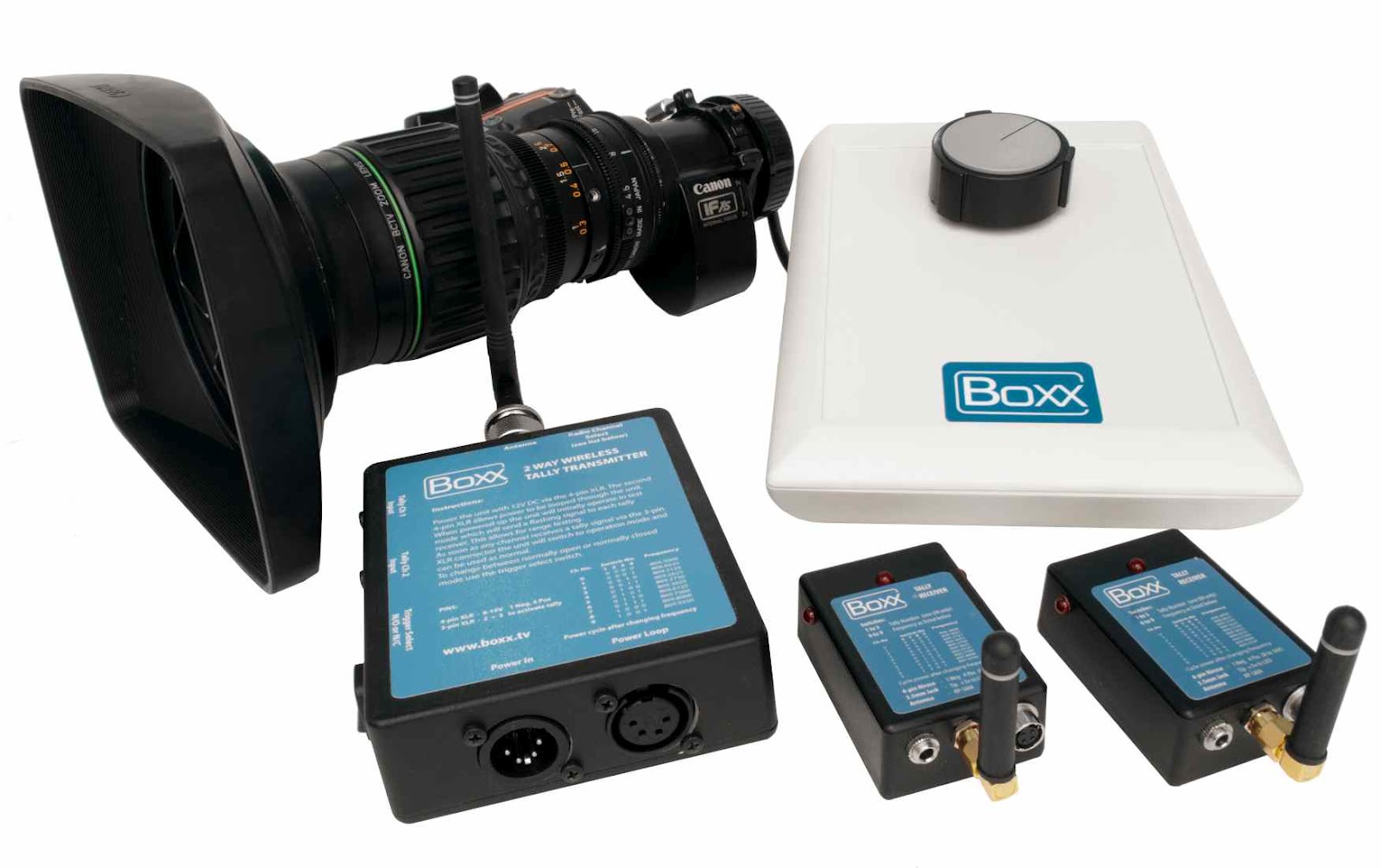
Boxx TV is launching a new zero-delay wireless link for less than $10,000 at NAB, alongside what it believes is the first Iris Control and Tally Light accessory for wireless broadcast cameras.

The Meridian Lite, its entry-level RF camera system with zero delay, is claimed to deliver broadcast HD video and sound perfectly in synch, and will support full 4:2:2 formats up to 1080p 30.

It boasts a simple interface for quick setup and ease of use, and has the same range and reliability as Boxx’s high-end systems. It will be upgradeable to provide all of the features of the full Meridian RF link.

The Meridian Lite is designed for live broadcast use on a budget, and for Steadicam operators, but it will also suit video assist, webcasting, conference, large venue audiovisual use and Big Screen outdoor presentations.

“Meridian Lite contains exactly the same technology as our established Meridian system, but with a reduced feature set. We believe the quality and performance of our RF links are unequalled at this price level,” said Boxx CTO, Scott Walker.

The existing Meridian system has been used on a wide-range of live programming, such as the X Factor finals, Who Wants to Be a Millionaire, Australia’s Got Talent, KABC and TTLA’s coverage of the Martin Luther King Parade Day and the Canadian General Elections. It is also used on a number of TV dramas and Hollywood feature films, where it is mainly used for video assist.

Meridian Tallis

Also at NAB (booth C7219), Boxx will introduce what it believes is the first iris control and tally light for wireless camera rigs, Meridian Tallis,

To keep costs low, it provides remote control only for Iris and the Tally light. This also means it is small enough to mount on any camera. As Tallis only controls the lens there is no Black level or red/blue gain control, but at a price of around $2,000, it opens up a solution to many productions where controlling the iris only is sufficient.

It works with any brand of broadcast camera on a wireless rig or Steadicam, and is not limited to Boxx TV’s own wireless camera systems.

The control knob is claimed to give accurate, high-resolution control of the iris, and the system solves the problem of providing iris control for a different manufacturers’ cameras by tapping directly into the lens to adjust the aperture.

"There simply isn’t another solution as this price point to control the iris on wireless camera rigs. This enables you to match the brightness of the video from a wireless camera with other cameras,” said Walker.

Related posts: Boxx unveils cost-saving wireless links + Boxx TV Cerulean wireless links

By David Fox