April 11, 2011

Sony enhances 3D + PMW- F3

Sony has announced new enhancements for its PMW-F3 Super 35mm camcorder, including 3D-Link capability, options for RGB 4:4:4 and S-LOG output and a wide angle, high power zoom lens.

The 3D-Link option (CBK-3DL01) will be available later this year via a firmware upgrade and 10-pin cable connection. This link is designed to provide synchronous remote command between two F3s using only one remote controller, with Genlock, timecode and camera control. Recording can be started and stopped by remote control. The PMW-F3 will be able to be used in any 3D rig that can support the camera’s size.

RGB4:4:4 and S-LOG output capabilities are available through the CBK-RGB01, which also enables Dual-Link/3G-SDI switchable functionality. It comes pre-loaded with four LUTs and five user LUTs for monitoring in S-LOG mode, and also has a planning meta function.

Two new lenses will be available for the PMW-F3: the SCL-P11X15 PL mount wide angle 1.5x zoom with a focal length range of 11-16mm and a speed of T3.0; and the SCL-Z18X140 FZ mount high power 14x zoom, with a focal length range of 18-252mm and a speed of T3.8.

The F3 is XDCAM EX-based, recording to SxS cards. Its Super 35mm CMOS imager delivers shallow depth of field, with high sensitivity and low noise levels (ISO 800, T11; and S/N ratio of 63dB in 1920x1080/59.94i mode), as well as wide dynamic range.

3D enhancements

Other additions to Sony’s 3D range include new application software for the MPE-200 3D processor box, which allows real time analysis and correction of stereoscopic 3D signals. The new MVS-7000X multi-format production switcher is capable of 3Gbps single-link operation suitable for live 3D production requirements. Sony's newly introduced SRMemory offers high-speed, high capacity recording media useful for 3D file-based production.

The MPES-3D01 3D software suite for the MPE-200 allows automatic and manual correction of images, which can "dramatically save on configuration time". There is also MPES-2D3D1 software for converting 2D into stereoscopic 3D, using Sony’s unique algorithm. Also, new 3D quality control software can perform real-time analysis of binocular disparity between left and right images, helping to overcome distortion issues that can make 3D viewing uncomfortable.

When shooting on location, production switchers are an essential component of creating high-quality, compelling 3D content. Following on from the high-end, Sony has developed the MVS-7000X, which has 80 inputs and 48 output, ideal for medium-scale 3D productions. Both products are compatible with a 3G single-link operation which together with optional 3D utility software can help to simplify the set-up of 3D Productions. The new MCS-8M and DFS-900M switchers can also be used for smaller 3D events through a software upgrade.

The MVS-7000X switcher has 80 inputs and 48 outputs, making it suitable for medium-scale 3D productions. Both it and the existing 200-input/100-output MVS-8000X are compatible with a 3G single-link operation which, together with optional 3D utility software, can help to simplify the set-up of 3D productions. The new MCS-8M and DFS-900M switchers can also be used for smaller 3D events through a software upgrade.

At NAB, Sony also introduced the SR-R1000 storage unit, the first memory-based studio deck from the SRMaster product family. The SR-R1000 has four slots for SRMemory cards, which can record at sustained data rates up to 5Gbps. It can be configured with up to four input/output ports, each of which can handle a 3D feed. Simultaneous recording and playback of multiple-streams from a single SR-R1000 makes it useful for studio, live and post production applications. Sony also launched the SR-R1 SRMaster portable recorder, which is useful for small-scale 3D productions.

Related post: Sony TD300 XDCAM 3D camcorderSR Memory lets Sony go beyond HD and Sony PMW-F3: Budget filmmaking?

By David Fox

Sony HXR-NX3D1 3D camcorder

Sony has launched a new compact, lightweight all-in-one 3D camcorder, the HXR-NX3D1, which is claimed to be exceptionally simple to operate, requiring just a simple adjustment of left-right disparity for each scene.

The NX3D1 has twin Sony G Lenses and 1/4-inch Exmor R CMOS sensors that can record Double Full HD 3D content into a single file. A 3.5-inch autostereoscopic LCD panel allows users to view content in 3D without glasses - it can display 2D, left/right or composite images.

It also has a 10x F1.8-F3.4 optical zoom (34.4-344mm - it is 12x, 29.8-357.6mm, in 2D), Optical SteadyShot with Active Mode, 96GB internal memory (enough for 7.5 hours of 3D - at 28Mbps), plus a card slot for SD or Memory Stick cards, and supports two-channel 16-bit 48kHz Linear PCM audio. It can record 1080i 60/50 or 1080p 24 in 3D and 1080p 60/50/30/24 or 1080i 60/50 in 2D.

The inter-axial distance is 31mm. Disparity adjustment can be performed to change the read-out areas of the left and right CMOS sensors so that they are closer together or further apart. This lets users control perceived 3D depth. Disparity adjustment is also possible during shooting using the manual dial. Moving a region of interest closer to the virtual screen enables shooting of comfortable 3D images with the desired feeling of depth. When capturing 3D, the minimum shooting distance is 80cm (at the wide-angle setting).

Output from its HDMI port to a 3D TV is selectable between frame packing with full HD output of alternate left and right images and side-by-side with output of horizontally compressed left and right images packed into a single frame.

It has a detachable handle with a built-in two-input XLR adaptor with selectable Phantom power and comes with an ECM-XM1 shotgun microphone.

It records using Multi-View Coding (MVC) to record left and right channel clips as a single file. These can be edited natively in Sony Vegas Pro 10.0d, without the need for time-consuming pairing. It should also be possible to convert MVC to the Cineform codec using the Cineform's Neo3D/NeoHD as a plug-in for 3D editing on the main non-linear editing systems. The supplied Content Management Utility 2.1 software also enables conversion of MVC video files to 2D AVC files with independent left and right channels.

If you record on the internal memory, the camera can also copy material directly to an external hard disk drive without the need for a computer, and can also access videos stored on the external drive for playback on a 3D HDTV.

The camera weighs about 745g, including battery (or 1,150g with lens hood, battery and microphone with XLR unit). The NP-FV70 battery should last about 190min for HD or 140min for 3D.

It comes with an AC adaptor, rechargeable battery pack, microphone, wind screen, XLR adaptor, lens hood, USB cable (mini-B), component A/V cable, A/V connecting cable, USB adaptor cable (for external HDD), Wireless Remote Commander, HDMI cable (typeC), and application software (CD-ROM).

Related post: Sony + JVC low-cost 3D camcorders

By David Fox

Sony TD300 XDCAM 3D camcorder

Sony has countered the introduction of Panasonic's first P2-based 3D camcorder with its own shoulder-mounted XDCAM EX 3D model. The new PMW-TD300 is one of two integrated 3D camcorders Sony unveiled at NAB and records at 35Mbps on dual SxS cards.

“This new camera will address many of the needs in live 3D production, working in the field as a perfect complement to the HD cameras currently used in 3D rigs by leading production companies and giving creative professionals a more flexible and mobile option for getting the right 3D shot,” said Olivier Bovis, Head of AV Media, Sony Professional, Sony Europe.

The PMW-TD300 uses six 1/2-inch Exmor CMOS sensors (two sets of three) with full HD 1920x1080 resolution. When recording in 3D, left and right eye signals are simultaneously recorded onto separate SxS cards (it has four SxS card slots in total, two slots for each view).

Although it records using a 35Mbps 4:2:0 codec, it should be able to produce good results in 3D as these are combined, and will typically be transmitted for broadcast in s side-by-side format that effectively halves the horizontal resolution.

Its shoulder-mount design adds stability in ‘run and gun’ shooting environments, which is important for 3D as jerky shots can cause viewers nausea in 3D.

The TD300 has an inter-axial distance of 45mm, with a 1.2m minimum convergence distance, so it should be useful for interview or documentary shots. A newly developed dual-lens system allows for full synchronisation with high accuracy in focusing, zooming and iris adjustment.

The camera is switchable between 2D and 3D modes. The 2D view is recorded onto a single card, with 2D redundancy achieved through parallel recording onto L/R cards. (Images recorded on the left and right cards are slightly different, because different lenses are used.) With a single SxS card, the camcorder is able to shoot images only through the left lens.

Features include: Intuitive manual convergence control with a dedicated dial; Viewfinder with 3.5-inch colour LCD; HD-SDI out (L/R dual stream, audio and TC embedded); HDMI out (3D/2D) for viewing on consumer 3D displays; Genlock in and timecode in/out for integration with multi-camera systems; and four-channel PCM audio (16-bit, 48 kHz). This is only a preliminary specification as the TD300 won't be available until Autumn.

Related post: Sony HXR-NX3D1 3D camcorder

By David Fox

Panasonic AG-3DP1 3D P2 camera

Panasonic introduced a new shoulder-mount 3D twin-lens P2 HD camcorder at NAB. The AG-3DP1 offers 10-bit, 4:2:2 independent-frame, full HD AVC-Intra recording to P2 cards.

“Less than a year ago, Panasonic simplified and lowered the cost-of-entry to high-quality 3D production with the AG-3DA1, the industry’s first fully- integrated, 3D camera recorder,” said Joe Facchini, VP of Sales and Product Marketing, Panasonic Solutions Company. “Now, the shoulder-mount AG-3DP1 offers a larger imager, 10-bit colour depth, AVC-Intra recording to P2 media, and EFP-style shooting, to expand the universe of affordable 3D production for live events, sports, documentaries and independent films.”

The 3DP1 uses two sets of 1/3-inch, full-HD 2.2 megapixel 3MOS imagers with enhanced sensitivity and a 20-bit Digital Signal Processor to acquire native 1920x1080 images. As with the 3DA1, the 3DP1 incorporates stereoscopic adjustment controls making for ease of use. The twin-lens system also allows the convergence point to be adjusted.

Functions for automatically correcting horizontal and vertical displacement are also provided. Conventional 3D camera systems require these adjustments to be made by means of a PC or an external video processor, but the integrated camcorders automatically recalibrate.

The 3DP1 records in AVC-Intra at 100 or 50Mbps, and is 50Hz/60Hz switchable. It records in 1080 at 59.94i, 29.97pN, 23.98pN, 50i and 25pN and in 720 at 59.94p, 50p, 29.97pN, 23.98pN and 25pN. It also has variable frame rate recording for fast and slow motion effects. In 720p mode, users can choose from 20 variable frame steps between 12 and 60 frames per second.

The 3DP1 will have dual zoom lenses (likely to be about 17x) and can record for up to 80 minutes on two 64GB P2 cards in AVC-Intra 100 1080/24pN. It has dual HD SDI outs, HDMI (3D compatible) out, and two XLR audio connectors, plus Genlock and timecode inputs for multi-camera operation. It also has a remote terminal for focus iris, zoom, REC start/stop and convergence point. Its 3.2-inch LCD can display Left, Right or overlay images.

As it uses P2 it can take advantage of recording features such as instant recording start-up, clip thumbnail view for immediate access to video content on all cards, and a time-saving recording modes, including continuous recording and interval recording.

It should be available this Autumn.

Related post: Sony TD300 XDCAM 3D camcorder

By David Fox

April 08, 2011

Movietech dolly escapes its chains

Movietech has announced a new version of its Arco camera dolly, which has been re-engineered to improve reliability, simplify maintenance and reduce the cost of ownership.

The Movietech Arco Dolly has become a familiar piece of equipment on film and TV sets. It has gained a reputation for being simple to operate, lightweight, sturdy and versatile. The latest technical enhancements should make it even easier to own.

The hydraulic system is now mounted on an easily extractable drawer system, to allow instant access for maintenance without having to dismantle the gearbox. The hydraulics themselves have been simplified with just one flexible tube from the circuit to the pressure chamber, dramatically reducing the chance of oil leaks.

The dolly's transmission chains have been replaced by belts, which reduces weight and means no need to grease or clean regularly, no wear of mechanical components and no need to regulate the tension.

Finally, thanks to a new valve mounted directly on the piston, it is now possible to regulate the speed of the arm much more easily.

"The dolly has always been a seriously impressive piece of equipment, being capable of lifting 60Kg five times on a single charge. Its new mechanics make it even more reliable and simple to maintain whatever the weather, terrain or shooting style," said Nick Allen-Miles, managing director of the Arco's UK distributor, Ianiro UK.

By David Fox

Canon updates EOS Final Cut Plug-in

Canon is showing the latest update for its EOS Movie Plug-in-E1 for Apple’s Final Cut Pro at NAB. The software provides quicker and easier editing of EOS Movie footage for FCP users.

The new version (1.2) will make importing EOS Movie files easier, allowing users to transfer files from any folder, without needing to mirror the folder structure on the camera itself.

It also enables smoother importing from Canon’s EOS 7D, EOS 5D Mark II and EOS-1D Mark IV models, allowing users to import footage without requiring the THM file generated by the camera.

The plug-in is designed to seamlessly convert EOS Movie footage into Apple’s high-quality ProRes 422 codec about twice fast as Apple’s standard conversion.

EOS Movie Plug-in-E1 for Final Cut Pro version 1.2 will be available to download free from 25th April 2011.

By David Fox

April 07, 2011

Canon adds 3D aid to XF305 + XF300

Canon has announced a firmware upgrade for its popular XF305 and XF300 HD camcorders that facilitates 3D shooting and adds double-slot recording.

Most of the new features were already possible on the newer, smaller, XF105, including the ability to configure two units for 3D HD video capture. The 3D Assist Function allows two units to be easily set up for 3D HD video, and adds an updated Scan Reverse function.

The new firmware includes the ability to use the optical image shift in the lenses to aid in optically aligning two XF305 or XF300 camcorders. There is also a Focal Length Guide that displays the zoom position of each camera in relation to each other to help calibrate zoom settings. This adjustment can be done through the menu system while the camcorders are mounted to a rig or tripod. Once aligned, the amount of the angle-of-view change is displayed after zoom adjustment, preventing camera misalignment and simplifying adjustment. This is similar to the 3D shooting functionality found in the XF105 and XF100 models.

The firmware will also update the Scan Reverse on the camcorders to allow for recorded images to be flipped on the horizontal axis, vertical axis, or both simultaneously to facilitate recording with 3D mirror rigs. The XF305, with its HD-SDI output, genlock, and SMPTE time code (in/out) terminals is more suitable for multi-camera or 3D production than the XF300 (which lacks these features).

Double-Slot Recording

Another new function that is already available on the XF100/XF105 is the ability to record footage simultaneously to both card slots, giving an instant backup of important content.

Relay Recording, where footage is seamlessly recorded to the second CF card as the first fills up, can now be turned off to prevent capture data from automatically being recorded to the second card. This allows the second card to be protected from recording and used only when designated or to allow the user to only copy or back up select takes to the card.

The XF300-series camcorders record MPEG-2 4:2:2 at 50Mbps (in a Material eXchange Format file wrapper), for 1920x1080 HD recording onto Compact Flash cards, and are accepted as full HD by the BBC for use on its programmes – as they are the least expensive camcorders on the approved list, they have become very popular for use on observational documentaries and magazine programmes.

The prototype firmware will be on show at NAB and is expected to be available for download in Q3 2011.

By David Fox

April 06, 2011

GoPro acquires CineForm - Goes 3D

GoPro, makers of the best-selling PoV action camera, has bought CineForm, creator of compression technologies (such as NeoHD, Neo4K and Neo3D) used with mainstream editing systems.

“CineForm is an industry leader in video codec technology and is famous in professional circles for their HD and 3D content creation tools. As GoPro is focused on making it easy for consumers to capture professional quality content, we’re eager to incorporate CineForm’s technology and passion into future GoPro products," explained Nicholas Woodman, GoPro’s founder and CEO.

The cross-platform 12-bit CineForm 444 Codec makes HD and 3D editing faster and more convenient while retaining image quality. CineForm has produced several award-winning editing applications that exploit the functionality of its codec, all of which are compatible with the likes of Adobe Premiere Pro, Apple Final Cut Pro, Avid Media Composer, and Sony Vegas, as well as Apple iMovie and Windows Movie Maker. Following the acquisition, the codec has been renamed GoPro CineForm "to emphasize GoPro's commitment to developing professional content capture and editing solutions."

“Numerous Hollywood feature films, including the runaway Oscar winner, Slumdog Millionaire, were captured with CineForm’s codec and edited with their software tools,” added Woodman. “GoPro is in constant pursuit of image quality and CineForm represents a terrific step for us.”

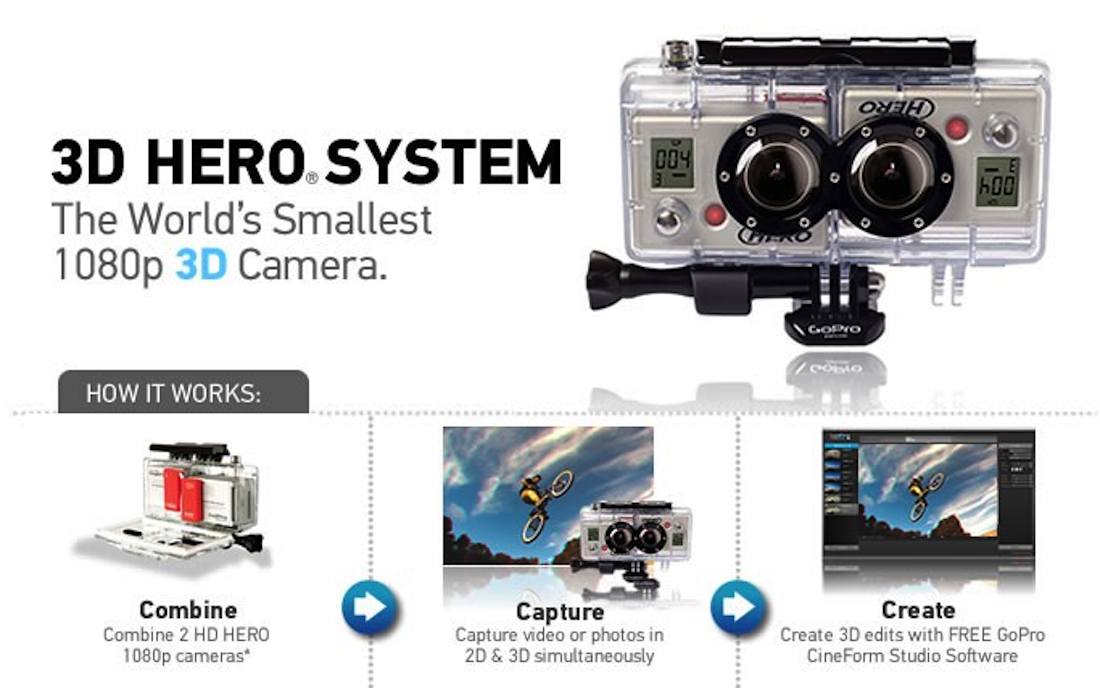
The first new GoPro product to incorporate CineForm’s technology is the new 3D Hero (pictured), a $100 expansion accessory for GoPro’s 1080p HD Hero line of cameras (cameras not included, but only $260 each), which started shipping this week.

The 3D Hero allows users to combine two of the cameras in a single housing to capture synchronized 3D photos and video. A synchronization cable joins the cameras via an expansion port on the back of each, and the package comes with the CineForm Studio 3D editing software, which converts the 3D Hero files into 3D H.264 files or 10-bit CineForm 422 Codec files.

“GoPro has come out of nowhere to become a leading HD capture solution for professionals wanting to capture new, never before seen perspectives,” said David Newman, CineForm’s co-founder and CTO. “We were very impressed with the 3D Hero System’s ability to rival cameras costing ten times as much. We’re looking forward to putting CineForm’s content creation tools into more hands than ever before thanks to GoPro’s global brand and distribution.”

David Taylor, co-founder and CEO of CineForm added: “It’s exciting to look out and see how many people, consumers and professionals alike, are using GoPro cameras to create compelling content. As we worked with GoPro over the last year, the more we learned about GoPro’s vision, the more we realized how complementary GoPro and CineForm are to each other. We’re thrilled to join GoPro and to help usher in a new era of accessible professional content capture and creation.”

CineForm will move to GoPro's San Diego offices, and will continue to develop its own software as well as working on new GoPro products.

The HD Hero camera is claimed to be used by more professional production crews in the broadcast and film industry than any other camera in its class. GoPro recently released a new $80 LCD BacPac attachment for the cameras and apparently shipped 75,000 in the first month. They are widely used by the BBC, on such programmes as Top Gear and Countryfile, the Discovery Channel, and almost any show dealing with skydiving, winter or water sports (the housings are waterproof). Fans include Lucasfilm producer Rick McCallum, who said: "When I saw the footage from the GoPro on our big screens at Skywalker Ranch, I was amazed..."

By David Fox

Birger adapts AF101 to Canon lenses

Birger Engineering is launching a new lens adapter at NAB that allows Canon EF-mount lenses to be fitted to Panasonic's AG-AF100/AF101 camcorder.

It will ship in May and allows users to have automatic and manual control of focus, iris and image stabilization with a variety of EF-mount lenses. Continuous (video-style) auto-focus will be supported on most Canon L-series lenses. Power is provided by the camera for most lenses. Image stabilization is supported on IS lenses, and this can be turned on or off from the lens.

The adapter will cost about £475 ($700 in the US), and optional cinema-style remote control will also be available. Birger also makes a Canon EF mount adapter for the Red One.

The move to large sensor camcorders was started by Canon with the full 35mm frame 5D Mark II, followed by smaller APS-C (Super 35mm sized) models like the EOS 7D. Their success has sold thousands of EF-mount lenses to video users.

Unfortunately, they are still essentially stills cameras, which is why there has been so much interest in the AF100/AF101 (as well as Sony's new Super 35mm camcorders, such as the PMW-F3 and FS100), which offers a full range of video controls.

"This new unit will give producers access to so many more lens options; we believe this will have massive benefits for their creativity," said Erik Widding, CEO of Birger Engineering.

"We think that this is what the industry has been waiting for," added Allan Leonhardsen of Holdan UK, the adapter's European distributor. "While [Panasonic's own] Lumix lenses are very strong optically, obviously the range can't yet match Canon's - after all they have been developing EF mount products since 1987. The Birger adapter opens the way for AF101 users to a far greater choice of lenses."

Holdan has also just been appointed as an official distributor for Panasonic's range of P2 products, including camcorders, drives, decks and media.

"As the distributor of our AVCCAM range, Holdan has already helped Panasonic increase our share of the market and deliver excellent service to the professional community," commented Adrian Clark, General Manager UK & Ireland at Panasonic AV Systems Europe. "Holdan's skills in logistics, marketing and customer support also make them ideally placed to help us drive demand for our P2 technology. This new appointment reflects the hard work that Holdan has put in to earn a reputation as a true value added distributor."

"Panasonic's P2 system is class leading with robust build quality and excellent all round performance, backed up with a mature, efficient workflow. We are delighted to represent a brand such as P2 that has been adopted by broadcasters across the world. We are looking forward to working with the channel to give P2 an even higher profile in the UK market," said Leonhardsen.

Other broadcast products Holdan distributes include: Grass Valley, Datavideo, Sonnet Technologies, HP, Apace and Blackmagic Design.

By David Fox

April 05, 2011

Atomos Ninja bug slips ship date

Deliveries of the Atomos Ninja have been delayed. It was expected to start shipping in mid-February, but a bug was discovered in the release firmware that had to be put right. However, the latest word from Atomos is that it should finally start deliveries about now....

"We had a very strange bug in the release version that has taken us a few weeks to fix, we are shipping this week, I am testing all now," explained Atomos CEO, Jeromy Young.


[UPDATE: The Ninja is now on firmware 1.04, and really is shipping, although in limited quantities. We've just had one delivered for review. There is still work to be done, especially on improving playback of recordings, but Ninjas should be out in force at NAB next week, alongside the new Samurai - which will have a slightly larger screen (at 5-inches compared to 4.3-inch, and with higher resolution - 800x400 compared to 480x270) and use HD/SD-SDI inputs instead of HDMI. It will loop through the SDI signals for use in other equipment, such as a monitor, and have timecode and genlock - it will even allow you to sync multiple Samurais, which could be useful for 3D use. There should also be the ability to extract 24p (3:2 pulldown) from 60i PsF footage in realtime (using hardware). It should cost about £929/€1,095/$1,495.]

April 04, 2011

Fast Forward's sideKick recorder

The rise of the high-quality SDI solid-state on-camera recorder will continue at NAB 2011 with the launch of Fast Forward Video's new sideKick HD combined recorder/monitor.

The $2,495/£1,695 sideKick HD includes a 128GB solid-state 2.5-inch (laptop sized) drive. It joins: the recently-introduced AJA Ki Pro Mini (which uses CF cards and costs about £1,400); the new Atomos Ninja (SSD or HDD, and about £680, but HDMI only, although an SDI version, the Samurai will launch at NAB); the Convergent Design nanoFlash (CF cards, about £2,250) and its new Gemini 4:4:4 (SSDs, about £5,000); and a new SDI-based CF card recorder from Datavideo also expected at NAB.

Like the Ki Pro Mini and Ninja, the sideKick HD records Apple's 10-bit ProRes 422 codec (at 145Mbps to 220Mbps), which can be imported straight to the timeline in any non-linear editor running on a Mac (or on Windows with a QuickTime plug in).

Additional codec options are promised in future, in purchased firmware updates.

The sideKick includes a 480x272 pixel resolution 4.3-inch TFT display for live and playback monitoring (including scrub and jog).

It has both HD-SDI and mini HDMI inputs (so can be used with DSLRs and budget camcorders without SDI), and it has automatic recording and frame rate/resolution sensing functions. It can record: 1080p at 29.97, 25 or 23.98, 1080i at 59.94 or 50, and 720p at 59.94, 50, 29.9, /25 or 23.98. It can also record eight channels of embedded audio at 24 bits/48 KHz, and has an analogue mini-jack microphone input.

It measures about 16x10.5x5.3cm, and weighs about 285g without the drive. There is also a USB port, which FFV says is for future use.

The sideKick HD comes with an AC power adapter, has a Mini XLR power connector (9-16v DC), and requires 16-21W of power. It can also be fitted with an Anton/Bauer or V-Lock battery adapter cable or have an optional external battery with charger.

By David Fox

Ianiro's shining new Alladin lamp

Ianiro has introduced a new LED version of its Aladdin 12v on-camera light that is about as bright as a 50W conventional tungsten unit with less than half the power consumption (18.7W or 9.3W).

Ianiro's lighting engineers have found that only high quality LEDs in particular arrays can deliver real efficiency and the right balance between consumption, performance and longevity. They claim that many earlier generation LED systems "have lacked the efficiency or performance required by television producers."

Ianiro's latest lights use Ianileds, which benefit from precise LED colour groups combined with new custom-designed printed circuit boards. They use Osram Oslon SSL LEDs, which are very small light sources designed to maximize efficiency, and have resulted in a slim, compact lighting unit that is claimed to deliver "directed light with outstanding efficiency." The light employs a mixed configuration with six white LEDs balanced by an amber LED to produce a colour temperature suitable for digital acquisition (about 5600K with quick White Tune settings of Warm at 4500K and Cool at 6500K). CRI is claimed to be more than 90.

The light has a wide-angle beam (80°) that is suitable for 16:9 production, is claimed to deliver a natural skin tone, and has a lifetime of around 50,000 hours.

It has a dimmer control, with colour temperature constant across the range, and a flip down tungsten orange filter (3200K). It comes with barn doors, a hinged arm and a D-Mount/Power Tap connector (other power connectors can be fitted).

By David Fox

April 01, 2011

SR Memory lets Sony go beyond HD

The centrepiece of Sony's offering at NAB will be its new SR Memory, an expansion of its SR format, and a move beyond HD.

The HDCAM-SR format has been Sony's high-end system for tape-based recording, but it will soon be moving mainstream, for broadcast multi-camera recording and as an option on its mid-priced PMW-F3 Super 35mm camcorder. It will also be going tapeless, using solid-state cards with capacities of up to 1TB.

This is part of Sony's push to cater for not just HD, but higher resolution capture, including 4K and above. Of course, "resolution alone does not make better pictures. There are other imaging parameters that we need to consider, such as higher dynamic range, wider colour space, multiple view points (such as 3D), and higher frame rates," said Yasuhiko Mikami, its Senior Manager for Product Planning (pictured above with the F3).

"By improving the technology and our products in these five directions, we can start addressing new applications that exist outside of the traditional broadcast business, such as 4K cinema and ODS (other digital stuff), UDTV, 3D, and HDR." Ultimately, he hopes that Sony can come up with "a group of new products that pretty much does everything."

The new SR Memory is the first generation of this, and will allow real-time recording and playback, file-based post production, and offer scalable compression levels for different types of application (one of the first of which he believes will be for the Olympics in 2012). It uses the MPEG-4 Simple Studio Profile, which covers everything from standard definition to 4K x 2K 4:4:4 at 10- or 12-bit 50/60p.

"Memory is a very good choice for high-capacity, high-speed recording, but there is still the problem of archiving, so we have to come up with a good way of integrating memory and tape for archive," he added.

To enable SR file based operation, it is providing the native SR compressed file and wrapping it in MXF. "SR is based on MPEG-4 SStP. A completely open codec," he explained. For high-end post work, this can be encapsulated in DPX files. However, this would be unnecessary for most broadcast work, so it is also adding a new level: SR Lite, which will record at 220Mbps. The other levels are 440Mbps SQ, for acquisition and post, and 880Mbps for 1080 50/60p and visual effects.

On File

SR Lite means "you can shrink the file size to half with minimum sacrifice in image quality. We firmly believe it is important to keep your camera original material at the highest possible quality. However when you're finished with grading, compositing, editing, you can shrink the file to make it pass through the broadcast food chain more easily. We also plan to create SR Lite files from regular HDCAM tapes, so that images acquired on your ten-year old F900 will still fit into the modern post production environment."

Sony has been working with the EBU to offer a production codec for HD production, and tests have shown that "SR Lite seems very promising, even after multiple generations."

The simplest way to go file based is to upgrade its existing SRW-5800 HDCAM/ HDCAM-SR tape deck. The new 5800/2 (above) will offer MXF file transfer, 4:2:2 and 4:4:4 double-speed recording and playback, 3D recording and playback, 2K in real time (2048x1556 / 2048x1080), and 12 channels of 96k/24bit audio.

Avid's Media Composer, Apple Final Cut Pro and FilmLight will all be supporting SR, and Mikami, who was speaking to a dealer meeting in London, showed plans for an SR Data Transfer Unit that will allow fast ingest of cards or tapes to servers or NLEs. It will support NFS and CIFS disk formats to mount a shared directory or folder on NLEs or servers, and can ingest using Gigabit Ethernet or, optionally, 10GbE. It will also clone SR Memory to tape at two times normal speed and will be controllable via a web browser.

On Deck

There will also be a new SR Memory Deck (the prototype is pictured above), which can be used as a multi-channel recorder for studio or outside broadcast. It is smaller than a normal VTR (4RU), but can handle four channels of I/O, including 3D or 4K, recording at 220Mbps, 440Mbps, or 880Mbps, or uncompressed DPX, with 16 channels of 24bit PCM audio. Each HD video channel is 3G SDI dual-link capable - 1080/60P 3D or Key + Fill. It can also have up to 8TB of internal fixed memory, giving it a maximum capacity of 12TB (100 hours of SR Lite). It can also copy material to SR tape for backup.

"The Memory Deck is very flexible in terms of I/O. It can combine four cameras onto a single card and use another card as backup, or one 2D or 3D camera onto four cards, if required," he explained. Theoretically it could have 12 inputs and record 12 channels onto a single card.

It can also do an "extremely fast" copy between a card and the built-in solid-state drives. It can also be used for slo-mo recording, and Sony is talking to third-party slo-mo controller companies about this, although it won't work at very high frame rates, but that is an interface problem rather than an internal problem. "You can't feed a 1,000 frame per second signal into the recording yet, but it will have a 4K video card in future which will support up to 240fps HD."

SR memory has a guaranteed transfer rate of 5Gbps, more than fast enough to enable multichannel HD and high framerate recording, and cards will be offered in various capacities, from 256GB to 1TB.

Sony chose 5Gbps as its design goal because if you record 4K 60p, full RGB, 10-bit material, the uncompressed data rate is about 20Gbps. "Then apply 4:1 good quality compression, like SR, and that gives 5Gbps."

An SxS card has a maximum transfer rate of 800Mbps, but this can fall to 200Mbps due to fragmenting and poor memory management. However, in SR Memory "a very clever memory chip controller mechanism is built in, so you will never skip a frame during recording or playback." It ensures that no single memory sector gets over used (making it more likely to fail), and has "incredible error correction."

Even if, in the worst case, some memory chips in the card fail, the system can recorder the data. This means that users don't have to stack up multiple cards with a RAID controller to make the system secure.

On Camera

For acquisition there will be a portable SRMemory recorder (above) capable of 3G and HD-SDI dual link recording, including uncompressed DPX files.

When used with an optionally-upgraded PMW-F3 Super 35mm camcorder, it can record 10-bit S-Log RGB files, with look-up tables (which are baked in to the MPEG-2 4:2:0 copies recorded to the SxS card, for offline use). "It's a very self-contained, integrated solution," said Mikami. However, it does need a dedicated power supply. The unit could be used with any camera with dual-link SDI, but it will only handle variable speed recording on the F3, thanks to a dedicated connection – the F3 apparently won't do variable frame rates with third-party recorders.

The high-end SRW-9000PL camcorder (above) started shipping as a tape-based unit, but there will be a card-based version by the end of the year, and all existing models will be upgradeable (with the card recorder replacing the tape drive). Users could also just add an external SR Memory unit in addition to recording to tape.


It offers RGB 4:4:4 sampling without interpolation (as in graphics above), at 1920x1080, with no deBayering needed (and therefore no interpolation as in typical Bayer pattern sensors - graphic below), as its Super 35mm sensor has an equal number of RGB pixels. It also has 12 +stops latitude at ISO800, S-Log and S-Gamut.


The F35 (below) and F23 will also be usable with the portable recorder, using a different connection that allows it to dock directly with the camera (the same as the existing SR tape recorder). It also adds the ability to do DPX recording and to work at up to 50 or 60fps (respectively) in 4:4:4 at full HD.

www.pro.sony.eu

By David Fox

March 28, 2011

Format choice: Going tapeless

Virtually every camera now available uses some form of tapeless recording. The few tape-based camcorders still being produced can record to some form of add-on memory or external recorder. However, with choice comes indecision... Moving to a new format or recording media means additional costs and trying to find a new workflow that's efficient and works for you and your clients.

To help put all of this in context, we've talked to camera users and owners about what tapeless systems they use, to find out the benefits and the disadvantages, and have put up a comprehensive (and rather lengthy) page on going tapeless.

March 23, 2011

Gemini twins record 4:4:4 and 3D

Convergent Design has announced a new uncompressed hard drive recorder/monitor. The Gemini 4:4:4 is a small, low power, lightweight unit that has two drive slots for 1.8-inch solid-state drives, allowing simultaneous backup recording or optional 3D.

The Gemini includes a 5-inch 800x480 24‐bit, 900:1 contrast LCD touch‐screen for monitoring and playback, with zoomable 1:1 pixel viewing, with user positioning via touch control, for fine focusing.

It doesn't replace Convergent Design's existing nanoFlash (which records to CF cards and now has an installed base of over 3,500), but its use of higher-speed drives enables Gemini to record 10‐bit 4:4:4 or 4:2:2 video in the main HD, 2K or 3G formats, including 1080 24p and 1080p 50/60, with up to 16‐channels of embedded audio and timecode (four channel audio initially, which will be expanded in a firmware update).

The 1080p 50/60 data has to be striped across both drives, while 4:4:4 is only supported in 1080p 23.98/24/25/29.97 and 2048x1080p 23.98/24. The DPX file format will be supported in a firmware update.

"Uncompressed is a lot of data, typically in the range of 125 to 150 megabytes per second [1 to 1.2Gbps]. But, technology advancements now make full uncompressed workflow quite manageable and affordable," explained Convergent Design President, Mike Schell. "For example, using the new 10Gbps Thunderbolt technology from Apple/Intel, it is now very reasonable to edit uncompressed using a laptop. New $180, 3-Terabyte hard disk drives enable portable RAID arrays with 9-12TB of storage (sufficient for 18-24 hours of uncompressed 1080p24 4:2:2 10-bit)."

Having two removable solid‐state drives allows it to offer instant backups, to counter the risk of lost footage, or longer record times from recording on one drive after the other. It also opens up new workflow options. Gemini includes S‐Log and C-Log video support, with user programmable viewing look-up tables, which can be enabled selectively for either HD‐SDI output. This means that users could record native S‐Log to one SSD (for on‐line editing) and the same footage with burned‐in LUTs to the second SSD (for faster creation of offline proxies and/or H.264 video for mobile or web viewing).

An extra‐cost 3D stereographic option will also be available, enabling dual‐stream recording and playback in a single Gemini unit; creating what is claimed to be "the world’s smallest, lowest power, 3D recorder."

Gemini will record independent left/right channel files while providing full synchronized playback of two streams as well as side‐by‐side, 50/50 composite, or anaglyph combinations. "Gemini uniquely allows you to simultaneously view 3D video in multiple formats, such as side by side and 50/50 composite, which should be very helpful in 3D camera alignment," he added.

It is housed in a lightweight (450g), milled aluminium case, and is about the same size and weight as the popular SmallHD DP6 monitor, but includes recording, playback, image processing, dual HD/3G SDI I/Os, HDMI output and consumer level audio I/O; while consuming only eight to 15 Watts of power.

Planned future enhancements include reference image overlay (onion skinning), where users can capture still frames or create their own reference images (custom grid overlays, for example) to mix with live video, using an opacity slider. This will enable directors to check the current on‐set environment against a previous day’s production, assisting in camera setup and easily identifying anything out of place. Other features include: user-programmable over/under crank, time lapse, 3:2 and 2:2 pull-down removal, and on-screen tally.

Convergent plans to support all major NLE programs, including Avid, Final Cut Pro, Premiere, Vegas and Edius. Editors have the option to edit full uncompressed video (transfer time off the SSD to a fast hard drive is about 1/3 real time) or use any of the popular codecs (ProRes, DNxHD, Cineform, etc). For example, using a recent eight-core MacPro, the transfer from the SSD and software encode to ProRes, occurs in about half real time (60 minutes of video requires 30 minutes to transfer and encode – a simple transfer of the same footage would only be about 10 minutes faster).

"We found that oftentimes the workflow and editing system is not well defined at the beginning of a production, or the client may want the footage in a different codec or format. Gemini gives you the flexibility to deliver accordingly, at the best possible quality levels. So after two weeks of shooting, when the director brings word that you’re changing from PC to Mac (or vice versa), you’re ready to encode that pristine uncompressed footage into a new codec / format, while maintaining the highest possible quality," said Schell.

The requirement for greater throughput meant Convergent had to switch from Compact Flash to SSD. "Compact Flash is a great choice for most compressed recorders, but it simply lacks the required performance for uncompressed video. Compact Flash tops out at about 90MBps, while uncompressed video ranges from 100 to over 300MBps so, clearly, it’s impossible to record uncompressed video onto a single CF card. Additionally, CF card capacity maxes out at 128GB, while SSDs are now available up to 512GB," he explained.

The Gemini SSDs provide read/write speeds of 415/260MBps respectively. "For most video formats, a single SSD has a sufficient bandwidth; however, 1080p 50/60 formats generate over 300MBps, requiring us to strip the data across both drives. We do, however, combine the data into a single file during the offload of the SSDs to your Mac or PC." The drives have a 6Gbps SATA interface.


3D nano - Convergent Design from UrbanFox.TV on Vimeo.

Gemini won't replace the nanoFlash, which "will continue to find applications needing long record times (10 hours), and/or requiring a strictly compressed workflow. At $1 per minute [at 50Mbps] for the Compact Flash media, nanoFlash still offers the lowest media cost for broadcast quality video."

Most of the nanoFlash features, with the exception of pre-record buffer, should be enabled for Gemini when it ships. "That said, we anticipated many special requests, so Gemini was designed with five times the programmable logic compared to nanoFlash, giving us quite a bit of room to grow (feature-wise, that is)," added Schell.

The Gemini 4:4:4 Kit, which includes the recorder, 1.8-inch SSD to eSATA transfer station, AC power supply and cables, housed in a custom‐fitted hard plastic case, will cost $5,995. The 1.8-inch 256GB and 512GB SSD drive prices will be announced at NAB, where Convergent will demonstrate Gemini 4:4:4 on a Sony F3 and on a 3D mirror rig.

Related post: Convergent Design Odyssey7 + 7Q

By David Fox