February 09, 2010

Canon cuts cost of HD

Canon has introduced a new, entry-level HD DSLR that will cut the cost of shooting full HD, taking it well below the price of any semi-professional camcorder. The new EOS 550D (Canon Rebel T2i in the US) camera will probably be available for under £800, including a kit lens, when it ships on February 24.

It uses a newly developed 18 Megapixel APS-C (22.3x14.9mm) CMOS sensor (more than five times the size of the 2/3-inch sensors commonly found in broadcast cameras), with Canon’s advanced DIGIC 4 14-bit image processor, as used in the larger 7D (which we used to shoot our video at the Canon event).

Users can record 1920x1080 at 24, 25 or 30 frames per second, or 720p at 50 or 60fps. As seen with the 7D, the 550D Rebel T2i should produce excellent pictures in low light – it can record at ISO settings of 100 – 6400 (expandable to 12800), with noise reduction delivering clean looking images. It also has a 3.5mm stereo microphone socket for an external microphone.

Highlight tone priority can be set independently for movie capture, without changing any still image capture settings. The 550D Rebel T2i also has a new Movie Crop function that records with the central 640x480 pixel area of the sensor, giving 7x magnification, however this isn't available for HD recording (where it would probably have to be 4x or 5x – perhaps an HD version is something for the future).

From an ergonomic point of view, the smaller size, and lighter weight (530g body) of the 550D Rebel T2i, may make it easier to hold than Canon's existing, larger, HD DSLRs.

For video output, there is a mini HDMI port, but this doesn't give access to the uncompressed video signal (for recording to an external recorder). Recording, to a SDHC card, uses the .MOV format with H.264 video and Linear PCM audio at 45Mbps (for a maximum duration of 30 minutes or 4GB file size).

There is also a 3-inch 720x480 pixel LCD screen (which has to be used in video mode as the conventional viewfinder can't be used because the internal mirror is locked up).

Plugging in to FCP

Canon has also announced a new EOS Movie plug-in for Final Cut Pro, to enable quicker and easier editing of EOS footage. A free Beta release of the plug-in will be available to download in March.

The plug-in will enable the log and transfer of video footage from the EOS 5D Mark II, EOS 7D, EOS-1D Mark IV and the 550D, and convert the recordings to Apple’s high quality ProRes 422 codec at approximately twice the speed of Apple’s standard conversion. Users will also be able to add timecode, reel names and metadata.

Related posts: HD DSLRs: Still developing and HD DSLRs: nice pictures, nicer price

By David Fox

Ikonoskop goes stereo with 3D A-Cam

Ikonoskop has created a 3D version of its tiny A-Cam dII uncompressed HD camera. The Stockholm-based manufacturer already has several clients lined up who want to shoot with the new camera, which will be built to order and could be five or six times the cost of the standard version. Both versions of the a-cam should be available by the Summer – the A-Cam dII at the new, lower price of 5,000 Euros.

The A-Cam3D will record 1920x1080 at 25 or 30 frames per second, uncompressed, at 12-bits, using Adobe's Cinema DNG RAW format. The video signals from each lens will be captured to two separate, timecode-locked 80GB memory cartridges.

The initial version (pictured) has been designed for action use, with a distance between optical axes of 91.5mm, and would weigh about 2.8kg including battery and memory cards. However, models could come with different fronts, to allow for the use of different lenses or lens positioning. This is one of several aspects that will have to be worked out in conjunction with the initial users, according to Ikonoscop's creative director, Göran Olsson.

"What's great about our camera in 3D work is that we work in uncompressed RAW. It's a very good thing for compositing," he said. "Also, for action, it is very compact. You can mount it easily and put it in tight situations." The only other twin lens 3D camcorder yet announced is Panasonic's $21,000 unit, which will record a compressed signal. There are compact 3D rigs for small cameras from several makers, but these won't be as simple to set up.

"We can provide our clients with something they can't find anywhere else," he said.

By David Fox

February 01, 2010

HD DSLRs: Still developing

Review of the Canon EOS 7D - DSLR Camera

There has been a lot of interest amongst video users in digital stills cameras recently, mainly because DSLR camera manufacturers like Canon, Nikon and Pentax have brought out reasonably priced, large sensor models that can record HD. Now, if you want a 35mm camera that can shoot HD (720p or 1080p), and take different lenses, you can buy one for less than the price of a used Sony EX1.

Canon has been the major player, especially with its 5D mark II, although that only records at 30 frames per second. We have been promised a firmware upgrade which should add 24 and 25fps - possibly due April 2010.

However, the latest Canon EOS 7D already has all the frame rates, and costs less, although it has a smaller sensor (APS-C, about 23x15mm).

It is an impressive stills camera, but while its 18-megapixel CMOS image sensor is great for still images, CMOS is not so suitable for video (although many video cameras have them). One of its problems is skew. This happens when you pan the camera and verticals don't look vertical on recording because the CMOS sensor reads line by line rather than all at once.
Some users may also notice aliasing. 

But, in the right hands DSLRs can produce stunning results.


The Canon EOS 7D It is not exactly a light camera (it weighs about 1.39kg with an 18-135mm zoom lens). Even with the image stabilisation in the lens switched on it was tricky to hold still because you couldn't hold it up to your eye (in video mode it only uses the rear LCD) so, it went on my Miller tripod and stayed there.

The 7D offers ISO speeds of 100-6,400, expandable to 12,800. My first thoughts were that any image taken at such a high ISO would be very grainy – but the camera's DIGIC 4 processors remove colour and luminance noise to give a cleaner image.

It has the usual optical eyepiece and a 3-inch LCD with 920,000 dots. I'm used to staring at LCD screens on cameras like the Sony HVR-Z1 with only 250,000 dots, so the Canon's screen was a joy to watch. Unfortunately, it is shiny and you do get a lot of reflections that are distracting when trying to shoot. If you were seriously considering buying this camera (or any of the other DSLRs) for video work you should take a look at the Zacuto Z-finder V2. It will keep out the light from the screen and, importantly, act as an extra point of contact with your body, for stability, if you are going hand held.

For video the camera uses MPEG4 AVC encoding wrapped up in a .mov file, and records onto Compact Flash cards at up to 45Mbps.

This is not a format to edit with. So, you'll need to consider software to convert it to something more edit friendly. MPEG Streamclip from Squared 5 gets consistently good reviews and is free.

In HD mode you can only record about 12 minutes of video on a 4GB card. There is only one card slot – so you can't hot swap like a Panasonic P2 camera or Sony EX. Buying a bigger card won't necessarily solve the problem, as the camera will stop recording once the file size reaches 4GB. So this might not be the perfect camera for doing that 'locked off shot'.


Recording times


4GB card
16GB card

1920x1080 HD
12 mins
49mins
24p (23.976fps), 25p (25fps),
30p (29.97fps),

1280x720 HD
12mins
49mins
50p (50fps)
60p (59.94fps)

640x480 SD.
24mins
1h 39mins
50p (50fps)
60p (59.94fps)

Stills cameras have been able to shoot video for some time – although not very well. But now the technology has improved and it is hard to deny that the results can be very good. I recommend you type 'Canon EOS 7D' into the www.vimeo.com website search box so that you can see some incredible results. If you shoot news and docs look at Guardian photographer Dan Chung's work on Vimeo and http://www.dslrnewsshooter.com

If you are a Mac user there is a lot of help getting your footage from camera into Final Cut Pro. One very helpful page is on Chris Fenwicks site. Vincent Laforet is also very helpful with advice and mentioned an upcoming new plug in (again for FCP).

The audio however is a different story. The camera does have an on board microphone which may come in handy as a guide track but it definitely won't be good enough for broadcast, it will also pick up camera handling noise and wind noise.

You really do need to record the audio on a separate recorder. Trawling through the forums it looks like most people buy the Zoom H4n. It has its own built in stereo mic, if all you need is some atmos. But, it also has two XLR sockets and can record at 48kHz, which should keep your editing software happy. With a splitter you can take an output from the Zoom for monitoring and feed the recorded audio in to the camera as a guide track for synching later. The problem is where do you put it? Maybe it might signal the return of the sound recordist.

You can swap info with other Zoom users at the Zoom forum.

If you don't want to be tethered to the recorder. Then you'd better brush the dust off your clapper board as it will once again come in handy to sync sound with vision. Funny how the more technology improves the more we rely on the old ways of working.

The evolution of the video camera has given us a body shape and layout that puts everything you need just where you want it. The iris, gain and white balance can be found without even taking your eye from its fully adjustable viewfinder.

I know many GTC members hate the Sony Z1 type cameras because of (amongst other things) their shape. But these DSLRs are even trickier to hand hold for any length of time. Unless you have the arms of a weight lifter you'll also need some sort of rig to make it feel more like a shoulder-mounted camera. Add in the cost of the viewfinder and your cheap video camera starts to look a little more expensive.

Rigs available include:
Check out their sites for demonstrations of how to use the kit and examples of user's videos.

But, if your budget is tight, start with a good old fashioned tripod. I used the camera on a weeks holiday and to keep the weight down I used my Manfrotto 561B monopod (which has feet!).


There is no peaking to help with focusing (and, even if you wanted to, Canon doesn't recommend using auto focusing when the camera is in movie mode.) There are no zebra stripes either, but there is a histogram which takes up about 1/9th of the screen. If you are used to using a shoulder mounted camera then using a DSLR will require some time to acclimatise.

Certainly, if you intend to use the camera, I recommend you download the manual (and any drivers you may need) and have a play with the camera before the shoot. For example, it took me a while to work out how to manually white balance. It isn't intuitive. 

You can also watch simple tutorials on the EOS 7D at Canon's USA site. 

Why buy one of these cameras?

Lenses, lenses and lenses. The range of lenses you can get for a DSLR is eye watering, but the prices generally aren't. So, if the director needs a one off special shot in a difficult location this camera could make you the hero of the hour.

I'd recommend you read photographer Doug Klostermann's page on "Why You Shouldn’t Buy the Kit Lens".

If one thing stands out, it is the possibility of very shallow depth of field. It seems everyone wants that film look and with 24p and a little help in post – you can have it at a relatively cheap price. The camera body costs around £1,200.

Time lapse on these cameras is stunning. If you are a timelapse newbie, start with Timothy Allen's starter guide. Take a look at the some great examples of DSLR timelapse by Tom Lowe at TimeScapes.


And if you mix timelapse and HDR (high dynamic range) photography - the results can be beautiful.

If you set the camera to record the largest still image size (5184x3456 pixels) you can import the time lapse stills into your editing software and pan and scan around the video. For a tutorial on how to do this on a Mac, Philip Bloom comes to the rescue. 


However, for timelapse you will have to spend about £100 extra on an intervalometer remote control unit to tell the camera when and how often to take each still image.

If money is tight, this camera may be all your low budget production can afford, and some people have shot incredible footage on it. It is not primarily designed to be a video camera, which means almost everything you do with it will be some sort of workaround, but considering the price, it could be worth the effort.

Would I buy one? 
I originally had a camera on loan from Canon for a week to write this review for the Guild of Television Cameramen's magazine, Zerb. I genuinely liked the camera - enough to buy it. I'm still experimenting with it and it really is essential to have the Zacuto Z-finder, which I now have on order.

Related post: HD DSLRs: nice pictures, nicer price and Canon cuts cost of HD

By Christina Fox

January 11, 2010

Panasonic unveils HD 3D camcorder

Panasonic has announced what it claims is the world’s first professional, fully integrated Full HD 3D camcorder. The Wall-E look-alike should start shipping late 2010, and Panasonic will start taking orders at NAB, when more details will be announced. It showed engineering samples of the solid-state camcorder at CES in Las Vegas, last week, and estimates that it will cost about $21,000.

The new camcorder should be simpler to use than existing twin-camera set ups, as its two lenses, camera head and dual memory card recorder are integrated into a single body. The camcorder also has stereoscopic adjustment controls. The twin-lens system allows the convergence point to be adjusted (according to the closeness of the objects being viewed), and there are also functions for automatically correcting horizontal and vertical displacement. Most current 3D camera systems require these adjustments to be made via a PC or an external video processor. The Panasonic camcorder will automatically recalibrate itself, making it easier to react quickly to changing requirements.

The camcorder is also a lot lighter and smaller than most current 3D rigs (although systems from Lux Media Plan [pictured right] and Polecam are smaller still, as both use two tiny cameras). However, the Panasonic model should be ideal for handheld use. Its simpler set up should make it particularly suitable for sports or documentary production.

Most conventional rigs require time-consuming adjustments whenever they are moved or knocked, but as this is a combined unit, the two cameras shouldn't go out of alignment. However, this may mean that it isn't as flexible in getting the perfect alignment for objects at certain distances.

All side-by-side 3D systems have an advantage over larger mirror rigs (where the cameras are too big to sit beside each other) as they don't lose any light coming through the mirror.

The Panasonic's left and right HD video streams will be processed separately and recorded as files on SDHC Memory Cards, with all the benefits that brings (less risk of being affected by dust or adverse weather, or knocks – compared to tape or disk), and reasonable costs compared to other solid-state media.

When Panasonic first showed a rather more curvaceous mock-up of this camera at NAB 2009 (right), it was to have recorded to P2 cards. That mock-up also had the AVC Ultra logo, but Panasonic hasn't stated what format the new camcorder will use. The fastest SDHC cards can record more than 100Mbps, but this could just as easily be an AVCHD device (at 24Mbps) – although AVC-I 4:2:2 would seem to be the minimum for professional 3D production and post.

Power consumption should be less than 19W, and it will weigh less than 3kg.

Panasonic is also developing a 3D Full HD LCD monitor for use on location and a professional HD digital AV mixer for live event production.

Like most of the big manufacturers, Panasonic sees considerable opportunities in moving to 3D, especially for its home theatre systems. It showed several 3D Plasma TV sets at the exhibition, 3D-enabled Blu-ray disc players, and 3D glasses, which will be available this Spring. It set up an Advanced Authoring Center (within the Panasonic Hollywood Laboratory) last February, where 3D movies are authored for 3D Blu-ray.

[UPDATE - Related post: Panasonic 3D camcorder gets AVCHD ]

By David Fox

January 08, 2010

Sony HXR-NX5 is NX big thing

Sony's first NXCAM camcorder, the HXR-NX5, is now available. Details are pretty much as described in  our previous post and video, but now we know the name, and have a a little more information. Most notably, its two Memory Stick slots can also be used to record content on to the more widely available (and cheaper) SDHC cards, which makes the NX5 one of the most flexible solid-state camcorders yet built. You just have to remember to insert the SD cards the other way round to the MS cards, as its electronic contacts are opposite the MS card's ones. [UPDATE: We have a further video looking at the practicalities of using the HXR-NX5 and how it works with various non-linear editors]

Recording codec: AVCHD (MPEG-4 AVC/H.264 - long GoP) at 24Mbps (Variable Bitrate), 8-bit sampling, 4:2:0, plus two-track PCM uncompressed (16-bit/48kHz) audio or Dolby AC-3 audio; MPEG-2 at 9Mbps for Standard Definition. It can also output 10-bit 4:2:2 video via HD-SDI or HDMI (for recording to a separate recorder, like the AJA KiPro, for example)

Recording media: Memory Stick Pro Duo (two slots - allowing consecutive "relay" recording) or SDHC (Class 4 or higher), plus optional HXR-FMU128 128GB Flash Memory Unit

Lens: Sony's own 20x G Lens (4.1-82mm - equivalent to 29.5-590mm); manual zoom, focus and iris rings (no end stops), Auto Focus can have manual assist; three neutral density filters; Optical Steady Shot image stabilisation with Active Mode (for added anti-shake)

Sensors: Three 1/3-inch Exmor CMOS chips using a ClearVid array for improved low-light sensitivity

Low-light sensitivity: 1.5 Lux (almost as good as the fabled PD170, which was 1 Lux)

Recording standards: 1920x1080 at 50i or 25p, plus 720/50p and Standard Definition - US version  offers 60i/30p/24p and 720/60p - an optional upgrade makes it 60i/50i switchable

Connections: HD-SDI, HDMI (both can be used at once), component, composite and stereo audio (using RCA jacks), USB 2.0; 2x XLR audio inputs with +48v phantom power; LANC remote control; Timecode link

GPS: Built-in GPS receiver,  which embeds GPS metadata when recording.

Display/Controls: 3.2-inch 921,000-pixel LCD (1920x480), with Touchscreen interface. There are also seven customisable buttons on the camera which can be assigned with different functions for quick access. Electronic, high resolution viewfinder (1,227,000 pixels)

Power consumption: 7.7 Watts (8.8W with HXR-FMU128)

Weight/size: 2.5kg; 175x193x342mm

HDR-AX2000

There will also be a less expensive, less professional version, the HDR-AX2000, which won't be able to take the 128GB drive, although, unlike previous cut-down versions of its professional cameras, the AX2000 will have two XLR audio jacks. However, it also apparently lacks HD-SDI (as can be seen in the picture on the left), 720p, Standard Definition recording, and GPS.

By David Fox

December 15, 2009

How to Cooke up a high-end lens

Cooke chairman, Les Zellan, with some of his lenses

An awful lot goes in to the making of a high-quality lens – but not arsenic, at least not since the European Union banned it from being used in glass (imagine if a sweet little infant were to suck on glass made with arsenic. The horror! The poor unfortunate would probably be dead within, oh…, a 100 years or so….).

Unfortunately, this effort from the EU to save us from ourselves makes life more difficult for lens manufacturers, as I found out on a visit to Cooke Optics' factory in Leicester.

The initial glass blocks come in from all over the world (Cooke uses more than 100 types of glass – each has a different colour and refraction index), and are ground and polished with incredible precision.

The lenses are then tested by eye, and rejected if there are any imperfections or bubbles. Unfortunately, these tiny bubbles don't show up until the elements are polished, which wastes a lot of hard work. This happens more often now, due to the EU ruling, because nothing matches arsenic at reducing the bubbles, which means: "We can't buy glass to the standard we reject it to," explained Les Zellan, Cooke's chairman.

Cooke makes very high-end lenses for 35mm film and digital production, a set of which can cost £100,000, but demand outstrips supply, as production takes time and requires great skill.

The Daily Grind
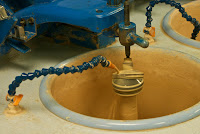
Glass initially goes to the grinding shop, where it is taken to about 20 microns of the eventual shape.

Then they polish it.

This can be done on wonderful leather-belt driven machines, which do the traditional spherical polishing. It takes longer, and is more labour intensive, but operators can do several elements at a time. Incredibly, the skilled operators can be more accurate than computer controlled polishers. They can fit up to 20 elements on a block (if they are small enough), which can also make them faster, even though it takes about eight hours per block (however many elements are on it).
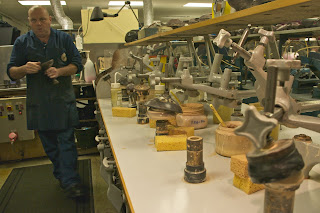
It requires great skill as each type of glass has its own idiosyncrasies and a slight temperature difference between the centre and the edge of a glass element can cause the glass to crack at a later stage in the process, when even more has been devoted to it.

"It takes about five years to train a polisher, but for the first three years you don't even know if they'll be any good, so it's a big investment," said Zellan, who bought the company in 1998 (it had spent many years as part of the Rank group).

The computerised machines are faster, but only do one element at a time (they can do one in about 30 minutes).

On reflection
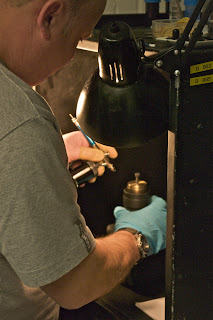

For most other manufacturers, the next part of the process is edging (blacking the edges to control reflections - pictured right), but Cooke goes to coating next – because it can, as its coatings are "really, really hard" and won't be damaged by edging.

Coating is done in large vacuum chambers, using a vapour of various metals. An uncoated element reflects 4% of the light for each surface, and as a modern lens can have 15 to 20 elements, this would considerably reduce the amount of light getting through.

Before coating, you might have an F4 lens with a transmission factor of T11 (indeed, that is why T stops came into being, as that was what the film labs cared about). With modern coatings, you lose less than 0.1% light per surface, which means that Cooke can build an F1.9 lens at T2.

Most manufacturers do multi-layer coating one layer at a time, but Cooke does all the layers at once.

To template each lens element, Cooke has about 4,000 master gauges (each of which is worth about £5,000 – about £20m in total), to which each new element is matched to make sure it is perfect. For every master gauge, there is a set of tooling.

Many of Cooke's machines are at least a century old (it has been manufacturing lenses in Leicester since 1894), although it also has computerised versions (designed especially for it) that were installed in 2008 (although they are unlikely to last so long).

"The lenses we put out are extremely consistent. There is lots of quality control checking along the way, so that a lens from today is virtually the exact same as one from ten years ago," he claimed.

It takes about three months for the whole process, from receiving the glass until the lenses are ready for delivery.

This could lead to very long delivery times, so Cooke sacrifices efficiency to make lenses in very small batches each month, so that it can deliver an order in one shipment.

An order for S4/i lenses can take one to four months. He hopes that the new Panchros will be a bit faster, as they are easier to put together), but the 5/i lenses are more complicated. "Every stop [wider] adds about a factor of eight times in terms of tolerances, so speed kills."

Two new lines

Cooke has about 80 staff, including a handful of designers (one woman was an original "computer" who did all the complex computations manually, although she now has a computer hardware to help her).

With so few people, it makes it even more impressive that they have developed two new ranges of prime lenses this year (adding to the S4/i line it already had). This was only possible because it has invested in new technology, and it now has eight computer-controlled machines running 24-hours-a-day five days a week.

"We've never been able to keep up with demand for our product," admits Zellan.

Traditional spherical lenses are relatively straightforward, but aspherical elements are a lot more difficult to polish, as they require extremely precise measurement.

It has a small network of grinding, polishing and measuring machines that talk to each other and make sure that the grinding and polishing is exact.

Several of the S4 lenses and many of the 5/i lenses have aspheric elements (which generally allows the lenses to be smaller and to use less glass).

The Panchro lenses cost less than half the price of the S4/i lenses, although it isn't a cheap lens. Indeed, it is essentially an S4 but with one stop less light. "We didn’t cut corners on the quality. What enabled us to cut the price is taking a stop out of it." At T4, it will match the S4 exactly.

Zellan doesn't know how long it takes to build a lens. "It takes as long as it takes to get right. It might take a few days or a week, depending on how long it takes to make so they are consistent."

Once the lens is built, it is taken apart again, to clean it, and rebuilt. Every lens is then hand-calibrated for iris and distance.

A 4K sensor (as on the Red One) only needs to be able to resolve 32 line pairs on a test chart, but the Cooke lenses are claimed to be able to resolve more than 200 line pairs (the equivalent of 18K or even 20K on a digital sensor – film is typically about 6-8K).

Besides its three prime ranges, there is also the CXX 15-40mm lens, which he claims is the "only fast, lightweight zoom" T2.0 lens.

The Cooke look

Its lenses are renowned for having a warm, attractive look. "The Cooke look is real. It tends to be a much more dimensional look than our competitors. The lenses are also warm, and flatter the subject," he said.

The designers aim for high resolution, but lower contrast, to give better results on film (or sensor) rather than in the viewfinder.

"Some of this is counter-intuitive. The reason our lenses look warm is because we pay a lot of attention to the blues and greens, which is what both film and chips are most sensitive to."

He says that Zeiss tends to accentuate reds and greens, which can make its lenses look cold.

"It's a combination of glass choices (all of which have different colour characteristics) and, to a much less extent, to the coatings."

Cinematographers who like the Cooke look tend to stick with it "Lenses are the paint brushes the cinematographers use," he explained, so aesthetics are very important.

This is why its lenses are used on many popular TV shows, such as House, CSI: New York, Bones, Grey’s Anatomy, 30 Rock and Burn Notice, as well as lots of movies, such as the Harry Potter series, The Bourne Ultimatum and Transformers.

However, it also helps that the basic maintenance needed for a Cooke lens is about an hour compared, he claimed, to about a day for its rivals. "This allows a rental house to get a lens back one night and put it back out the next day."

The new and the old: A 5/i with the first zoom lens
/i technology

Cooke, which manufactured the first ever zoom lens in 1936, has been a leader in putting electronics in the lenses. Its /i technology is a metadata system that it introduced in 2005, although it is only now really catching on. All of its lenses are smart lenses, so that they can talk to the cameras and other equipment on set.

The Red One adopted /i, although it only got that working fully late in 2009, but it can now read and record it. Other /i cameras include the Sony F35, Arri cameras and the new Aaton Penelope film camera – "It's quite a bit of work for them, because they have to put in contacts for the lens. But everybody now understands the need for metadata in post," he said. It is widely used in post production, such as by The Foundry for its Nuke system.

The lenses typically have two sets of connectors – four contacts on the lens mount and an external connector (although that is not on the Panchro).

As lenses become faster, everything about their construction becomes more difficult, including calibrating their scales, so Cooke had to build a new calibration area with computer controlled equipment for the 5/i range.

The scales are never pre-engraved on the metalwork, because they need to be exact for each lens, all of which have subtle differences. The /i technology is also set for each lens.

Zellan at IBC: with the new 5/i and Panchro lenses
New line for cinema

The PL-mounted Panchro By Cooke lenses are a modern redesign of the fast Cooke Panchro lenses that were much favoured in Hollywood from the 1930s onwards.

The Panchro is small, lightweight, and sacrifices one stop of light, at T2.8, compared with T2.0 for the S4. "Traditionally lenses were best used two stops down from the widest stop, 2.8 or 4.0, but the S4 was one of the first lenses designed to be used wide open, and today's lenses are all designed to be used at their fastest speeds," explained Zellan. However, "you only work at those speeds if you absolutely have to, because depth of field is so limited. Most shooting is probably done at F4."

The reduced size, weight and true focal length markings also make the Panchro range more suitable for 3D stereoscopic productions. It is available in 18mm, 25mm, 32mm, 50mm, 75mm and 100mm lengths.

Cooke sold out its first production run of Panchros, just before IBC, in just 90 minutes, and is now back-ordered six to nine months ahead.

The even newer 5/i lenses are a stop faster than the S4, at T1.4, covering: 18mm, 25mm, 32mm, 40mm, 50mm, 65mm, 75mm, 100mm, and 135mm.

It is the first set of lenses with illuminated scales. "This means the end of the assistant standing with a flashlight in their mouth in the dark," said Zellan. This is important as the speed of the lens makes them suitable for night filming. The lenses cost about 20-25% more than the S4.

By David Fox

November 30, 2009

HD DSLRs: nice pictures, nicer price


One of the most exciting developments of the past year, for those whose ambition is larger than their budget, has been the introduction of HD DSLR cameras, most notably from Canon. These allow the use of lots of relatively cheap, high-quality lenses with an APS-C (about 23x15mm) or even 35mm (36x24mm) sensor that can capture beautiful images for less than the price of a Sony EX1 or other low-budget professional camcorder. The APS-C sensor has about 5.5 times the area of a 2/3-inch sensor used in most mainstream broadcast cameras (and about ten times the area of a half-inch sensor used in the EX1 - although broadcast cameras usually have three such chips so performance isn't exactly comparable).

As HD DSLRs are designed primarily for stills photography, they don't have the ergonomic layout you'd expect from a video camera, and there are limitations in what controls you can use while recording and in facilities (especially audio). The choice of recording codecs is not always ideal either. But low-light performance is often excellent, and they are particularly useful for stop-frame animation or time-lapse videos.

Virtually all CMOS sensors used on DSLRs (as with most low-end camcorders) exhibit rolling shutter artefacts (when the camera is panned any vertical lines in the picture will wobble while photographic flashes may only occupy part of the picture). High-end digital cinema camcorders typically use a global shutter (which electronically shutters all pixels simultaneously) or simply readout fast enough from top to bottom to reduce or avoid it. However, it is certainly a problem with the current crop of HD DSLRs, necessitating slower panning speeds, the use of Steadicams or shake reduction technology for hand-held shots, or fixing the problem in post, with the likes of The Foundry's RollingShutter plug-in for Nuke and After Effects (watch a video about RollingShutter).

A further issue is audio. Many of the higher-end cameras have a mini-jack input for mono or stereo audio, some rely on inadequate built-in mics. However, it is generally best to work with them like a film camera and record audio separately.

There are also restrictions on the length of clips that can be recorded at one time (12 minutes on the Canon EOS 7D, for example), possibly to avoid sensor heating or power problems, and users have to be careful to buy memory cards that are fast enough that they will record all the way through without problems (there can be a big difference between card manufacturers on this, with some performing better at a lower stated class than others do at a higher classification).

If you're wondering what difference would it make buying a 35mm sensor over an APS-C or broadcast 2/3-inch sensor camera: 35mm will give you shallower depth of field (less of the picture in sharp focus - and more of it, especially the background, pleasingly blurred). However it can also be a nuisance. You can set up a shot, have the subject perfectly in focus, start shooting and he's moved back or forward slightly and is now out of focus. In most situations, you'll be able to get as little depth of field as you'll ever need with an APS-C sensor (and often even with 2/3-inch chips). Of course, the larger the sensor, the better quality image you should get - especially in low light, as the pixels aren't as closely packed together (but a 25megapixel 35mm sensor will have about the same pixel density as a 10 or 11MP APS-C sensor), and you're only going to be shooting at 1 or 2MP for HD video - so how the recording codec performs may have a bigger impact on your video quality than the sensor size.

Playing the field

The camera that started this trend is Canon's EOS 5D Mark II (the first 35mm HD DSLR - pictured top in use with a Vocas DSLR rig), which is ideal for anyone who wants shallow depth of field at the lowest price possible.

It currently records 1920x1080 at 30 frames per second (which has been a problem for those of us in Europe, although that can be dealt with – look at filmmaker Philip Bloom's website for suggestions). However, that will be rectified early in 2010 when Canon promises to update its firmware to allow 24 and 25fps. It has already updated the camera to allow full manual exposure while recording video.

[UPDATED: The 24/25fps update (firmware 2.04) is now out and also adds full manual audio controls.]

The new Canon 1D Mark IV already has full HD at 24, 25 and 30fps (plus 720p/50 and 60), but uses a slightly smaller 1.3x crop sensor (APS-H - although its performance in low light seems to be particularly good). The recently introduced Canon EOS 7D offers the same formats on a less expensive APS-C model (about 1.5x crop). Files are saved using AVC/H.264 compression in a .MOV container (at about 44Mbps for full HD), with Linear PCM 48KHz audio.

[UPDATED: There is also now the Canon EOS 550D (Rebel T2i in the US), which is smaller and lighter (and about half the price for the body) than the 7D, but offers the same video formats on the same sensor - although it isn't as feature rich as a stills camera as the 7D.]

Although Canon is the key manufacturer of HD DSLRs, others have entered the market.

The APS-C Nikon D90 was the first DSLR to record HD video, at 720p/24, as now do Nikon's 35mm D3S and APS-C D300S and D5000 models, using AVI Motion-JPEG codecs.

The compact Pentax K7 is another APS-C 720p camera, but only at 30fps (AVI Motion JPEG at about 45Mbps variable), although it can also shoot at a non-standard higher resolution (1536x1024 - 3:2 aspect), however the even smaller Pentax K-x records 720p at 24fps, has very good low-light performance, and is currently about the cheapest HD DSLR available. Both Pentax models benefit from in-body shake reduction, which means that they can be used hand held with inexpensive, old prime lenses.

The Panasonic Lumix DMC-GH1 has an interchangeable mirrorless lens system, which means it can be smaller than conventional DSLRs, although it also has a smaller (Micro Four Thirds) sensor with a 35mm crop factor of about two. It seems to be the only "HD DSLR"* that can auto-focus while recording video, although that should be less important for anyone coming from a video or film background than it seems to be for stills photographers moving up (although autofocus only works with certain lenses). It records 1920x1080 at 50/60i or 24/25p using AVCHD (about 17Mbps), or can record 720p/50 AVCHD or 720p/25 using Motion JPEG (.MOV at about 28-30Mbps). Tests show a lot more artefacts in 1080 than with 720, which isn't surprising as the bitrates are the same. There is also the cheaper Panasonic GF1 which only records 720p/60 and 30.

*Note: Of course the Panasonic isn't a DSLR - as it doesn't have a mirror (the Reflex), but as it has interchangeable lenses it should probably be included here....

Related Posts: Cheap 35mm video - Canon cuts cost of HD - HD DSLRs: Still developing

By David Fox

November 29, 2009

Sony NXCAM video

While we were at Sony's Power of Images event, we shot a piece about the new NXCAM with Sony's Kanta Yamamoto, who told us all about it....


If you haven't read our piece about the new camera, have a look at our previous post.

Also, now that it is available, read our update - Plus, another video looking at the practicalities of using the HXR-NX5, including how it works with various non-linear editing systems.

Christina Fox

November 26, 2009

AVCHD choices increase for budget camcorders


Sony has joined Panasonic in offering professional AVCHD camcorders recording to low-cost solid-state media.

The prototype NXCAM revealed by Sony last month is essentially a remodelling of its Z5 with a new recording system. This replaces the Z5's HDV tape drive and add-on Compact Flash card recorder with two Memory Stick slots and an add-on solid-state drive, recording 24Mbps AVCHD. It is intended to be first of a new, low-cost solid-state line-up, with the first cameras shipping sometime in the first half of 2010. [UPDATE: The HXR-NX5 is now available. See more details here.]


AVCHD (which uses an MPEG-4 codec), is widely used in consumer camcorders (almost always at lower bitrates) and is supported natively by some non-linear edit systems (such as Edius, Vegas and Premiere), but not yet by Apple and Avid, where transcoding is necessary, which will probably diminish its appeal to many potential users initially.

It will cost about the same price as the Z5, and will address one problem professionals have with AVCHD, its AC3 audio codec. Although this will still be included, the NXCAM will also add linear PCM audio to be meet broadcast expectations.

The optional 128GB Flash memory drive will be especially appealing to anyone shooting observational documentaries or to wedding videographers, who need long recording times, as it will store up to 11 hours at maximum quality (and will cost less than Eur1,000). Users will be able to record on to it and the Memory Sticks at the same time. Memory Sticks currently come in sizes up to 32GB (costing less than a quarter of the price of Sony's SxS-1 cards) and the NXCAM will automatically record on the second one once the first is full.

The camera includes a GPS receiver for the first time on a professional Sony camcorder, recording the metadata in the AVCHD stream. This could be useful for future applications, whether offering a map-driven interface to online video, for retrieving archives, or for researchers shooting a recce.

"It will also have HD-SDI output for the first time on a compact Sony camcorder," said Sony product marketing manager, Bill Drummond (pictured with the camera at the recent Power of Images event in London).

We like the Z5 as a camera (it's certainly better ergonomically than the Z7), so the first NXCAM should be pretty good. The only real drawback, at least initially, is Final Cut Pro not being AVCHD native.

The NXCAM will compete with the likes of Panasonic's AG-HMC41E, which records 24Mbps AVCHD to SD memory cards, and is being offered with a copy of Edius Neo 2 editing software (until March 2010) for Eur2,470.

The AG-HMC41E records up to 180 minutes of HD at 1920x1080 on a 32GB SDHC card at 24Mbps. It has three 1/4.1-inch progressive MOS sensors with a total of 3.05 million pixels, a 12x Leica zoom lens, weighs less than 1kg, captures still images at 10.6 million pixels, and includes various focus-assist functions, such as facial recognition and touch-type auto-focusing, as well as professional functions, such as waveform monitoring. Accessories include a removable grip and an optional removable XLR microphone adaptor.

Another possible choice for anyone needing a compact camcorder is JVC's GY-HM100, especially if you use Final Cut Pro as it can record native .MOV (QuickTime) files direct to its cheap SDHC cards. It can also record Sony XDCAM EX-compatible .MP4 files for other Nnon-linear editors.

It records full 1920x1080 at up to 35Mbps, as well as 720p (19/35Mbps) and 1080i (25Mbps HDV) in SP mode. At 35Mbps, two 32GB SD cards can record for up to six hours, automatically switching between them. SD cards are now fairly inexpensive. Indeed, the cost per minute is about the same as tape, so it is economical enough to use the card for archiving, and they will probably be more reliable than storing your video on a hard drive (which needs to be spooled up about every three months or so to ensure it doesn't sieze up). The HM100 has three 1/4-inch CCDs, a fixed Fujinon 10:1 zoom, manual controls, and an HDMI output.


By David Fox

October 22, 2009

Sony EXpands XDCAM EX range


Sony has updated its EX1 camcorder and added a new shoulder-mounted model with 2/3-inch sensors.

Improvements to the new PMW-EX1R are mainly the result of customer requests, and include:
• an improved hand grip (making it more comfortable for hand-held shots)
• easier to access switches (although the one-push auto focus button hasn't been moved, and is still in the wrong place for hand-held use)
• smooth handle zoom transitions (stop/start)
• HDMI output
• one-click S&Q (Slow and Quick) mode [button glowing in photo - right]
• a 15-second buffer for continuous pre-recording
• a higher-resolution viewfinder (the same as on the Z5 and Z7)
• an image inversion option that reverses an image upside down and left/right for a Cine-style depth of field adaptor
• a new IR-cut filter to give deeper (non infrared contaminated) blacks
• an improved audio limiter.

It retains the EX1's three half-inch 1920x1080 CMOS sensors, a Fujinon 14x HD zoom lens and a dual focus ring mechanism.

Besides its 35Mbps and 25Mpbs HD formats, it now has 25Mbps Standard Definition DVCAM recording – although given that the only difference between DVCAM and DV was that DVCAM used a faster tape speed (to reduce the impact of any tape drop out), why continue to call it the more professional sounding DVCAM for a tapeless system (other than that, of course)?

That Sony has added SD to its HD range shows that there are still plenty of people who still need to shoot SD but want to buy a tapeless/HD camcorder to future-proof their investment (although why Sony didn't realise this two years ago when it launched the EX1, who knows?). It has also added a 1440x1080, 35Mbps, recording mode for compatibility with users of its XDCAM HD optical disc systems (the EX1 already recorded 1440x1080 at 25Mbps for HDV).

It has two SxS memory card slots, which allow it to record up to 280 minutes of HD using two of the newly introduced 32GB SxS cards – there is also a new, lower-cost range of cards (the SxS-1 range), which trades off a shorter lifespan (five years of daily use – with life indication displayed in the viewfinder) for its use of cheaper flash memory, and has 800Mbps transfer speed. It should cost under £450 for 32GB, compared to at least £600 for a 32GB SxS PRO card.

A lot of EX1 users had been using a lower-cost SxS alternative – SDHC-to-ExpressCard/34 adapters, from the likes of Delkin, E-films and Hoodman (for lots more on these have a look at Guy Barwood's excellent site). Obviously, Sony would rather you use its own products, so it has responded with a new adaptor (MEAD-MS01) that will allow you to record to Sony's own 8GB, 16GB or 32GB Memory Stick Pro HG Duo HX cards (although not as reliably as SxS and at the expense of some features, such as high speed recording, and with lower transfer speeds). The adapter should cost less than £100. Current EX1 and EX3 models will also be compatible – through a firmware upgrade that should be available early 2010. Users can also add a 120GB hard-disk recorder, the PHU-120K.

The EX1R should be available in December for about the same cost as the EX1 (under £5,500).


PMW-350 shoulders responsibilityThe new lightweight PMW-350 will sit comfortably on your shoulder and has the extra quality (and shallower depth of field) of three 2/3-inch 1920×1080 CMOS Exmor sensors.

It has timecode in/out, genlock in, and HD-SDI and HDMI out, making it suitable for studio use, and records to the same HD formats as the EX1R (with the option of DVCAM).

It can be bought with a bundled 16x lens (as the model PMW-350K), and has automatic lens aberration compensation, independent focus, zoom and iris rings; auto focus mode, manual focus assist. However, the lens isn't particularly wide, with a focal length of f 8mm-128mm (which is the equivalent of 31.5mm-503mm on a 35mm lens).

It boasts good, low, power consumption (15W), giving it a longer run time on a single battery.

It should typically cost under £14,000 without lens and under £16,000 with lens, and will be available January 2010.

David Fox

October 11, 2009

Off-the-shoulder prompting


For reporters, doing a piece to camera is always interesting (translation: cause of abject terror…). There's a high likelihood that you'll forget something and have to do it again, and again, and again… or just feel red-faced and ridiculous if you're live on air and can't activate the Omega 13 device to jump back 13 seconds and do it properly.

A piece of paper, with a few bullet points scribbled on it, taped just below the lens is handy (unless there's a slight breeze that will inevitably blow it over the lens), but the ideal is to have a prompter, just like they do in the studio. Until recently this wasn't especially practical. Prompters tended to be big, heavy, power hungry, and expensive.

Now, there are several cheap, simple, lightweight units you can use – including your iPhone.

Autoscript's new Miniscript on-camera TFT monitor, has all the standard connectors of its larger prompter displays, but the 5.6-inch panel weighs only 455g, so that it isn't a burden on location or in the studio (it was actually developed in response to a camera supervisor who wanted something small for the increasing number of hand-held cameras for live and studio-based entertainment productions – where presenters can't be expected to work without a script [that's why they're paid the big bucks…]).

It uses the smallest of Autoscript's new range of LED back-lit displays, which have "eight times the life span of CCFLs [Cold Cathode Fluorescent Tubes]. The output of CCFLs diminishes over time and they need replacing. LEDs produce very little heat and that's a big factor in component failure. There are still fans to regulate heat, but they only come on if it is in a hot studio or outside in the sun," explained Autoscript's MD, Brian Larter (pictured). LEDs are more expensive, but Autoscript has taken a hit on its margins to offer them at the same price as CCFLs.

There's an app for that

Autocue's new Starter Series is an entry-level product aimed at users that previously couldn't afford it. It is taking on the likes of Prompter People head on, with prices below £1,000.

For portable prompting it has introduced an iPhone Prompter, designed for freelance cameramen. It costs £599, and is similar to the 7-inch Starter pack, but with an adapter plate for an iPhone.

It uses software available from the iPhone App Store, although not written by Autocue, but Frank Hyman, Autocue's CEO (pictured) promises that it will have its own Autocue App in the near future. Autocue has also launched Mac software for its other Autocue systems, "because this market is 30 to 40% Mac based."

David Fox

Tapeless takes over


For the first time, sales of non-tape cameras have taken a majority of camcorder sales in the European professional and broadcast market with sensors of 1/3-inch or larger. They already dominate sales of consumer camcorders.

The latest figures, for the quarter from April to June 2009, reveal that 50.84% of sales from all manufactures selling in the EU went to tapeless systems. This included 7.29% of hybrid camcorders that can record tape and tapeless (although sales of such cameras have declined since last year when they reached a peak of 24.23% of the market). Sales of fully tapeless systems have trebled over the same period, according to figures from Futuresource Consulting.

Panasonic appears to have been the biggest winner from this. Its HPX301 camcorder, introduced at Broadcast Video Expo 2009 (see our video here), has taken one third of the market for tapeless shoulder-mounted, 1/3-inch or 1/2-inch sensors under Eur10,000, in just one quarter. Panasonic already has an 85% share of broadcasters that have gone tapeless (using its P2 format – mainly for news).

"Everybody in the industry knows that solid state is the future. There is no question about it," said Jaume Rey, its Director, Provideo & Broadcast IT Systems, Europe (pictured).

He believes that the rapid change in broadcaster's purchase requirement is largely due to the recession. "People are very careful about spending money and are worried that if they don't buy solid state they will be left behind. Because access to finance is so hard, investments must last longer. So, what's the point in choosing a tape-based format when I know tape is declining?"

He talked to a broadcaster last year that had just invested in a lot of SD camcorders, who justified the purchase by the fact that they would be replaced in three years, now he doubts that any CFO would allow such a short term choice.

Hybrid systems may have seemed a good interim measure, but he believes that their decline is because broadcasters no longer want to "stay on a bridge. They either stay tape or go tapeless."

By going tapeless he maintains that broadcasters will benefit not only from a faster, more efficient workflow, but also help the environment through lower power consumption.

Ultimately, at least for news, he believes that the future is medialess, with wireless connections from the camcorder to the station and any media just being used for a backup in the camcorder.

David Fox

Making 3D a spectacle


The most common complaint when people watch 3D TV is that it gives them a headache. The cause, certainly when watching anaglyph images (red/cyan) is generally not the 3D, but the glasses.

Most cheap 3D glasses are made with whatever blue/green (cyan) and red gel a manufacturer has on the shelf. But "if you get the blue wrong you might get a headache, and if you get the red wrong you won't see 3D," according to Daniel Llovet (pictured), marketing director of broadcast filter maker, Cotech. It has launched a range of custom 3D glasses. "We can match any colour any 3D designer may wish."

With programmes like Chuck broadcasting 3D specials, and broadcasters (particularly Sky) intending to roll out 3D services. Such glasses will be the main way to watch 3D unless we buy new 3D sets.

David Fox