Carl Zeiss is creating a set of prime (from 18mm to 85mm) and zoom lenses for HD DSLR cameras.
Its upcoming Compact Prime CP.2 and Lightweight Zoom LWZ.2 lenses will have interchangeable mounts that can be used with Canon EF, Nikon F, and PL-mount cameras.
The primes can be used on full frame cameras (like the Canon 5D Mark II), and will all open to T2.1 (although in the press photograph of the lenses, the 85mm is shown as a T1.5). However, the 15.5-45mm/T2.6 zoom lens can only be used with crop sensors (such as on the Canon EOS 7D – up to 24.9x18.7mm, a Super 35mm film frame). The zoom will weigh about 2kg, which makes it useful for Steadicam applications. Thanks to the interchangeable mounts, the lenses should be very attractive to hire companies, as they will cover a wide range of traditional cine cameras and HD DSLRs.
Prices are likely to be at least as much as many of the cameras they are fitted to, and they should be available from June.
Being designed for moviemaking, they will be a lot easier to use than stills lenses, especially for focusing, with longer focus rotation (making it a lot easier to be precise – particularly for manual use).
The iris opening in the prime lenses uses 14 high-precision blades, which stay consistently round and symmetrical over the entire T-stop range. This should translate into natural and pleasing out-of-focus highlights and a smooth bokeh (the ring around the blurred highlights). The lens design and tight tolerances are claimed to "ensure low distortion, high resolution and excellent colour rendition for sharp, punchy images."
By David Fox
April 18, 2010
DaVinci colour grades going cheap
Blackmagic Design is to unleash high-end colour grading at low end prices, offering the full capabilities of a DaVinci Resolve system as software for OS X at only $995. Its new Resolve version 7.0 basically does what previously took a system costing $200,000 upwards, although you have to provide your own Mac – and the DaVinci controller hardware (if you want it) does cost extra, although still a significant price reduction at $29,995.
DaVinci is the gold standard of colour correction and grading systems, used by most high-end facilities, and in the OS X configuration will be good enough for HD or even 2k work in realtime. For top-end use (such as 3D movies), the price has also dropped dramatically, from more than $800,000 to about $150,000 for a fully featured Linux multi-processor system. Blackmagic Design only bought DaVinci six months ago.
Certainly, for any Mac users that find Apple's Color software insufficient for their purposes, Resolve sounds like a fantastic deal. It should be available by July.
Have a look at the TVB Europe story for lots more information.
By David Fox
DaVinci is the gold standard of colour correction and grading systems, used by most high-end facilities, and in the OS X configuration will be good enough for HD or even 2k work in realtime. For top-end use (such as 3D movies), the price has also dropped dramatically, from more than $800,000 to about $150,000 for a fully featured Linux multi-processor system. Blackmagic Design only bought DaVinci six months ago.
Certainly, for any Mac users that find Apple's Color software insufficient for their purposes, Resolve sounds like a fantastic deal. It should be available by July.
Have a look at the TVB Europe story for lots more information.
By David Fox
April 15, 2010
Canon fires out first 4:2:2 file-based camcorders
Canon has launched its first Full HD MPEG-2 4:2:2 50Mbps camcorders. The XF305 and XF300 record industry-standard MXF (Material eXchange Format) files to Compact Flash memory cards, making them very easily compatible with broadcast post production (all the major non-linear editing systems). Most rival cameras record 4:2:0, which offers half the colour information – making them less suitable for such things as greenscreen work.
The cameras have 18x L-series HD lenses, three 1/3-inch CMOS sensors and DIGIC DV III processors. They have two CF card slots, for continuous recording.
The sensors are claimed to offer "exceptional colour accuracy, wide dynamic range and low noise" and use high-speed data readout (2x speed) to minimise the rolling shutter skew common to most CMOS camcorders.
The 29.3mm "wide angle" F1.6 lens has zoom and focus rings with physical end stops, for more accurate control, plus an independent iris ring, and uses high-end optics and coatings.
The cameras have a 1.55 million dot electronic viewfinder with 100% coverage and a high-resolution (1.23 million dots) LCD that can be switched from left to right and, at 4-inches (10cm) is about the largest of any LCD in this class of camcorder.
The cameras will also offer slow and fast motion recording, with 20 speeds to choose from in 720p mode and nine in 1080p (normal recording speeds are 1080 50i or 25p, 720 50/25p (in the European versions).
Both models record 16-bit linear PCM audio at 48kHz, from either the integrated stereo microphone or via two XLR connectors. Power consumption is an admirably low 9W, and the cameras weigh about 2.7kg.
The only difference between them is for studio or multi-camera use, for which the XF305 adds HD-SDI output, Genlock input and Time code i/o. The XF305 should cost about $8,000, while the XF300 will be $1,300 less (list), with availability from June.
Related post: Canon's codec choice
By David Fox
The cameras have 18x L-series HD lenses, three 1/3-inch CMOS sensors and DIGIC DV III processors. They have two CF card slots, for continuous recording.
The sensors are claimed to offer "exceptional colour accuracy, wide dynamic range and low noise" and use high-speed data readout (2x speed) to minimise the rolling shutter skew common to most CMOS camcorders.
The 29.3mm "wide angle" F1.6 lens has zoom and focus rings with physical end stops, for more accurate control, plus an independent iris ring, and uses high-end optics and coatings.
The cameras have a 1.55 million dot electronic viewfinder with 100% coverage and a high-resolution (1.23 million dots) LCD that can be switched from left to right and, at 4-inches (10cm) is about the largest of any LCD in this class of camcorder.
The cameras will also offer slow and fast motion recording, with 20 speeds to choose from in 720p mode and nine in 1080p (normal recording speeds are 1080 50i or 25p, 720 50/25p (in the European versions).
Both models record 16-bit linear PCM audio at 48kHz, from either the integrated stereo microphone or via two XLR connectors. Power consumption is an admirably low 9W, and the cameras weigh about 2.7kg.
The only difference between them is for studio or multi-camera use, for which the XF305 adds HD-SDI output, Genlock input and Time code i/o. The XF305 should cost about $8,000, while the XF300 will be $1,300 less (list), with availability from June.
Related post: Canon's codec choice
By David Fox
Sensor sensitivity ULTra enhanced
Panasonic's new AG-HPX370/AG-HPX371 P2 HD camcorder is an update to its very successful HPX300/HPX301. The shoulder-mounted model retains the same reasonable price (under 10,000 Euros/ $11,700 list), but uses newly-developed 1/3-inch, full-HD 2.2 megapixel Ultra Luminance Technology 3-MOS sensors.
The new sensors are claimed to rival "the image quality and sensitivity of half-inch imagers" offering "marked improvements in sensitivity, measured at F10" thanks to ULT. These levels of sensitivity and image quality have been achieved with a new high-sensitivity photodiode and low-noise pixel transistor, both based on low-noise analogue process technology. The same levels of sensitivity and image production that characterize the interlace mode are now possible in progressive mode courtesy of Progressive Advanced Processing, a 3D adaptive processing technology.
The HPX370/HPX371 also features flash band detection and compensation software that eliminates the "flash band" effect that can occur with MOS-based imagers (a by product of rolling shutter).
It also has a 20-bit Digital Signal Processor, and records full 1920x1080 using 10-bit, 4:2:2, independent-frame AVC-Intra recording (to two P2 card slots).

In AVC-Intra 100 and 50, it records in 1080 at 59.94i, 29.97p, 23.98p (native 24p/30p), 50i and 25p (native) and in 720p with variable frames in 23.98p (native), 29.97p (native), 59.94p, 50p and 25p (native). It also supports 100Mbps DVCPRO HD and standard definition recording in DVCPRO50, DVCPRO and DV.
The kit lens is a Fujinon 17x HD zoom but it can take any 1/3-inch lens or, via an adapter, 2/3-inch lenses. The camera has Chromatic Aberration Compensation, scan reverse for use with film lenses, a Dynamic Range Stretch to help compensate for wide variations in lighting, a waveform monitor and vector scope display, and two focus assist functions – picture expansion and a focus bar. It also has a one-clip REC function that records up to 99 consecutive cuts as a single clip, to make nonlinear editing simpler.
It has two HD-SDI outputs, FireWire, USB 2.0, time code input/output, and can be used as a studio camera. with the optional AJ-RC10G Remote Control Unit and compatible studio remote control systems. Panasonic offers a customized studio configuration that includes the AG-BS300 base station, AG-EC4 extension control unit and AG-CA300 remote control camera adapter.
It weighs about 3.6kg and power consumption is 19 Watts.
[[UPDATE: Panasonic has released 18 new, free, downloadable scene styles for the HPX370]]
AVCCAM HD + SD
Panasonic's new 3megapixel, 3MOS HMC80/HMC81 camcorder is the first AVCCAM model with both HD (up to 24Mbps AVCHD) and SD (DV 25Mbps) recording. It can also take 10.6MP still images and store them as standard JPEGs on the SDHC card.
The shoulder-mounted camera includes: user-assignable manual focus ring functions (Focus/Iris/Zoom); time code/UB recording; time/date stamp; and two wired remote control terminals (for zoom, focus, iris, REC start/stop controls). It has a 12x zoom lens with a surprisingly poor 40.8mm (35mm lens equivalent) wide-angle setting. It has an Optical Image Stabilizer, Dynamic Range Stretch and a Cine-Like Gamma mode to give recordings a more film-like look – it can record 1080/24p (as well as 25/30p, 50/60i and 720 24p, 25/30p. 50/60p).
Outputs include: HDMI (AVCHD only), USB 2.0, composite (BNC), analogue component (BNC x 3),and FireWire (DV). For audio it has a built-in stereo microphone, a 3.5mm mini jack, and two XLR inputs. It will be available in September.
3D to order
Its new twin-lens HD 3D Camcorder, the AG-3DA1, is now available for pre-order, promising September delivery, and has already garnered a lot of interest, showing a working prototype at NAB. "As a single rig camera offering recording direct to an SD media card, it vastly simplifies 3D content capture, which will help to bring down remaining barriers to 3D filming," said Carmen Mendoza, Panasonic’s Broadcast Marketing GM.
It records AVCHD 1080 60/50i, 30/25p and 24p (native), plus 720 50/60p, weighs less than 3kg, has dual HD-SDI out (so you can bypass the AVCHD and record on a Ki-Pro or nanoFlash), HDMI (version 1.4), two XLR connectors, built-in stereo microphone and twin-lens camera remotes. It will cost 16,800 Euros.
Related post: Panasonic 3D camcorder gets AVCHD
By David Fox
The new sensors are claimed to rival "the image quality and sensitivity of half-inch imagers" offering "marked improvements in sensitivity, measured at F10" thanks to ULT. These levels of sensitivity and image quality have been achieved with a new high-sensitivity photodiode and low-noise pixel transistor, both based on low-noise analogue process technology. The same levels of sensitivity and image production that characterize the interlace mode are now possible in progressive mode courtesy of Progressive Advanced Processing, a 3D adaptive processing technology.
The HPX370/HPX371 also features flash band detection and compensation software that eliminates the "flash band" effect that can occur with MOS-based imagers (a by product of rolling shutter).
It also has a 20-bit Digital Signal Processor, and records full 1920x1080 using 10-bit, 4:2:2, independent-frame AVC-Intra recording (to two P2 card slots).

In AVC-Intra 100 and 50, it records in 1080 at 59.94i, 29.97p, 23.98p (native 24p/30p), 50i and 25p (native) and in 720p with variable frames in 23.98p (native), 29.97p (native), 59.94p, 50p and 25p (native). It also supports 100Mbps DVCPRO HD and standard definition recording in DVCPRO50, DVCPRO and DV.
The kit lens is a Fujinon 17x HD zoom but it can take any 1/3-inch lens or, via an adapter, 2/3-inch lenses. The camera has Chromatic Aberration Compensation, scan reverse for use with film lenses, a Dynamic Range Stretch to help compensate for wide variations in lighting, a waveform monitor and vector scope display, and two focus assist functions – picture expansion and a focus bar. It also has a one-clip REC function that records up to 99 consecutive cuts as a single clip, to make nonlinear editing simpler.
It has two HD-SDI outputs, FireWire, USB 2.0, time code input/output, and can be used as a studio camera. with the optional AJ-RC10G Remote Control Unit and compatible studio remote control systems. Panasonic offers a customized studio configuration that includes the AG-BS300 base station, AG-EC4 extension control unit and AG-CA300 remote control camera adapter.
It weighs about 3.6kg and power consumption is 19 Watts.
[[UPDATE: Panasonic has released 18 new, free, downloadable scene styles for the HPX370]]
AVCCAM HD + SD
Panasonic's new 3megapixel, 3MOS HMC80/HMC81 camcorder is the first AVCCAM model with both HD (up to 24Mbps AVCHD) and SD (DV 25Mbps) recording. It can also take 10.6MP still images and store them as standard JPEGs on the SDHC card.
The shoulder-mounted camera includes: user-assignable manual focus ring functions (Focus/Iris/Zoom); time code/UB recording; time/date stamp; and two wired remote control terminals (for zoom, focus, iris, REC start/stop controls). It has a 12x zoom lens with a surprisingly poor 40.8mm (35mm lens equivalent) wide-angle setting. It has an Optical Image Stabilizer, Dynamic Range Stretch and a Cine-Like Gamma mode to give recordings a more film-like look – it can record 1080/24p (as well as 25/30p, 50/60i and 720 24p, 25/30p. 50/60p).
Outputs include: HDMI (AVCHD only), USB 2.0, composite (BNC), analogue component (BNC x 3),and FireWire (DV). For audio it has a built-in stereo microphone, a 3.5mm mini jack, and two XLR inputs. It will be available in September.
3D to order
Its new twin-lens HD 3D Camcorder, the AG-3DA1, is now available for pre-order, promising September delivery, and has already garnered a lot of interest, showing a working prototype at NAB. "As a single rig camera offering recording direct to an SD media card, it vastly simplifies 3D content capture, which will help to bring down remaining barriers to 3D filming," said Carmen Mendoza, Panasonic’s Broadcast Marketing GM.
It records AVCHD 1080 60/50i, 30/25p and 24p (native), plus 720 50/60p, weighs less than 3kg, has dual HD-SDI out (so you can bypass the AVCHD and record on a Ki-Pro or nanoFlash), HDMI (version 1.4), two XLR connectors, built-in stereo microphone and twin-lens camera remotes. It will cost 16,800 Euros.
Related post: Panasonic 3D camcorder gets AVCHD
By David Fox
Sony embarks on 35mm camera development
At NAB, Sony showed a mock-up/prototype of an "entry level" 35mm sensor camera that is scheduled for launch "prior to NAB 2011" as part of a whole range of such cameras. It should be "affordable", said Alec Shapiro, Sony's senior VP sales and marketing, Broadcast and Production Systems Division (pictured above). It will almost certainly be more expensive than Panasonic's AG-AF100/AG-AF101, but probably higher quality too (larger sensor, probably recording to SxS cards).
April 14, 2010
Pan pipes in micro 4/3 video camera
The HD DSLR revolution has taken an unexpected turn with the introduction of the first video camera based on a stills camera system – albeit not the one many people were wishing for.
Panasonic launched a few new cameras at NAB, most notably the first professional micro 4/3-inch HD video camcorder. Micro Four Thirds stills cameras with interchangeable lenses are available from Panasonic and Olympus (and will record video too, although at lower bit rates), but the new AG-AF101 (or AG-AF100 in the US) will give users a shallower depth of field than even the larger sensor broadcast cameras (which use 2/3-inch chips), plus the benefit from being designed primarily for video rather than stills.
It is aimed at digital cinematography, and will be able to use any micro 4/3-inch lenses, filters and adapters (for access to other 35mm lenses). It will record AVCHD (up to 24Mbps 4:2:0) in 1080 60/50i, 30/25p and 24p (native) plus 720 60/50p, 30/25p and 24p (native), with variable frame rates and professional audio, on to SDHC and SDXC cards (two slots – allowing it to record up to 12 hours on two 64GB SDXC cards at best quality). It will be 60Hz/50Hz switchable for use in any country.
The micro 4/3-inch 16:9 MOS imager will give a 2x crop compared to 35mm stills (so a 50mm 35mm stills lens is effectively 100mm – although the chip size isn't much smaller than a 35mm movie frame).
It will have built-in ND filtering and promises "dramatically reduced video aliasing" thanks to an optical low pass filter, and will have HD-SDI out (for uncompressed 4:2:2), HDMI, USB 2.0, time code recording, built-in stereo microphone, two XLR inputs with +48V Phantom Power, 48-kHz/16-bit two-channel digital audio recording (LPCM/Dolby-AC3). As the mock-up pictured above shows, it should be easier to hold than a DSLR-style camera, being about the size of Panasonic's HPX200 camcorder (but a little taller).
It should be available by the end of 2010, with the price expected to be under $6,000. Of course, by then, Canon could have announced its own repackaging of a larger sensor HD DSLR in a video body….
[UPDATED: Have a look at our report on the AF100 / AF101 from IBC - with pictures of the engineering prototype (there will be changes to some of the buttons and they'll make some of the dials bigger), plus a mini-review of the first videos made with it.]
By David Fox
Panasonic launched a few new cameras at NAB, most notably the first professional micro 4/3-inch HD video camcorder. Micro Four Thirds stills cameras with interchangeable lenses are available from Panasonic and Olympus (and will record video too, although at lower bit rates), but the new AG-AF101 (or AG-AF100 in the US) will give users a shallower depth of field than even the larger sensor broadcast cameras (which use 2/3-inch chips), plus the benefit from being designed primarily for video rather than stills.
It is aimed at digital cinematography, and will be able to use any micro 4/3-inch lenses, filters and adapters (for access to other 35mm lenses). It will record AVCHD (up to 24Mbps 4:2:0) in 1080 60/50i, 30/25p and 24p (native) plus 720 60/50p, 30/25p and 24p (native), with variable frame rates and professional audio, on to SDHC and SDXC cards (two slots – allowing it to record up to 12 hours on two 64GB SDXC cards at best quality). It will be 60Hz/50Hz switchable for use in any country.
The micro 4/3-inch 16:9 MOS imager will give a 2x crop compared to 35mm stills (so a 50mm 35mm stills lens is effectively 100mm – although the chip size isn't much smaller than a 35mm movie frame).
It will have built-in ND filtering and promises "dramatically reduced video aliasing" thanks to an optical low pass filter, and will have HD-SDI out (for uncompressed 4:2:2), HDMI, USB 2.0, time code recording, built-in stereo microphone, two XLR inputs with +48V Phantom Power, 48-kHz/16-bit two-channel digital audio recording (LPCM/Dolby-AC3). As the mock-up pictured above shows, it should be easier to hold than a DSLR-style camera, being about the size of Panasonic's HPX200 camcorder (but a little taller).
It should be available by the end of 2010, with the price expected to be under $6,000. Of course, by then, Canon could have announced its own repackaging of a larger sensor HD DSLR in a video body….
[UPDATED: Have a look at our report on the AF100 / AF101 from IBC - with pictures of the engineering prototype (there will be changes to some of the buttons and they'll make some of the dials bigger), plus a mini-review of the first videos made with it.]
By David Fox
April 13, 2010
ENG and studio connected by ProHD
JVC has introduced a new range topper for its ProHD camcorder line at NAB. The GY-HM790 effectively takes the successful GY-HM700 and makes it more flexible and studio friendly. The HM790 can be fitted with multicore or fibre outputs for studio or OB use.
It has three 1/3-inch CCDs (so no rolling shutter effects), recording 1920x1080 at 50/60i, or 720p, or standard definition, recording using Sony's 35Mbps XDCAM codec or Final Cut-compatible .mov files to SDHC cards. An optional SxS recorder module allows simultaneous recording to SDHC and SxS cards.
An optional ASI output module provides a direct feed from the camera to a satellite uplink or microwave transmitter via BNC for live HD video. For ENG use, there is also an analogue SD pool feed input. It has a 4.3-inch LCD screen and a 1.2megapixel LCOS viewfinder, plus two XLR audio inputs, HD-SDI and FireWire ports
For studio or multi-camera use the HM790 has time code in/out and genlock. The studio modules connect directly to the camera without external cabling, so they can be used either with the studio sled or handheld JVC may bring out further modules. A remote camera control unit, remote shader panel, 8.4-inch studio viewfinder, and multi-input special effects generators, are also available. It should be available in the Summer, priced at under $12,000 including a Canon 14x zoom lens (it will also be available without the lens).
However, there will be a further version in the Autumn that might be very interesting. The GY-HM790LL is a low light version that will use JVC’s patented LoLux function to capture video in "extremely low light" – on some of its other cameras this is as low as 0.05 lux, which is hardly any light (1 lux performance is usually about the best you can get).
By David Fox
It has three 1/3-inch CCDs (so no rolling shutter effects), recording 1920x1080 at 50/60i, or 720p, or standard definition, recording using Sony's 35Mbps XDCAM codec or Final Cut-compatible .mov files to SDHC cards. An optional SxS recorder module allows simultaneous recording to SDHC and SxS cards.
An optional ASI output module provides a direct feed from the camera to a satellite uplink or microwave transmitter via BNC for live HD video. For ENG use, there is also an analogue SD pool feed input. It has a 4.3-inch LCD screen and a 1.2megapixel LCOS viewfinder, plus two XLR audio inputs, HD-SDI and FireWire ports
For studio or multi-camera use the HM790 has time code in/out and genlock. The studio modules connect directly to the camera without external cabling, so they can be used either with the studio sled or handheld JVC may bring out further modules. A remote camera control unit, remote shader panel, 8.4-inch studio viewfinder, and multi-input special effects generators, are also available. It should be available in the Summer, priced at under $12,000 including a Canon 14x zoom lens (it will also be available without the lens).
However, there will be a further version in the Autumn that might be very interesting. The GY-HM790LL is a low light version that will use JVC’s patented LoLux function to capture video in "extremely low light" – on some of its other cameras this is as low as 0.05 lux, which is hardly any light (1 lux performance is usually about the best you can get).
By David Fox
XDCAM eXtended by a half…
Sony has added to its XDCAM range with a new, lightweight shoulder-mounted camcorder with three half-inch sensors. The new PMW-320 (announced at NAB) is basically a cross between the EX1R and the PMW-350.
To the sensors and functions of the EX1R it adds enhancements such as a Scene File System and four-channel audio of the 350. It weighs just 3.2kg (plus lens and battery, and anything else you add), which should make it a very comfortable system for anyone who needs to run around a lot carrying a camcorder – certainly a big improvement on hand-holding an EX1.
It can do slow/fast motion, with speeds from 1-60 frames per second in 720p mode, or 1-30fps in 1080p, can be bought with a 16x Fujinon HD lens, or as a body only, and records to two SxS cards.
It effectively competes with Panasonic's HPX-300 camcorder (watch our video here). The Panasonic has a higher bitrate 10-bit 422 compression system while the Sony has larger sensors (and probably a higher price).
Related posts: Sony EXpands XDCAM EX range
By David Fox
To the sensors and functions of the EX1R it adds enhancements such as a Scene File System and four-channel audio of the 350. It weighs just 3.2kg (plus lens and battery, and anything else you add), which should make it a very comfortable system for anyone who needs to run around a lot carrying a camcorder – certainly a big improvement on hand-holding an EX1.
It can do slow/fast motion, with speeds from 1-60 frames per second in 720p mode, or 1-30fps in 1080p, can be bought with a 16x Fujinon HD lens, or as a body only, and records to two SxS cards.
It effectively competes with Panasonic's HPX-300 camcorder (watch our video here). The Panasonic has a higher bitrate 10-bit 422 compression system while the Sony has larger sensors (and probably a higher price).
Related posts: Sony EXpands XDCAM EX range
By David Fox
Small addition to Sony AVCHD line
Sony has announced a new entry-level addition to its NXCAM range. The HXR-MC50E camcorder records AVCHD and should cost less than £1,600.
However, it only has a single 1/3-inch Exmor CMOS sensor (although it promises reasonable low-light performance of about 3Lux).
There isn't a lot of information about it yet, but it seems to be an upgraded consumer camcorder (I think it is the Sony HDR-CX550), recording to SDHC or Memory Stick cards at 24Mbps. It includes improved audio control plus an ECM shotgun microphone (instead of the in-body mic), a higher capacity battery, and a lens hood for the Sony 10x G lens (with a could-be-wider wide angle of 29.8mm).
It is not, however, a proper replacement for the much-loved and now venerable HVR-A1 (with its ability to shoot infra-red for night shots and dual XLR connectors). That would be more interesting.
By David Fox
However, it only has a single 1/3-inch Exmor CMOS sensor (although it promises reasonable low-light performance of about 3Lux).
There isn't a lot of information about it yet, but it seems to be an upgraded consumer camcorder (I think it is the Sony HDR-CX550), recording to SDHC or Memory Stick cards at 24Mbps. It includes improved audio control plus an ECM shotgun microphone (instead of the in-body mic), a higher capacity battery, and a lens hood for the Sony 10x G lens (with a could-be-wider wide angle of 29.8mm).
It is not, however, a proper replacement for the much-loved and now venerable HVR-A1 (with its ability to shoot infra-red for night shots and dual XLR connectors). That would be more interesting.
By David Fox
April 10, 2010
Alexa picks ProRes and SxS workflow
Arri has chosen Apple's ProRes 422 (HQ) and ProRes 4444 codecs recording on to Sony's SxS cards as the primary workflow for its upcoming Alexa digital cinema camcorder. While it can also output uncompressed HD video and uncompressed Arriraw data, it believes that ProRes will offer the fastest possible workflow.
"It is a combination of the most popular and widely spread codec and probably the fastest recording medium at the moment," said Milan Krsljanin, Arri Media's business development manager. The ProRes XML files (including metadata) will be instantly available for use in Final Cut Pro, with no need to transcode – or any quality loss that might entail. "We wanted to get as fast to post as possible," and the introduction of 12-bit ProRes 4444 (at 330Mbps) in the current version of FCP made the choice "irresistible."
Read the rest of this in my piece for TVB Europe magazine.
For more on the Anonymous Red Mysterium X v Alexa test, mentioned at the end of the article, have a look at Marc Weigert's blog article.
By David Fox
"It is a combination of the most popular and widely spread codec and probably the fastest recording medium at the moment," said Milan Krsljanin, Arri Media's business development manager. The ProRes XML files (including metadata) will be instantly available for use in Final Cut Pro, with no need to transcode – or any quality loss that might entail. "We wanted to get as fast to post as possible," and the introduction of 12-bit ProRes 4444 (at 330Mbps) in the current version of FCP made the choice "irresistible."
Read the rest of this in my piece for TVB Europe magazine.
For more on the Anonymous Red Mysterium X v Alexa test, mentioned at the end of the article, have a look at Marc Weigert's blog article.
Making the work flow: Four ways of getting video from the Alexa to your non-linear editor
By David Fox
March 29, 2010
3D film – in glorious Technicolor
The rise of interest in 3D is mainly due to the success of Avatar, which gained about 80% of its revenues, so far, from 3D screens, and showed that consumers are willing to pay more for 3D. However, there are very few 3D cinemas. This hasn't mattered too much so far as there have only been 25 major studio movies released in 3D since 2005, but there will be at least 19 in 2010. Currently, only about 6-7% of screens in North America and Western Europe are digital AND can display 3D (about 3,000 screens in each region).
In response, Technicolor has created an "affordable" system for displaying 3D 35mm film, without any of the sync or registration problems that would normally entail when using two film projectors. It has developed a way of putting both the left and right eye images on a single frame of film (one on top of the other) and using a new split lens to project them.
The only investment exhibitors need to make is in a silver screen (which would also be needed for digital projection). Technicolor provides the lens on pay per use. It already has support for this from seven of the major studios, and is now deploying it to about 150 initial screens. The first release on this format is Dreamworks' just-released How to Train Your Dragon, with Warner Bros' Clash of the Titans next.
By David Fox
In response, Technicolor has created an "affordable" system for displaying 3D 35mm film, without any of the sync or registration problems that would normally entail when using two film projectors. It has developed a way of putting both the left and right eye images on a single frame of film (one on top of the other) and using a new split lens to project them.
The only investment exhibitors need to make is in a silver screen (which would also be needed for digital projection). Technicolor provides the lens on pay per use. It already has support for this from seven of the major studios, and is now deploying it to about 150 initial screens. The first release on this format is Dreamworks' just-released How to Train Your Dragon, with Warner Bros' Clash of the Titans next.
By David Fox
March 28, 2010
Graeme Beck: HD DSLRs and hybrid cameras
Graeme Beck is an Australian cinematographer, and inventor of the Hyper 35 – a mash-up of an old Sony Betacam camcorder and a Canon 5D Mark II, which makes the Canon easier to use and a lot more ergonomic (as it can act as a shoulder-mounted camcorder). The 5D can also be taken out of the Hyper 35 and used on its own.
I interviewed Beck for an article on HD DSLRs for TVB Europe magazine, but was only able to use a little of what he told me in that. However, he had a lot of interesting stuff to say, so here it is, in full:
"The Canon 5DMKII with its large capture area is a breakthrough in cinematography. Its large capture area is similar to Panavision's 35mm Anamorphic system and a little under 70mm, but by being able to use spherical lenses that are over a stop faster, it is capable of producing shallow focus pictures that have not been seen in motion pictures before," he said.
The Hyper 35
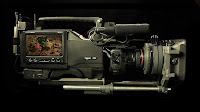
"The Hyper 35 rig is a hybrid of the 5D and a Sony Betacam and it brings the speed and accuracy of ENG style shooting to 35mm. The rig supports the Canon 5D and taps off a video feed to the rig's viewfinder and monitors. Audio can be recorded by the camera directly or fed into the Canon 5D where the leads are protected by a light aluminium frame that surrounds the camera."The electronic viewfinder is essential for the critical focus required for HD and especially the shallow focus of full frame 35mm. It is the peaking circuits that help you snap focus quickly and accurately during a shot. Having a rotating viewfinder is also essential for everyday shooting.
"The Hyper 35 rig is about half the weight of a Betacam and balances nicely on your shoulder with Canon's zooms and prime lenses or clicks straight back onto the tripod. The 400mm [lens] needs the support of the rails.
"The Canon 5D is attached to the rig via a Sachtler 'touch and go' plate for quick release of the 5D body. The 5D can be 'click' attached onto a Merlin Steadicam, either the handheld or arm version, or clicked straight onto a tripod. Other 'touch and go' systems could be easily adapted to the 5D and Hyper 35 rig.
"The Hyper 35 rig doesn't leave the client bewildered as the Canon 5D on its own invariably does. I also use the 5D on its own with or without a loupe [magnifying viewfinder attachment] on the back and it is excellent for gorilla shooting. "
For more information on the Hyper 35 go to www.electricfilms.net.au - It is also possible to purchase the Hyper 35 (for $4,850 - less if you already have a Betacam SP camera).
- What sort of projects have you shot using the DSLR (hybrid or otherwise)?
"I have been shooting a lot of Corporate and Industrial videos with the 5D and have a film to shoot next month. If the 24p upgrade had been around last year I would have been able to shoot a feature then. I did some tests on the big screen and was blown away the results. We projected it alongside the RED and I couldn't see any difference. Although the RED is cleaner in noise while comparing the pictures on a monitor, the 5D has more 'life' similar to the random grain of film. At times I also operate the camera for other DPs."
- Why did you chose to use a DSLR instead of (or alongside) a conventional video camera?
"The full frame 35mm produces images that have a more three dimensional quality to them when compared to smaller format cameras like 1.85 and other 35mm digital cameras. By looking at any picture now I can tell what format it was shot on. Even 3D movies would benefit by using a larger capture area which increases the three dimensional depth.
"The first time I saw images from this camera that was it for me. I find going back to smaller format cameras annoying, as they are just too flat. Its low light capabilities leave any camera for dead. It is a clear three stops faster than any camera I've used. As a cameraman for the last 30 years I've just about used every camera made and this camera literally sees in the dark. "
The following two photos show the difference between a Sony XDCAM wide open and at 9db of gain compared to the Canon 35mm sensor at 6400 ISO – click on photos to enlarge.
- What problems did you face that you wouldn’t normally face using a video camera, and how did you overcome them?
"The main problem with DLSRs is that they are difficult to use for general shooting. A loupe on the back of the camera helps, but as focus is a lot more critical on HD and 35mm, without peaking circuits it is not good enough. Although the 5x and 10x blowup [magnifying display on the Canon's LCD] with the touch of a button is handy for setting focus, it is difficult to adjust critical focus during a shot. Also a non-rotating viewfinder makes operating difficult with varying camera heights. The Hyper 35 rig with its electronic viewfinder overcomes this problem.
"The Canon 5D also has electronic iris control that is lumpy in 1/3 of a stop increments. When needed, I use two high transmission polarizing filters with one reversed or set the ASA [ISO] setting to automatic to overcome this problem." If you don't have a mattebox, you could fit a Light Craft Workshop Fader ND adjustable ND filter, which does the same thing, but is a lot smaller. We have one and it seems to work well.
- How do you set up the camera (in terms of menu settings, 24/25/30p or 50/60p, highlight tone priority, etc.)?
"Apart from using the extended highlight range, which gives you an extra stop in the highlights at the expense of 1 stop in ASA [ISO] rating, I leave all the other settings pre-set. I also find recording in 1/30th second fine on motion when shooting in 30fps or when using reverse pull down to 25fps. In projected tests in the cinema it actually helped a little in motion blur, but it goes against convention for progressive shooting. Maybe it is not true 1/30th of a second, must find out what is going on there."
- Did you have problems with aliasing or moiré patterning?
"With Adobe Media for editing and transfers I don't have any aliasing or moiré problems and find it is similar to any other video camera I've used. "
- How do you use the camera (lens choice, rig, follow focus, viewfinder, Steadicam, etc.)?
"I have a set of Canon's zooms for general shooting and a set of Canon's super speed prime lenses, which really separate the subject from the background when used wide open. I also have the 400mm and a wide-angle shift and tilt, which is great for bringing low angle wide shots into better perspective. Also you can do some creative effects with it. The 5X macro brings up an Ant into full frame for that occasional macro shot. I also have three camera bodies, extension tubes, doublers and extensive filter sets.
"Having the lightweight Merlin hand held Steadicam in a small box brings great production value and I will be equipping this with wireless focus control in the future. I can also attach the Merlin to its vest, which looks a bit more impressive and takes the weight off your arm. Both systems produce much better results than hand holding the camera. I have never used follow focus much with video cameras as you are generally shooting with a lot less light and the focus marks cannot be drawn fine enough at times.
"The peaking circuits in the [Hyper 35's] electronic viewfinders are accurate and easy to use. At other times I have had two assistants working the focus, one calling out the marks as the other concentrates on the lens. This system has been more accurate than a single focus puller."
- What were the advantages of using a DSLR?
"Shooting with the Canon 5D full frame sensor brings the look of 35mm Anamorphic to the small or big screen at no cost. The images are outstanding and jump off the screen."
- What other features would you like to see added that would make shooting video easier?
"I would like to see the camera shooting in 10-bit. Panasonic 3000 series, HDCAM SR and Digital Betacam are the only other cameras shooting in 10-bit. All the rest including XDCAM, HDCAM, P2 and Blu-ray are 8-bit. That extra bit depth in acquisition helps a little in the final 8-bit release."
- What was your post-production workflow? How did it differ from normal, and were there any choices you made on the camera that proved particularly successful or unsuccessful in post?
"When the camera first came out in was shooting in 30p only, which is a great speed for the web (and an ideal speed for the cinema). I extensively tested a variation of the 2:3 pull down as used in converting 24p to the NTSC system. A variation of this process produces a nice compromise between the fast look of 50i (25i) and the staccato look of 25p as two progressive frames are followed by three interlaced frames. Sound is perfect and frame accurate over an hour's shooting next to a DVCAM. It is time consuming in post so the new 24/25p upgrade will be used more often here. On some projects I will still be shooting in 30p as it is great for the web, and universal for NTSC and PAL without any pitch changes.
- How successful were the results?
"Even my wife can see the difference in the pictures you get from this camera."
By David Fox
March 27, 2010
nano3D launches at NAB
Convergent Design is introducing a 3D recording package, nano3D, at NAB. It consists of two standard nanoFlash solid-state recorders, plus a nano3D kit, which provides for synchronized 3D recording from two cameras with high quality “Pixel Synced” playback.
The Pixel Synced playback enables easy, on-set playback of 3D with the proper monitoring equipment. The nanoFlash has already been used for 3D recording, but this will make it easier to use.
The nano3D can also be used with a single camera for redundant recording, or simultaneous High Quality and Proxy Mode recordings - the quality is good enough for high-end recordings (the picture above shows it being used with a Grass Valley Viper digital cinema camera), so extra redundancy is a good thing. It can also be quickly separated into two independent recorders. The nanoFlash records from HD-SDI or HDMI camera outputs at bitrates up to 180 Mbps (Long-GOP) or 280 Mbps (I-Frame), 4:2:2, in various QuickTime, MXF or MPEG formats, onto Compact Flash cards.
The nanoFlash has also received new firmware that allows it record up to eight uncompressed audio channels for 5.1 and 7.1 audio or Holophone recording. It also adds variable frame rate (over/under cranking), loop recording (where it will continuously record for as long as the power lasts - overwriting the oldest video on the card) and expanded XDCAM Optical support for 50Mbps HD 422, 35 Mbps HD 4:2:0, and 30/40/50 Mbps SD IMX formats.
Related post: HD video recording in a nanoFlash
By David Fox
Solo to so high
Miller Camera Support has extended its Solo DV tripod range with a new three-stage version with a 75mm bowl - we use the older two-stage version, which is a very nice tripod. The carbon fibre model has been designed with Miller's recent Compass 15 and 20 fluid heads in mind and now goes up to 187cm (plus head), to give a lens height of about 2m. It's minimum height is just 22cm (which is shown in the hands of Greg Neal, Miller's General Manager, above), and it packs small for carrying.
It retains the Solo's foam "leg warmers", which make it a lot more comfortable to carry on your shoulder (although there is also an air-cushioned carrying strap), and has rubber feet with a retractable spike. It can carry up to 20kg and needs no spreader.
By David Fox
It retains the Solo's foam "leg warmers", which make it a lot more comfortable to carry on your shoulder (although there is also an air-cushioned carrying strap), and has rubber feet with a retractable spike. It can carry up to 20kg and needs no spreader.
By David Fox
March 26, 2010
New lens options for budget camcorders
Many people who buy camcorders with interchangeable lenses only have one lens - mainly because video lenses can be as expensive as the camera itself. Now a small British company, Adaptimax, has brought out a range of adapters that allow you to fit stills photography lenses from Canon and Nikon to 1/3-inch or half-inch camcorders, such as Sony's PMW-EX3, HVR-Z7 or HVR-S270, JVC's GY-HM700, GY-HD 100 or 200, and Panasonic's HPX300. The Canon converter only works with Canon EF lenses and the EX3.
It previously had an EX3 adapter for Nikon lenses, but only old lenses that had an external aperture ring (a limitation that also applies to its new 1/3-inch bayonet adaptor). However, its new Adaptimax Plus (for the EX3 - pictured right) can use all Nikon lenses, including DX and G-series models, and allows users to open and close the aperture using a thumb screw.
It opens up a whole array of interesting lenses to camcorder users (a Nikon 55mm macro lens can be bought for as little as £50 on e-bay - one is pictured top fitted to the Z7). "You can also add very long lenses. When you factor in the crop factor of an EX3 (5.4), a 1000mm lens becomes 5400mm," explains Steve Shovlar, Adaptimax' sales director. "You don't lose any light, so you can stop right down." Prices range from £195 to £235.
By David Fox
It previously had an EX3 adapter for Nikon lenses, but only old lenses that had an external aperture ring (a limitation that also applies to its new 1/3-inch bayonet adaptor). However, its new Adaptimax Plus (for the EX3 - pictured right) can use all Nikon lenses, including DX and G-series models, and allows users to open and close the aperture using a thumb screw.
It opens up a whole array of interesting lenses to camcorder users (a Nikon 55mm macro lens can be bought for as little as £50 on e-bay - one is pictured top fitted to the Z7). "You can also add very long lenses. When you factor in the crop factor of an EX3 (5.4), a 1000mm lens becomes 5400mm," explains Steve Shovlar, Adaptimax' sales director. "You don't lose any light, so you can stop right down." Prices range from £195 to £235.
By David Fox
Subscribe to:
Posts (Atom)


