October 26, 2010
OConnor gets a grip on Mattebox
It is OConnor's first mattebox and is very compact while accommodating lenses up to 18mm (and in some cases wider). It accepts up to three filters: two in top-loading filter frames (two 4x4-inch and two 4x5.65-inch frames are included). The rear frame is rotatable 360º. A third 138mm round filter fits in the bellows.
The O-Box WM is the first commercially produced mattebox to have integrated handgrip interfaces. Traditionally operators have used the sunshade as a handle, but this can easily damage it. The O-Grips can be used in single-jointed or double-jointed (two together) configurations, making it easy to set up a grip system that suits you – even to create a top carry handle. They can be attached directly to the O-Box support cage in three locations: camera left, right or bottom centre. The latter position is particularly useful for small setups such as with HD DSLR cameras, becoming a pistol-style grip for the operator’s right hand while the follow focus hand wheel is in their left.
The O-Box WM can be clamped directly onto lenses with outer diameters of 150mm or less, and can also be supported by the removable 15mm LWS rod bracket. Studio 15mm and 19mm mounting options are possible via adapters.
Constructed using OConnor’s proprietary rugged composite material, the sunshade is lightweight but claimed to be substantially stronger and more impact-resistant than existing units. This translates to fewer sunshade replacements arising from the rigors of professional production environments.
The kit includes: the WM Mattebox including the Wide Mini Sunshade with two stages; front fixed/rear rotatable 360º, filter frames, top flag and mounting bracket. Options include: Side flags, retaining brackets, a bottom bracket and flags, and universal mask set that clips into place within the sunshade. Bellows step-down rings to 80mm are also available.
By David Fox
Low-profile TeleGlide for small spaces
The TG3 is designed with a fixed platform trolley for increased stability and is complemented by a track frame of easily assembled lightweight aluminium components and steel rods for bearing contact. The fully servo-controlled system permits location feedback for accurate pre-set positioning and repeatable motion control while soft electronic end stops help ensure professional operator-like moves.
For added operational flexibility, the straight-track system can be floor or ceiling mounted with custom lengths and cable management systems. The TG3 works with all of Telemetrics' pan/tilt heads, extendable camera mounts, telescoping camera mounts and control systems. It can support up to 109kg with a maximum speed of 30cm per second.
“Robotic camera systems are a sound investment in today’s economic environment because of their cost effectiveness and increased production flexibility,” said Anthony Cuomo, Telemetrics' VP and General Manager. He believes that the TG3 will be particularly attractive for facilities that want to supplement their existing production systems or expand capabilities into new venues.
Four of the new systems have already been implemented in studios across Canada. “The TG3 is a great addition to our TeleGlide Camera Track system product line. Its performance has been proven in these tier one national news virtual set studios," he said.
By David Fox
October 25, 2010
Jib is smooth operator for DSLRs
It uses carbon fibre tubes to keep the weight down (3.9kg) and packs small for portability. It is also claimed to offer an "extremely short assembly time of only a few seconds" and uses a QuickPin system to allow a rapid change of location and camera angle.
It offers a boom length of 1.52m and can carry cameras and accessories weighing up to 4.5kg (making it suitable for many compact camcorders too).
In use, it has a parallelogram bar that can be continuously changed allowing for an automatic tilt as well as precise adjustment of the tilt head angle. It also has a "special swivel system that enables the Light-Jib to glide avoiding any disturbing swinging when it is stopped."
It includes a built-in level, quick release and built-in brakes (horizontal and vertical), and will be available in December for about €1,190.
By David Fox
New Cine DSLR head wins award
The head has been developed specially for HD DSLR cameras, such as the Canon 5D Mark II or EOS 7D, and has a special camera plate with an anti-twist safeguard that prevents the camera from twisting.
With a payload range of 1kg to 5kg, the fluid head uses Sachtler's three-step damping system, which enables precise and smooth horizontal and vertical panning. The head's robust metal housing protects it from exterior influences under challenging working conditions. It is compact, robust and offers precision when performing camera pans.
By David Fox
Cam Caddie carries compact cameras
It is designed to work with virtually any lightweight HD DSLR camera or camcorder, to provide a comfortable, solid camera platform that dampens movement while shooting.
Optional add ons include an Accessory Shoe for lights, flash units, microphones and monitors. The Accessory Wing and Tripod Adapter works with the Accessory Shoe to mount multiple accessories. There’s also a 1/4-20 Flash Shoe Adapter to attach multiple accessories to any flash shoe, hot or cold mount
The Cam Caddie Scorpion costs from $59.95. A kit including the Cam Caddie and three accessories costs $109.95.
By David Fox
Neutron 3D rig goes Naval gazing
“The director wanted to re-create this event with two cameras in 3D mode with a system that was lightweight, flexible and could do both tight and wide shots in real locations like a war room at a restricted Navy base,” explained cinematographer Steven Douglas Smith (pictured). He specified two SI-2K cameras, Fujinon lenses, and view/playback on CineDeck. "The Neutron was simply the best set-up for the job.”
Smith had to get shots moving through corridors and around the electronics in a small missile ship as well as sequences within a naval war room. “We chose the Neutron because of its ability to act as a lightweight support device for these two HD cameras that we could fly on a Steadicam. Because 3D doesn’t like jittery handheld movements, the Neutron allowed us to move the camera in small spaces and still have it be effective in the 3D environment. Also, the Neutron has the ability to do swap over and change configuration from beamsplitter to two cameras side-by-side for long lens work. We wouldn’t have to use two separate devices," he said.
“One of the things that I really like about the Neutron is the high-grade mirror they use. It doesn’t cause abnormalities in the image that you get with many lower grade units. The Neutron configuration is also extremely steady and rock-solid when in the 3D environment, and still extremely lightweight," he added.
“We had to move quickly, had limited time in our restricted environment, and a lot of footage to capture. The Neutron performed extremely well, allowing us to capture the necessary material without reshoots or resets.”
Related post: ET's Neutron star shines for 3D
By David Fox
October 14, 2010
Panasonic HPX3100 WiFi link
It can use a standard web browser, so up to three people, such as the director, camera assistant, continuity or logger, can access it at once using their laptop, iPad or mobile phone.
The €32,500 mid-range camcorder replaces the HPX-3000 (but is smaller and lighter), and now generates much more usable proxy video files, thanks to improved resolution of up to 960x540 from 320x240 previously.
"We've adopted the .mov format for the proxies, so they are easier to handle than MP4, and we haven't forgotten the audio, which is now AAC or uncompressed 16-bit 48kHz [up from 24kHz on the 3000], so that an editor can do a complete audio edit on the proxies and not have to redo anything for the full resolution video," explained Jerome Berrard, director AV Systems, Panasonic Europe (pictured above).
It weighs 3.9kg, has three 2/3-inch 2.2-megapixel CCD sensors, has Chromatic Aberration Compensation and Dynamic Range Stretch. It records AVC-Intra (up to 100Mbps 10 bit, 4:2:2) at various HD formats, plus SD, DVCPRO50, DVCPRO and DV, to two P2 card slots.
[[UPDATE: Panasonic has released 18 new, free, downloadable scene styles for the HPX3100]]
By David Fox
Shoulder-mounted AVCHD cameras
A lot of users prefer shoulder-mounted camcorders, because they are easier to use if you are doing a lot of hand-held work, where actually hand holding the camera makes it harder to keep stable and tires you out pretty quickly.
The MC2000 will record AVCHD 24Mbps to 64GB of internal memory as well as memory stick Pro Duo or SD/SDHC cards.
Features include: a 12x (29.8mm-357.6mm) G-Lens; single 1/4-inch Exmor CMOS sensor with reasonable low light performance (3lux); Optical SteadyShot; a 2.7-inch 230k touch panel; an external microphone (stereo mini jack); and weighs 2.9kg including battery.
“The release of the HXR-MC2000E is further evidence of Sony’s desire to provide professional equipment suitable for every level of the market. This new camcorder comes complete with a great feature set and as well as being lightweight, is also highly affordable. Ideal for a range of customers from event videography though to corporate communications and educational training use, the MC2000E is bound to offer existing tape-based customers a clear migration path to solid-state acquisition,” said Bill Drummond, European Product Manager, Sony Professional.
Its main competitor will probably be Panasonic's new AG-HMC80/AG-HMC81. It lists at €2,550 excluding VAT (so should cost about £2,000), and records both HD at 24Mbps and SD (in the 25Mbps DV format) to SD cards.
It uses three 3-megapixel MOS sensors, and can also take 10.6-megapixel still images - storing them as standard JPEGs on the SDHC card.
The shoulder-mounted camera includes: user-assignable manual focus ring functions (Focus/Iris/Zoom); time code/UB recording; time/date stamp; and two wired remote control terminals (for zoom, focus, iris, REC start/stop controls). It has a 12x zoom lens with a 40.8mm (35mm lens equivalent) wide-angle setting. It has an Optical Image Stabilizer, Dynamic Range Stretch and a Cine-Like Gamma mode to give recordings a more film-like look – it can record 1080/24p (as well as 25/30p, 50/60i and 720 24p, 25/30p. 50/60p).
Outputs include: HDMI (AVCHD only), USB 2.0, composite (BNC), analogue component (BNC x 3) and FireWire (DV). For audio it has a built-in stereo microphone, a 3.5mm mini jack, and two XLR inputs (something the MC2000 doesn't have).
[UPDATE: There are very few low-cost shoulder-mounted camcorders about, but Sony has introduced the NEX-EA50 NXCAM camcorder, which is designed to sit well on the shoulder without any accessories.]
[March 2013 UPDATE: JVC has now introduced a new shoulder-mounted AVCHD Progressive (28Mbps 50p or 60p) camera, the GY-HM70 (pictured), with dual hot-swappable batteries for longer shooting times and dual SD memory cards, for under $2,000.]
By David Fox
Sony PMW-500 solidifies XDCAM
The PMW-500 is based on the same architecture as the disc-based PDW-700, but records to SxS cards (two slots). It has three 2/3-inch Power HAD FX CCD image sensors and can record both 1080 and 720 HD pictures at 50Mbps, and four channels of uncompressed 48 kHz digital audio.
“The PMW-500 represents the next step in the evolution of the XDCAM product range. Since 2003, XDCAM has become an industry standard with over 150,000 units sold worldwide." Customers had requested a solid-state HD422 model to sit alongside the PDW-700, said Richard Brooking, XDCAM Product Manager, Sony Professional. The camcorders have already been ordered by RTL TVI in Belgium, WDR Germany and TV New Zealand.
Sony has also introduced a new higher capacity 64GB SxS card which can record two hours of material in HD422 50Mbps MXF mode and has an increased transfer speed of 1.2Gbps. The camera is switchable between MXF and MP4 for recording in XDCAM HD422, XDCAM HD and XDCAM EX modes. There is also an option to record MPEG IMX and DVCAM material for users migrating to HD.
On station
Sony has also announced XDCAM Station, a line of media recorders that handle SxS and Professional Disc. These will be useful for outside broadcast and SNG trucks, playout, archive, live production with slow motion, and ingest to non-linear editors.
There will be three models in the line-up: The XDS-1000 with an SxS card slot and internal HDD storage; the XDS-PD1000 with an SxS, a Professional Disc drive and HDD storage; and the XDS-PD2000 with SxS, Professional Disc and SSD storage.
The material can be accessed for editing or replayed under slow motion control. They have SDI I/O and network connections and can function as an MXF gateway linking XDCAM media, baseband video and networked operation. The Professional Disc models will support the new higher capacity 128GB four-layer disc media.
“We see applications within broadcast centres where customers can use XDCAM Station as an ingest gateway for their SxS memory card and Professional Disc media, and also on location for live applications and material sharing between camera operators and production staff," said Brooking.
The XDS-1000 will be available from March 2011, while the other two will ship summer 2011 along with the 128GB discs.
By David Fox
October 13, 2010
Track and slide + HDSLR stabilisation
The Cam-Slide Traveller promises to give "a nice, smooth tracking shot either attached to a tripod or directly onto a flat surface". It is small enough to fit in your suitcase, and joins Hague's existing Cam-Slide, which is slightly larger.
The Cam-Slide Traveller is quick and simple to set up; it can be mounted to the video head of a tripod, placed on a table or on the floor for low shots. The camera fastens directly to the carriage, or an optional Ball Levelling Head can be used between the camera and carriage, this enables the camera angle to be adjusted when used on a table or the floor.
Two track supports are also supplied, one for each end of the track, to support the Cam-Slide track when it is used on a table or floor and also prevent the carriage from coming off the end of the track. The Carriage has a 1/4-inch camera screw to mount the camera. A thumb screw on the side of the carriage locks the carriage to the track when used in a fixed position.
It is 50cm long, 5cm wide, weighs 1.125kg, and can support camcorders or DSLRs weighing up to 3.5kg. It is currently available at an introductory offer price of £189.95 inc VAT. The larger Cam-Slide is also on special offer at the moment at £199.95 inc VAT (down £25) – it is 1m long, weighs 1.5kg, but can only carry cameras weighing up to 2.5kg.
Motion Cam
Hague's new DSLR Motion-Cam is a budget hand-held stabilisation system designed for Canon 5D, 7D or similar DSLRs used for HD video weighing between 0.8kg - 2kg. It can help smooth camera movement and eliminate camera shake.
It has been designed to cope with different lenses being used, and the fact that on these camera's the tripod mounting hole is never in the centre of balance, which can make them difficult to balance on some stabilizers. Therefore, the DSLR Motion-Cam offers an increased range of movement forwards and backwards, plus extra sideways movement for balance correction.
It is essential that the handle is free moving, so its gimbal has a highly polished ball with a nylon socket, plus a radial ball bearing handle to ensure free movement. It comes with a selection of counterbalance weights. Once balanced, fine trim is achieved by manually moving the camera plate forwards or back, and sideways fine trim achieved by moving the weights on the counterbalance plate from side to side. It costs £149.95 including VAT.
By David Fox
October 12, 2010
GTC Red, Alexa and 3D workshops
Its Red workshop (A Red Day Out) will be on October 22, at Molinare, London, and will cover the technology and workflows involved, with camera shooting tests (including very low light) and an introduction to the Baselight grading facility with a demonstration of working with Red material. Talks and demos will be done by Molinare and 4K London.
The Alexa Camera workshop (16 November 2010), will take place at Arri Media, Uxbridge, near London, with morning and afternoon sessions (numbers limited to 15 in each), to allow everyone get their hands on the cameras, go through usage and workflow, and ask questions.
On December 7 there will be 3DTV – The Emerging Picture, at Telegenic, High Wycombe. It will cover: an overview of the development, principles and shooting techniques of stereoscopic 3D; and offer hands-on time with a range of 3ality active 3D rigs and, if available, a tour of one of Telegenic's dedicated 3D OB trucks.
The GTC workshops are free to GTC members – non-members are welcome, if there's space, for £80 (more than membership costs), but the 3D day is sold out.
[UPDATE: The 3D day has had to be postponed, because Telegenic has now been booked for a 3D production - however, it should be rescheduled at a later date].
October 10, 2010
Lensbaby Tilt Transformer
The adaptor will initially fit any Panasonic or Olympus digital camera using a Micro Four Thirds mount (such as the upcoming AF100/AF101) and will also come in a version later in the year for alpha-mount cameras such as Sony's NEX range, priced at $250 and $350 respectively.
The Tilt Transformer allows users to capture pictures that have a slice of focus through the image, bordered by a soft blur. Lensbaby already makes relatively inexpensive, lower-quality Optic Swap lenses allowing interesting tilt/shift type effects, but the ability to fit a higher quality lens make them even more interesting. It gives 12.5º of tilt in any direction.
“We got excited when we realized that the Lensbaby Optic Swap system could be extended to include Nikon mount camera lenses, including primes, fisheyes, zooms and macro lenses," said Craig Strong, Lensbaby Co-Founder and President.
Tilting a Nikon mount lens on the Tilt Transformer will place the slice of focus in different orientations within the image. Vertical, horizontal, and diagonal slices are possible depending on the direction the lens is tilted. Objects in both the foreground and background can be in focus within that slice. For example, a user can focus on one person close up in the left portion of the frame while also focusing on someone standing much further away from the camera on the right side of the frame. The ability to focus on several items at once (while blurring out the rest of the image) when each item is placed at a different distance from the camera, is typically possible only with traditional tilt-shift lenses or view cameras. It can also be achieved in post, but that is easier for a single frame than for a video clip.
The size of the slice of focus is dependent upon the aperture used. For example, f/1.4 will produce a very thin slice of focus with abundant blur. F/22 will produce a very wide slice of focus with just at tiny bit of blur. Also, when tilting extremely and shooting at a very wide open aperture like f/1.4 the slice of focus will appear even thinner than when shooting at f/1.4 with minimal tilt.
There is also a built-in mechanism that allows Nikon G lenses to function properly at all apertures. Nikon G lenses do not have an aperture ring on the lens itself. This mechanism allows the aperture to open and close by manually rotating the lens.
The Tilt Transformer is also compatible with the Lensbaby Optic Swap System and ships with a Double Glass Optic installed, while other optics can be swapped in and out, for different effects (such as Pinhole or Soft Focus). The Lensbaby optics typically give a round, gradient blur effect rather than the slice of focus you'd get by adding the Nikon lens.
There's a good review of the Tilt Transformer on DP Review's Micro Four Thirds forum (with photos).
By David Fox
October 08, 2010
MacVideo Expo - 19th October
Dedo Weigert, A Lighting Masterclass from UrbanFox.TV on Vimeo.
Dedo Weigert, the inventor of the Dedolight, will be giving a 45-minute lighting demonstration at MacVideo Expo in London on Tuesday the 19th. Dedo is always interesting, and there will be numerous other talks and demonstrations from manufacturers and users, covering: camera technology, editing, encoding, lighting, sound, motion graphics, and of course, video on the Mac.
There will be a panel discussion on The great DSLR vs Video Camera debate, focussing on what DSLRs are good for, where this technology excels and when to use conventional video technology, plus Final Cut Pro: Tips and Tricks, giving 10 tips in 10 minutes.
Blackmagic will show off its new Da Vinci Resolve colour grading suite; Autodesk is demonstrating Smoke on the Mac; G-Technology will address storage for content creation; and Avid will show how Media Composer 5 works on the Mac. There will also be short talks from Holdan (looking at AVCCAM and iPod teleprompting) and Corbis Motion, the footage library.
These and others, such as JVC, Cirrolite, Matrox, Focal Press, The Foundry, Elgatto and Atomos (with its new Ninja ProRes recorder - see video below), will also be exhibiting.
It will take place at The Royal Society of Medicine (One Wimpole Street, London W1G 0AE), starting at 4:30pm with the trade show exhibit area. The main show runs from 6.30 to 10pm. Tickets are £10.
October 06, 2010
Monopods - a leg + 3 feet to stand on...
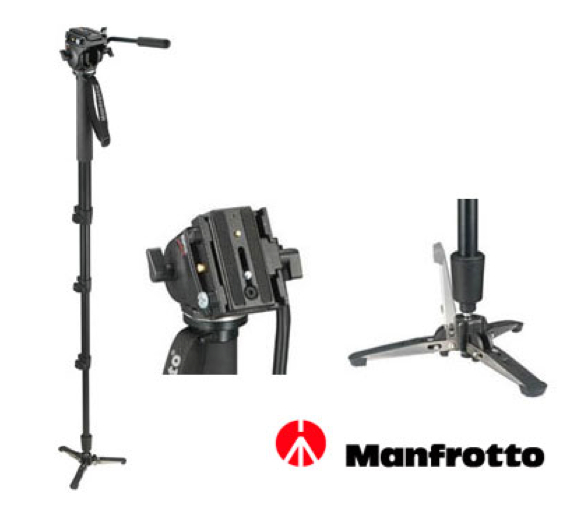
We think that everyone shooting video (and most stills photographers) should have a monopod in their arsenal, because they are ideal for fast moving situations, where you might not have time to set up a tripod, put the camera on and level it. You can also use them for getting really high shots (holding them above your head if necessary - perfect for anyone doing news or red carpet events where there are a mass of other cameras between you and the subject), and you can use them as a budget stabiliser: just carrying the camera on the monopod, with the weight of the leg beneath it will give some stability to your shot. Even better, you can hold it upside down (rotating the picture in the edit), and use it for really low, ground-skimming shots.
The 561B supports up to 4kg (almost any compact camcorder or DSLR), extends up to 2m high from a minimum height of 76.5cm, and the aluminium leg telescopes in four sections. It weighs 1.91kg, and comes with a fluid tripod head with a tilt range of -60° to +90°, with counterbalance and fixed drag, plus a quick release camera plate. Having the little feet at the end also allows you to swivel it about and tilt the monopod forwards, back or side to side.
There is also a version for heavier cameras (up to 8kg), the Manfrotto 562B, although it doesn't extend as high (from 69cm to 193cm) - best price for it seems to be about £120, from several places found via Google shopping.
By David Fox
October 05, 2010
Marvin minimises media management
It is currently in use on its first production: An 80-day shoot for the Dutch miniseries Lijn 32, directed by its co-developer, where it automates the creation of backups, LTO tape masters, QuickTime proxies for offline editing and DVD dailies, all in a single step. It is claimed to be "a fraction of the cost of competing data recorders", and to provide data security and all of the production formats required for digital cinematography.
The Amsterdam-based company has just signed a sales agreement with Band Pro Film & Digital, which will be its exclusive distributor in Germany, Switzerland, Austria and the US. "With the growing use of data cameras, like RED and SI-2K, data management is becoming as important as the camera used to capture it. Marvin is a natural result of this transition and is perhaps the simplest, most elegant solution available," said Amnon Band, president of Band Pro.
“New technology demands new tools, and Marvin is the data management solution that many RED owners and data camera-based productions have been waiting for," added Gerhard Baier, Managing Director of Band Pro Munich.
Marvin supports the Red One, Silicon Imaging SI-2K, Arri D21/Alexa, Panasonic P2, Phantom and Weisscam HS-2 cameras. The system is housed in a 4U housing with a padded case and controlled through a simple browser GUI running on a laptop computer connected via Ethernet.
Once users enter the settings for a new project, Marvin automates the rest of the process, saving hours of manual data wrangling and effectively eliminating the risk of human error. When removable media from the camera is attached to the system, Marvin creates verified copies of every shot to its own internal RAID5 storage array. The system then generates multiple verified LTO copies of all of the shots from the day, along with DVD dailies and QuickTime files for offline editing.
![]() |
| Lijn 32 on location |
Lijn 32 is an eight part thriller being shot on Red MX cameras by ID TV for NCRV Channel 2 and KRO, for transmission in the next few months.
The shoot is generating between 150 and 200GB of data each day, captured on 16GB CF cards. Once full, the CF cards are attached to Marvin, which copies the data to its internal 12TB RAID5 array, as well as separate hard drives. Marvin verifies the data as it copies, flagging any corrupt file it finds. When the data is verified, it generates LTO tape masters, DNxHD 36 MXF files with a mixdown of the audio for offline editing and DVD dailies.
![]() |
| Marvin in use in the back of a van for Lijn 32 |
During the first few weeks, they found that the standard Core i7 920 CPU could not process data fast enough to keep up with the volume of material being captured every day, so upgraded to an Intel Core 980x processor, which allowed it to copy 16GB cards in under ten minutes, as well as verifying the data. "We had wondered if we would need to upgrade to an LTO4 drive, but we have found that LTO3 is fast enough to keep up. While we continue shooting, Marvin processes the data, creating the masters, offlines and dailies.”
“We’re using a total of five CF cards on Lijn 32,” said the production's DIT, Marcel Vendrig. “When we’ve copied the data, we erase the card and send it back to the cameras. We typically use each of those cards several times each day.”
Marvin saves high-resolution stills for each take (pictured right). “I use them to check image quality, for example to make sure all the camera sensors are registering correctly," he added.
"Before Marvin, I did my data wrangling with a laptop, Data Manager and external hard drives. When I had copied the files, I sent the drives to the post house where they created the dailies and offlines. It was more complicated and much more time-consuming, and there was always the nagging fear that something might go wrong." But using Marvin means he no longer needs to spend time just copying data. "Instead I can focus on my real work – checking image quality and fixing problems when they come up."
"We know right away when there was an issue with a file. We can check right away to see if there is enough material to salvage the shot, or if we need to re-shoot," said Treurniet. “Out of 385 reels, which we have shot so far, we’ve only had four corrupt takes. Marvin flagged all of them and we had no problem dealing with the issues right there on the spot."
By David Fox