February 11, 2011

JVC's new GY-HM750 ProHD

JVC Professional will be showing its latest GY-HM750E ProHD compact shoulder-mount camcorder at BVE 2011. It is claimed to offer "the industry’s fastest shoot-to-edit workflow by recording native HD or SD footage in ready-to-edit file formats on low-cost SDHC memory cards."

It uses the same 3-CCD imaging system as the GY-HM790E, JVC’s ProHD flagship camcorder, and records HD in 720p, 1080p, and 1080i, as well as SD (576i) at selectable data rates up to 35 Mbps.

It has a dual card slot design that records to SDHC cards and/or an optional SxS recorder. This had been requested by customers and allows simultaneous recording to both SDHC cards, for instant backup or client copy.

Users can record in ready-to-edit file formats for Apple Final Cut Pro or Adobe Premiere (.mov), or as Sony XDCAM EX files (.MP4). For standard definition work, it can also record DV files (.avi or .mov).

Building on the modular approach of the GY-HM790E, the GY-HM750E includes a 68-pin chassis connector for a clean, direct interface to various modules. The new KA-AS790 ASI output module, for example, provides a direct feed from the camera to a satellite uplink or microwave transmitter via BNC, ideal for broadcasting live HD from the field. The GY-HM750E automatically switches to low-latency mode (less than 300ms delay) when the module is in use.

JVC has also improved its Pre Rec (cache) feature, which continuously records and stores footage in cache memory and helps prevent missed shots of breaking events, which now stores 20 seconds. Other features include variable frame rate recording, extensive image customisation, a high-resolution (1.22 million pixel) LCOS viewfinder and 4.3-inch flip-out LCD monitor, and JVC’s Focus Assist. It also has two XLR audio inputs with phantom power, plus manual audio level controls with an audio meter.

The GY-HM750E includes a Canon 14:1 zoom lens, but accommodates any lens with a 1/3-inch bayonet lens mount.

Because it uses CCDs instead of CMOS sensors, it doesn't suffer from any rolling shutter effects (such as skew or flashes from photographers covering only part of the frame). Combine this with its 20-second cache, quick workflow, and reasonable price (about £6,000) and it seems to be one of the best choices for news or event coverage - CNN bought 177 of its little brother, the HM100 for news use.

By David Fox

3D stereoscopic workflow at BVE

Holdan, Panasonic's UK distributor, will demonstrate a complete stereoscopic content creation workflow from camera to edited programme at an affordable price, at BVE 2011 in London next week (15-17 February).

Its starting point is the AG-3DA1 3D camcorder, feeding a HP Z400 workstation running Grass Valley's Edius 6 - the full system costing less than £18,000.

The AG-3DA1 HD 3D camcorder has dual lenses and two sets of 1920x1080, 2.07 megapixel 3-MOS imagers. It also has dual 32GB SD cards and interfaces include dual HD-SDI outputs and HDMI (v1.4). It includes automatic correction for horizontal and vertical displacement allowing it to recalibrate without the need for external equipment, so that you can shoot 3D more easily. 

Taking the dual HD-SDI feed from the camcorder will be a Blackmagic Design HDLink Pro Display Port 3D that converts the signals to side-by-side, field by field, top and bottom or frame-packed 3D formats. The editing system, based on an Intel Xeon HP workstation and Edius 6 will demonstrate 3D cutting techniques. Edius works natively with professional formats without the need for rendering or transcoding. This philosophy has been extended to stereoscopic, with support for synchronized left and right field editing built into the latest version (which costs less than £600).

The demonstration will also include a Grass Valley T2 hard disk recorder, playing out 3D signals (manually or from a playlist) so that users can display or project high quality 3D.

Panasonic will also be showing all of its 3D products, in its own workflow demo on its stand, as well as the new AG-AF101 large sensor camcorder, which is in high demand thanks to the ability of its Micro Four Thirds sensor to produce shallow depth of field, as the sensor has about four times the area of a broadcast 2/3-inch sensor, although it can't go as shallow as a Super 35mm-size sensor (as used in Sony's new F3 and any APS-C DSLR) at the same lens settings.

The AF101 (AF100 in the US) can be fitted with a wide range of lenses, including Zeiss Compact Primes and stills lenses via adaptors. Unlike HD DSLR cameras it has no visible aliasing or moiré effects, thanks to an optical filter that reduces the resolution of the sensor (to HD resolutions) and smoothes out any possible defects. It also has lots of video features, such as peaking, waveform display, various gamma modes, internal optical ND filters, uncompressed audio with XLR inputs, and timecode input/output, which are not typically available on DSLRs. 

It records 24Mbps AVCHD onto SD cards, but has HD-SDI and HDMI outputs for 4:2:2 recording. There is also variable frame rate recording.

By David Fox

February 10, 2011

BeachTek HD DSLR audio adapters

BeachTek now has two audio boxes for HD DSLRs that take XLR inputs, allow you to adjust levels, and route the result to the DSLR's mini-jack input.

The BeachTek DXA-5DA (pictured top) is a passive adapter, which doesn't have phantom power – you would use it with self-powered condenser microphones or wireless receivers, or as an interface to an audio mixer.

It has two inputs, a level meter, and a "unique AGC Disable feature controls the wild swings of the Auto Gain Control that plague most cameras," which reduces noise during quiet moments of recording so that you can record cleaner audio. It fits under the camera and can also be mounted to a tripod. It is powered by one 9-volt battery and costs about £290.

There is also the BeachTek DXA-SLR, with phantom power. It is similar, but without the little LCD meter display. It has Good/Peak signal indicators that show the ideal input levels at a glance, plus the AGC Disable feature. You can also monitor the playback audio from the camera. It costs about £350.

Also potentially useful is BeachTek's MultiMount 5D ($89), which provides four horizontal cold shoes and one vertical shoe for mounting microphones, wireless receiver, lights, etc. on your DSLR or camcorder. It is made of polycarbonate with metal shoe inserts and has threaded 1/4-inch/20 holes on all shoes for added flexibility. It also has a rubber mounting foot with locking plate for mechanical shock isolation, but it may not be advisable for use with heavier devices, which is why it also comes with an extra foot that provides a firmer mount.

By David Fox

Electric dolly for fume-free filming

The new Flyka Electric Dolly is the first product from a new company, and was developed by photographer and cameraman Tony Holker, who broke his leg in 2008 and used a disabled buggy for filming.

"The smooth ride from a disabled buggy was a great platform to film from. I researched and researched to see what else was out there, but there seemed to be nothing, so I set about developing a prototype. Five prototypes later, I now have number 4 and 5 developed into working, conceptual vehicles for filming and the reaction from the industry has been superb," explained Holker.

The Flyka should save many hours by making it simpler to set up shots, while no time will be wasted laying track. Users will also be able to record sound during filming, despite using a motorised Dolly. Hire costs are £500 per day (£200 for the first day new clients) or £1800 per week, and future models are now being developed, including lighter vehicles, jib cranes, all terrain capabilities, and remote control.

Other benefits include: being able to do forward or backwards tracking shots without track coming into shot; doing long shots without having to grips getting tired pushing a dolly back and forth; no down time needed while a Steadicam operator recovers; the ability to create very slow moving Steadicam shots without footstep jerks; variable speed and constant speed from 0 to 8mph; easier use of handheld shots for long distance; and step-off capabilities with a Steadicam. 


It is being launched at BVE 2011, next week (15-17 February) in London.

By David Fox

ABC's new DSLR Light-Jib ships

ABC Products' new DSLR Light-Jib is a lightweight and compact jib arm designed for DSLR cameras and small camcorders. Represented by Ianiro UK, the Light-Jib will be available from resellers from mid-February.

It can carry cameras and accessories weighing up to 4.5kg making it equally well suited to compact DSLRs and camcorders, such as the Canon XF105 and XF305, Panasonic HMC-151 and HMC-41 or the Sony NXCAM range.

Its weighs 3.9kg thanks to carbon fibre tubes, and packs small for portability in three parts - assembly time is claimed to be less than a minute. It is also fast and flexible in use thanks to its QuickPin system that allows a rapid change of location and camera angle. Its boom length is 1.52m.

In use, it has a parallelogram bar that can be continuously changed allowing for automatic tilt as well as precise adjustment of the tilt head angle. It also has a special swivel system that enables the jib to move smoothly throughout its range.

"The Light-Jib is a highly adaptable piece of equipment. It's a great multi-purpose tool. It's flexible for use with DSLRs and camcorders, fast enough to be set-up without missing a shot and light enough to transport anywhere," said Nick Allen-Miles, MD of Ianiro UK.

The kit includes a built-in level, quick release and built-in brakes (horizontal and vertical).

By David Fox

Scout, Phantom + Zephyr blow in

Three new Steadicam rigs will be making their public UK debuts at BVE 2011 (on the Tiffen stand). The lightweight Zephyr, the Scout and the Phantom.

The Zephyr (pictured) supports camera loads of up to 11kg and offers "unique control over the feel of the rig with features usually only found on high-end models." These include a new tool-free gimbal, HD ready out of the box, fully adjustable lower sled for inertial and dynamic balance, side loading stage and a tool-free Iso-Elastic arm, requiring only ounces of force to support the unit throughout its huge boom range.

The Scout offers a precise and versatile lightweight system in an affordable package. Supporting up to 8kg, it has the same side loading stage as the Zephyr, a new base design for adjusting dynamic and inertial balance and the same tool-free performance from its Iso-Elastic arm.

The Phantom is a low cost big rig that performs just like the top-of-the-range Ultra2. Working with loads up to 20kg it includes two posts, the Ultra2 tilt stage, an inertially-adjustable sled, G-70 arm and a SD monitor, upgradeable to a high definition monitor, and a motorised stage.

Also showing are the Tango, which delivers long-sought floor to ceiling boom range with lateral reach and Steadicam stabilisation, and the Smoothee that steadies iPhones and other smartphone videos.

By David Fox

Fusion features flexible automation

Vinten Radamec will show how studios can migrate to camera robotics by adding automation to manual pedestals and heads in a demo at BVE 2011. The presentation will also feature compact automated camera systems for parliaments.

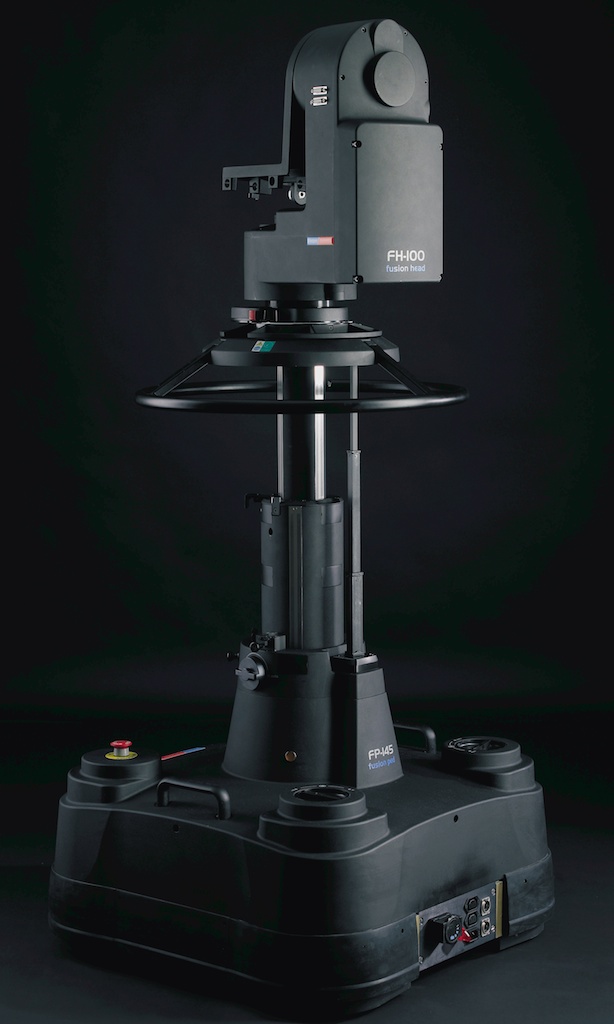
It will show a Vinten Osprey Elite studio pedestal, fitted with a Vinten Radamec Fusion Bolt on Height Drive and Fusion FH-100 robotic and manual head. These can be fitted to any Vinten or Sachtler non skirted manual pedestal in the field, giving precise control over pan, tilt and elevation when in automatic mode, with the capability of switching at the touch of a button to fully manual mode, giving the system the feel of a conventional Vinten pedestal.

It will be teamed with a Vinten Radamec HDVRC control system, which can perform complex moves, with on-shot trims can be made using a joystick, or pre-set shots from a touch-screen controller. The networked architecture of the HDVRC allows camera control over multiple sites, so that remote and local studios can be operated simultaneously from the same controller. The system can also drive Autocam and Radamec products, as well as specialist units such as external weather cameras.

The legislative system will feature a specialist Radamec 431 pan and tilt head, designed to provide excellent stability and range of movement in an unobtrusive form factor. It will be shown with a Legislative Control System that provides a simple single point of control for any installation, and can involve a very large number of robotic cameras.

The LCS can be linked into a voting or audio system that provides speaker information, from which its internal logic will choose the most appropriate camera to cover the speaker. Alternatively, it can be manually controlled using a touch screen to select and direct the cameras. In both cases, a joystick is provided to trim and tighten pre-set shots.

“Automation - whether for a public building like a legislature or for a busy studio - is definitely no longer a complex, risky and expensive process,” said Karen Walker of Vinten Radamec. “What we are showing at BVE this year is that it is simple to implement, secure in operation and delivers a real return on investment in a surprisingly short timescale.”

Vinten Radamec has now sold more than 500 of its Fusion heads worldwide. Recent orders include Sky Italia’s 24 hour rolling news channel, which has equipped four of its studios with Vinten Radamec robotic camera supports, including three FH-100 heads with Fusion FP-188 robotic camera pedestals, plus a control system.

Paul Vickerage, head of studios for Sky Italia, said: “We have two robotic studios for Sky Sports 24 and two for TG-24. These systems give us the ability to provide seamless interworking not just with newsroom systems but with other studios, which is very important to us. Our sports team controls a studio in Rome from its main production base in Milan, and the news team has the use of two separate studios but everything is under a single point of control.”

Other recent customers include Hong Kong-based Phoenix TV, which bought six robotic pan and tilt heads as part of a sophisticated Vinten Radamec robotics system, working in conjunction with its Orad Proset virtual studio software to provide fully automated control of pan, tilt and elevation, as well as high precision positioning around the studio floor. Another Asian broadcaster, now TV, has also equipped its sports studio with broadcast robotic systems from the Fusion range (pictured). In the US, major broadcasters such as HSN, Fox and NBC have all installed Fusion heads.

By David Fox

February 09, 2011

Sola ENG LED Fresnel lights ship

Litepanels’ Sola ENG LED Fresnel light (pictured) is now shipping. Offering beam control of 10° to 70°, the daylight-balanced Sola rang provide the controllability and single-shadow light you'd expect from a Fresnel light, but use a lot less power than conventional fixtures. It has a proprietary 7.62cm lens, and draws 30 Watts, but produces light output equivalent to a 250W tungsten fixture.

It boasts instant dimming from 100% to 0 with no noticeable colour shift, and provides manual focus and dimming control via a camera lens-style control. Output is flicker-free and remains consistent as the battery voltage goes down. Designed for on-camera and off-camera mounting, the Sola ENG is only 102x102x127mm and weighs 280g. We first wrote about the Sola ENG last July, but hopefully it will be worth the wait.

The larger (off camera) Sola6 provides output equivalent to a 650W Tungsten Fresnel while drawing 75W. Electronic dimming and motorised mechanical focus are completely controllable either by using the manual dials, touchscreen or DMX.

The lights will make their UK show debut at BVE 2011 next week, along with the recent MicroPro Hybrid, which offers continuous output and flash functions (making it ideal for use with HD DSLR cameras), and Litepanels' range of LED 1x1 panels.

By David Fox

Gekko unveils bright soft light

Gekko Technology is showing the latest additions to its lighting range at BVE, including the kezia 200-E colour tunable hard-source, the kezia 200F white-optimised LED hard source, and karesslite 6006-DD high output soft light.


The new karesslite 6006-DD high-brightness soft light (pictured) has twice the number of emitters and hence twice the brightness of the standard karesslite 6006. Available in daylight (5600K) and tungsten (3200K) versions, it incorporates a 6x12 emitter format in a 300x300mm panel with a front-to-back depth of 165mm and a weight of 4.8kg including diffuser.

It delivers the same 2600 Lux at 1m brightness as the 600x300 mm karess 6012 and can be used as a key light (with louvre) or fill, with consistent colour through the dimming range.

Power consumption is 85W, allowing more than 90 minutes of continuous operation from a single rear-mountable V-Lock battery. Power can also be derived from a 12 to 40v DC feed via an XLR 4 connector, or from a mains supply. It has on-board dimming and integrated DMX.


The recently introduced kezia 200-E (pictured) gives dynamic control of colour output without the need for gel. Based on Gekko's award-winning kleer-colour LED multi-chip array, it combines high quality output, long component life, creative versatility, low power consumption and minimal heat generation. Users can generate colour effects that are consistent from lamp to lamp, thanks to the closed-feedback loop that constantly monitors and corrects the light temperature. Controllable via DMX or an optional rear panel, the kezia 200-E can be adjusted manually or remotely to produce millions of colours.

Drawing less than 200 Watts of power, the kezia 200-E has an output roughly equivalent to a 1 kW tungsten fixture.

Also relatively new is the kezia 200F, a white-optimised LED spot lamp, with presets for of 2900, 3200, 4300, 5600 and 6500K via DMX or optional rear panel. Colour temperature remains constant when the light is dimmed, as ambient conditions change or as the unit ages.

Interchangeable optics provide beam angles of 20º, 40º or 60º. Output intensity is 8300 Lux at 1m, 1900 Lux at 2m and 900 Lux and 3m.

By David Fox

Octica sees The Light on LEDs

Octica Professional has been chosen as exclusive distributor for the UK and Ireland for Thelight's new advanced LED lighting systems, which it will be showing at BVE 2011 next week in London.

Thelight's LED lighting is claimed to offer "absolute lighting control over colour temperature, light intensity and beam direction".

It is available in three formats for both studio and location use, with each model being slim, lightweight, compact and rugged, using ultra-high-output, long-life, low power consumption LEDs that are claimed to give "superior lighting and accurate colour temperature control compared to panel type LED lighting systems."

They use a combination of optical, electronic and thermo-mechanical engineering coupled with direct input from the LED manufacturer, to make lighting easier and faster to set up, with no need for correction gels due to the patented digital variable colour temperature control, dimmer and green/magenta bias. An articulated structure enables instant focusing or flooding of the light beam while the LEDs are supported by specially designed Fresnel lenses that focus and blend the LED beams to deliver a "soft but fully directional light".

The control unit allows digital adjustments of colour temperature calibrated in 100K increments from 2800K to 8500K while light intensity remains constant, stable digital dimming is calibrated in half stop increments.

The initial three-model line up can deliver a high light output: with 10,000, 9,000 or 5,500 Lux at one metre.

Related post: Thelight articulates case for LEDs

By David Fox

Rycote boom poles go graphite

Rycote has introduced three new lightweight, telescopic carbon-fibre audio boom poles. The 1.63-metre-long G3, with three sections, and the 2.49-metre-long G5, with five sections. The G5 comes in two versions, a standard pole and one with an internal coiled cable and built-in Neutrik XLR connector in the hilt (pictured).

For several years, following its takeover of US boom pole manufacturer Lightwave Audio, Rycote has been selling telescopic boom poles under the Lightwave name. However, with the launch of the Rycote-branded G-series carbon-fibre poles, the entire range, including the A3 and A5 aluminium poles, will now be rebranded as Rycote products - Rycote is probably best known for its shock-mounts and windshields (we use a Softie on our gun mic).

The G-series poles use the same lightweight, patented, triple-cam grip and twist locking system as the A3 and A5 poles, and with no metal parts to add to their weight combine lightweight construction with tensile strength. As on the A3 and A5, the locking mechanism is designed to be resistant to jamming when the pole is dirty; however, if necessary, the locking collars can be completely stripped down for cleaning in the field if required. The G3 weighs just 360g, the standard G5 is 580g, while the G5 with internal cable weighs 720g - if you are holding a boom mic over your head for a long take, any weight saving is appreciated, and having the built in cable is one less thing to worry about or hear flapping in the wind....

List prices are G3: £150; G5 Standard: £204; and G5 with internal cable: £288, including VAT.

By David Fox

Røde’s VideoMic goes Pro

The original Røde VideoMic is widely used for video production, and is a particular favourite for HD DSLR users. Now there is a VideoMic Pro offering new features specific to professional video.

Noise transference has been significantly reduced using both a revised, more elegant shock mounting system and a lightweight premium cable.

The VMP is smaller (15cm long), weighs 85g, and is also centrally balanced, making it mosre suitable for use in conjunction with low-cost camera stabilisation systems.

It has a super-cardioid condenser microphone, integrated foam windshield, 3.5mm stereo mini-jack output (dual mono), two step High Pass Filter (flat, 80Hz), three-position level control (-10dB, 0, +20dB), uses a 9v battery offering up to 70 hours battery life (alkaline). It has a camera shoe mount with 3/8-inch thread for boompole mounting, and comes with a DeadCat VMP furry windshield.

It will be on show at BVE 2011 on stand C-44 (www.sourcedistribution.co.uk).

By David Fox

Wireless audio without interference

Shure’s upcoming Axient Wireless microphone system is claimed to be the first wireless system to both detect interference and automatically change frequencies to avoid interference.

“Uncertainty and volatility in the RF spectrum are the new reality for professional wireless users,” explained Sandy LaMantia, Shure's President and CEO. "They face increasing pressure to deliver interference-free performance even though conditions are more unpredictable than ever before. The Axient wireless system was designed from the outset to withstand interference from the analogue and digital sources that exist today and may exist in the future.”

The Axient system employs several new innovative technologies that work together to deliver interference-free audio at critical events, such as live broadcasts.

“Axient defines a new standard for control and confidence in applications with zero tolerance for failure,” added Erik Vaveris, Category Director for Wireless Products at Shure. “This is the first wireless microphone system that can detect interference and avoid it automatically. Today, when unexpected RF interference arises, an engineer is either stuck with dropouts or they can run a backup mic out to the performer. Axient makes that a thing of the past.”

Features include: Frequency Diversity, which transmits full-bandwidth audio on two separate frequencies to ensure seamless, uninterrupted audio for mission-critical channels, even in the face of direct RF interference; ShowLink remote control, which enables the user to make real-time remote adjustments from the receiver or a laptop, of transmitter settings like audio gain while the microphone is live; Axient Spectrum Manager, which constantly scans the RF environment, performs frequency compatibility calculations to assign clear frequencies to each wireless transmitter, and deploys backup frequencies automatically; Smart lithium-ion rechargeable battery packs; and Wireless Workbench 6, a new software interface that enables users to monitor and control the entire system.

“The Spectrum Manager functions as an air traffic controller for the system,” said Vaveris. “When the receiver’s Interference Detection & Avoidance feature senses interference, the Spectrum Manager assigns a new frequency that it knows is clean. The frequency is deployed to the transmitter by the ShowLink wireless access point, and the transmitter and receiver execute a synchronized frequency change in a matter of milliseconds, making it virtually undetectable. And with Frequency Diversity enabled, there is no audible trace whatsoever.”

The Axient Wireless microphone system will be available in mid-2011.

By David Fox

OConnor CFF-1 follows focus

OConnor's new CFF-1 Cine Follow Focus features modular construction that eliminates the need to juggle separate bridge plates.

The CFF-1 has the lowest clearance available in a double-sided studio unit, and sports a large diameter lens-friendly design. It integrates with existing accessories such as whips, gears, cranks, and is designed to be both camera versatile and to accommodate future accessories.

Another recent innovation is OConnor's O-Grips Handgrip system. They feature single-handle ball joints with high-load capacity, and a rod bridge that fits all three rod standards. The modular O-Grips are stackable for custom applications and can be configured to create double or even multi-joint handles. Each grip is fully adjustable and is capable of a half sphere of stepless articulation. By combining two grips, the range can be extended to a complete sphere.

The new O-Box WM mattebox (pictured) is designed for 16:9 format full-size sensor camera setups, including HD DSLRs. It is compact and accommodates lenses up to 18mm in focal length; some wider. The mattebox can mount up to three filters: two in top-loading filter frames (two each 4x4-inch and 4x5.65-inch, frames included), with the rear frame rotatable through 360º. A third 138mm round filter fits in the optional bellows ring. O-Box WM is claimed to be the first commercially produced mattebox to have integrated handgrip interfaces.

OConnor is also showing its new 2065 Fluid Head at BVE. It is designed for cameras like the Red One, Sony F35, and Arri Alexa. Features include: stepless, ultra-smooth pan and tilt fluid drag, and sinusoidal counterbalance that provides, accurate balance at any tilt range point.

By David Fox

Compact camera controllers

Camera Corps will introduce new Switchpad and Mini Joystick controllers at BVE 2011 in London next week, as part of programme production system that includes its Q-Ball robotic cameras.

Switchpad is a multi-camera control unit which increases from five to 96 the number of remote camera heads that can be operated via the company's Joystick Control or CCU Panel. It can also be used with Camera Corps' Multi Camera Combiner unit to allow up to four Joystick operators and up to four CCU engineers to control the 96 cameras and pan & tilt heads simultaneously using just a single data line.

It can drive different types of video router, enabling the picture monitor to follow camera selection at any of the eight operator positions. Up to 255 channel numbers and routing-matrix assignment numbers can be selected via the keypad for easy integration of the 96 sources with existing camera channel configurations on video matrices with up to 256 inputs.

Switchpad is compatible with many different types of camera as well as the Q-Ball. Connection is via a robust interface, which encodes control data onto a standard audio line at user-selectable bit-rates.

The Mini Joystick Control has been developed for applications such as commentator-camera control or OB vehicles with restricted space, the compact controller is compatible with Camera Corps and Egripment pan and tilt heads. The joystick and control buttons have the same tactile responsiveness as those on Camera Corps' full-size controller, including fully adjustable pan, tilt and zoom speeds and reverses. Zoom is controlled by rotary twist of the joystick. Up to five separate heads can be operated from a single panel. Reverse settings and control speeds for each of the five channels can be stored in non-volatile internal memory."

Camera Corps' generic audio data communication system is employed to allow unlimited operating distances between Mini Joystick Control and the remote heads. Each of the five channels has its own red and green cue/tally light switch. Individual channels can be locked to prevent inadvertent alteration of presets. Focus can be remote-adjusted manually or switched between manual and automatic when used with cameras that support these features. Mini Joystick Control operates from 9v to 18v DC power adapter or battery. Total panel dimensions are 190x140x110mm. Weight is 400g.

By David Fox